
SuperVerse (SUPER) is a Web3 gaming and DeFi ecosystem built around a single ERC-20 token, SUPER, which is used for in-game payments, DAO governance and staking that pays rewards in ETH. The project started life in February 2021 as SuperFarm, an NFT farming protocol created by the crypto YouTuber Elliot Wainman (EllioTrades), and rebranded to SuperVerse in 2023 when its focus moved to games such as Impostors and to liquidity products such as the Blackhole DEX on Avalanche.
SUPER has a fixed maximum supply of 1 billion tokens, and as of October 2026 roughly 653 million are circulating at a price near $0.18, according to CoinGecko's SuperVerse page. That puts the market cap around $115 million, a long way below the $4.74 all-time high set in the 2021 bull market. This guide covers where SuperVerse came from, what the token does today, how the supply is split, and the risks a trader should weigh before taking a position.
From SuperFarm to SuperVerse
SuperFarm launched its token generation event on February 22, 2021, at the peak of the first NFT boom. The original pitch let any project spin up "farms" where users staked tokens to earn NFTs, plus a cross-chain NFT launchpad. EllioTrades' YouTube following gave the token an unusually large retail audience on day one, and SUPER set its all-time high during that 2021 cycle.
As NFT farming faded, the team pivoted. The 2023 rebrand to SuperVerse folded the old products under a new umbrella and pointed the roadmap at two things: games that could pull Web2 players on chain, and NFT marketplace tooling. The token kept its ticker and contract, so nobody had to swap anything. Later the same year, the shutdown of the Multichain bridge forced a migration of the BNB Chain version of SUPER to a new V2 contract, with a one-way bridge back to the Ethereum original.
The project's own documentation now describes SuperVerse as a "barbell": a large creator-driven community on one end supplying attention, and liquidity infrastructure on the other end designed to capture fees and route them back to the token. Whether that barbell holds weight is the central question for anyone evaluating SUPER today.
What the SUPER Token Does
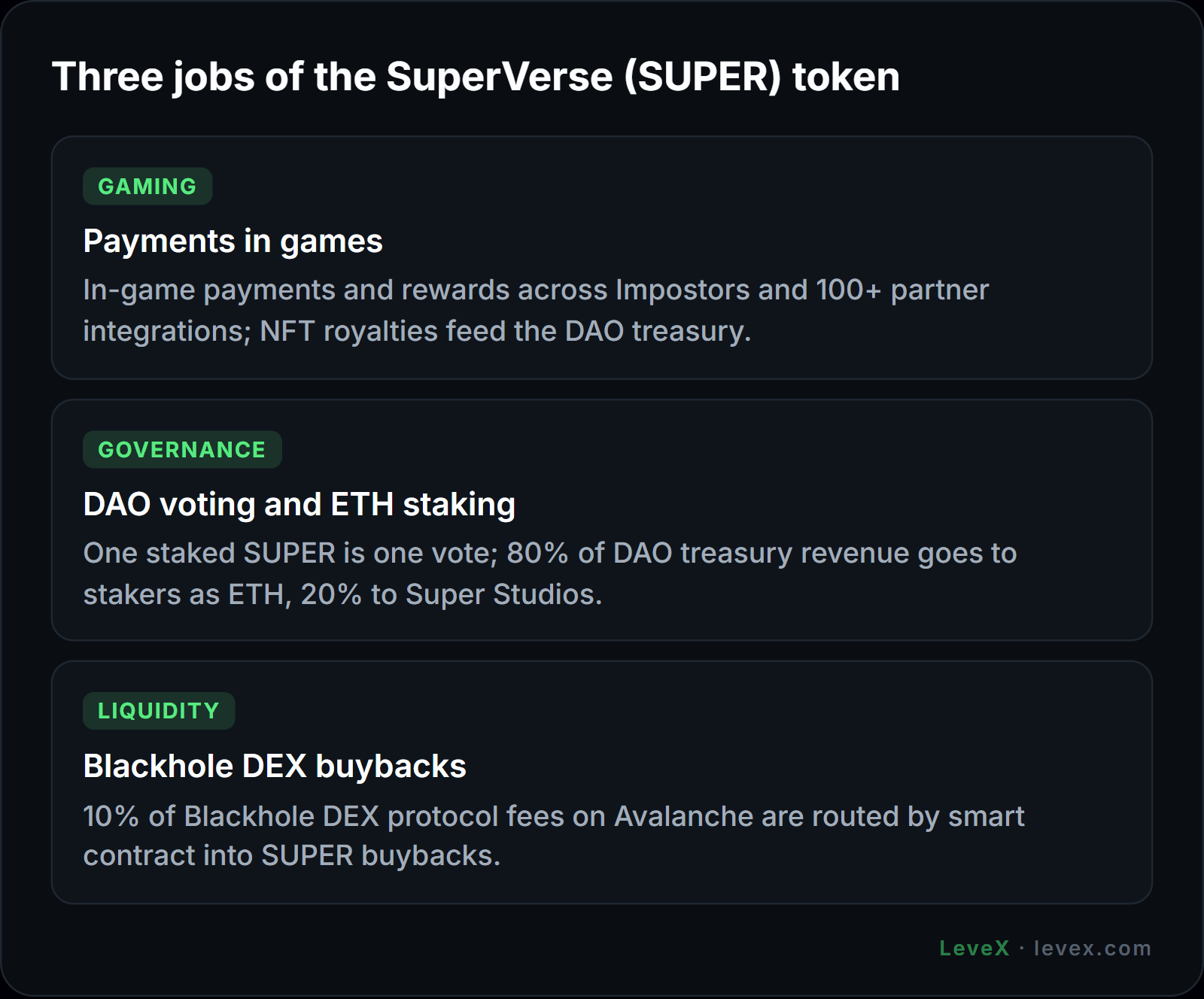
SUPER sits at the center of three separate layers, and each one gives the token a different job.
Gaming and the Impostors metaverse
Impostors is SuperVerse's flagship game, a social deduction title in the style of Among Us where characters, UFOs and pets are NFTs. Players get a personal BASE for crafting and resource generation, and holders who bundle a full set of Genesis NFTs can mint a LAND NFT that boosts drop rates and can be rented to other players. Royalties from secondary sales of Impostors NFTs flow into the DAO treasury. Our guide to the Impostors game covers the game loop and NFT layer in more detail. Beyond its own game, SuperVerse lists more than 100 partner integrations where SUPER is accepted for in-game payments or rewards, and it is building a GameFi SDK called SuperCharger.
DAO governance and ETH staking
Holders who stake SUPER in the DAO pools become members of the SuperVerse DAO. One staked SUPER equals one vote on Snapshot, a proposal needs 5% of circulating supply to participate and 60% in favor to pass, and submitting a proposal requires at least 15,000 staked SUPER. Under the SVIP-3 proposal, 80% of DAO treasury revenue goes back to stakers as ETH and 20% funds Super Studios, the development team. Rewards are paid in ETH block by block, so staking does not dilute the token with new SUPER emissions. The mechanics are covered in our walkthrough on how to stake SUPER.
Liquidity and buybacks through Blackhole
Blackhole is a ve(3,3) decentralized exchange on Avalanche that SuperVerse lists as its first liquidity engine. According to the SuperVerse documentation on Blackhole, 10% of the DEX's protocol fees are routed by smart contract into SUPER buybacks. Blackhole has its own token, BLACK, so SUPER's exposure comes only through that fee share. We break down how the fee flow works in Blackhole DEX and SUPER buybacks.
SUPER Token Supply at a Glance
SuperVerse publishes a transparency report listing every vault address. The allocation below comes from that report.
| Allocation | Tokens | Share | Vesting terms |
|---|---|---|---|
| Private rounds (P1, P2, P3) | 340M | 34% | 2-month cliff, 6-month unlock |
| Community staking | 250M | 25% | 12-month unlock |
| Development, team and advisors | 200M | 20% | 12-month cliff, 24-month unlock |
| Ecosystem | 90M | 9% | 12-month cliff, 24-month unlock |
| Community incentives | 50M | 5% | 12-month unlock |
| Seed round | 50M | 5% | 6-month cliff, 24-month unlock |
| Liquidity | 10M | 1% | Unlocked at launch |
| IDO | 10M | 1% | Unlocked at launch |
Every schedule finished years ago, so 100% of SUPER is technically unlocked. The gap between the 1 billion supply and the ~653 million in circulation is tokens still sitting in team, ecosystem and staking vaults. Those vaults can release tokens whenever the team decides, which makes supply overhang a discretionary risk instead of a dated unlock event. Our SUPER tokenomics breakdown tracks each vault in detail.
Where SUPER Lives On Chain
SUPER is native to Ethereum at contract 0xe53ec727dbdeb9e2d5456c3be40cff031ab40a55. Bridged versions exist on Polygon, Base, Soneium, Avalanche and BNB Chain, each representing the same underlying supply. For self-custody, any wallet that handles ERC-20 tokens works, and hardware wallets are the safer choice for long-term holdings. Always copy contract addresses from the official SuperVerse docs, since fake SUPER tokens circulate on several chains. Our comparison of the best SUPER wallets lists the options by chain.
How SuperVerse Compares With Other Gaming Tokens
SuperVerse competes for the same players and capital as larger gaming ecosystems. Immutable runs a dedicated gaming chain with hundreds of titles, while Axie Infinity built its own network around a single hit game. SuperVerse's approach is lighter: it owns one game, integrates with many others, and leans on its community and its DEX fee share for token demand. That keeps costs lower but also means SUPER has fewer hard sinks than a token that pays for gas on its own chain. Our SuperVerse vs Immutable comparison sets the two models side by side, and the Axie Infinity (AXS) guide explains the single-game model.
Risks Worth Weighing Before You Trade SUPER
Concentrated vaults are the first risk. Roughly a third of the total supply sits in wallets controlled by the team and the DAO, and any large release would hit a market that trades only a few million dollars a day.
Founder and promoter reputation is the second. SUPER's early run was driven by influencer marketing, and in October 2024 on-chain analysts alleged that wallets linked to the YouTuber MrBeast sold millions of dollars of SUPER received in an early private round. Those claims were never tested in court, but they still shape how many traders view the token.
The third is revenue durability. DefiLlama data shows Blackhole's total value locked across its pools at about $3.4 million in October 2026, far below the $260 million the project reported in its first month in 2025. A smaller DEX generates fewer fees, which means a smaller buyback. For forecasts that account for these factors, see our SUPER price prediction.
Frequently Asked Questions
What is SuperVerse crypto used for?
SuperVerse's SUPER token is used for in-game purchases across Impostors and partner games, for voting in the SuperVerse DAO, and for staking that earns ETH rewards from DAO revenue. It also receives a share of fees from the Blackhole DEX through buybacks.
What happened to SuperFarm?
SuperFarm rebranded to SuperVerse in 2023. The SUPER token, its ticker and its Ethereum contract stayed the same, so holders did not need to swap tokens, and the old SuperFarm products were folded into the SuperVerse ecosystem.
Who founded SuperVerse?
SuperVerse was founded as SuperFarm in 2021 by Elliot Wainman, known online as EllioTrades. Game development is handled by Super Studios, which receives 20% of DAO treasury revenue under the SVIP-3 governance proposal.
What is the max supply of SUPER?
SUPER has a hard cap of 1 billion tokens, and no new tokens can be minted. As of October 2026 about 653 million are in circulation, with the rest held in team, ecosystem and staking vaults.
Is SUPER on Ethereum?
Yes. SUPER is an ERC-20 token native to Ethereum, with bridged versions on Polygon, Base, Soneium, Avalanche and BNB Chain. The Ethereum contract is the canonical one.
SuperVerse Lives or Dies on Its Flywheel
SuperVerse has survived two market cycles, a rebrand and a bridge collapse, and its token still trades in the top 300 by market cap. What it has today is a working game, a DAO that pays stakers in ETH, and a fee link to a DEX. What it needs is proof that those pieces generate enough revenue to matter against a large pool of unreleased supply.
SUPER is available on the LeveX spot market for direct ownership, and the SUPERUSDT perpetual contract lets you trade both directions from the same account. For more short project explainers, head over to Crypto in a Minute.