
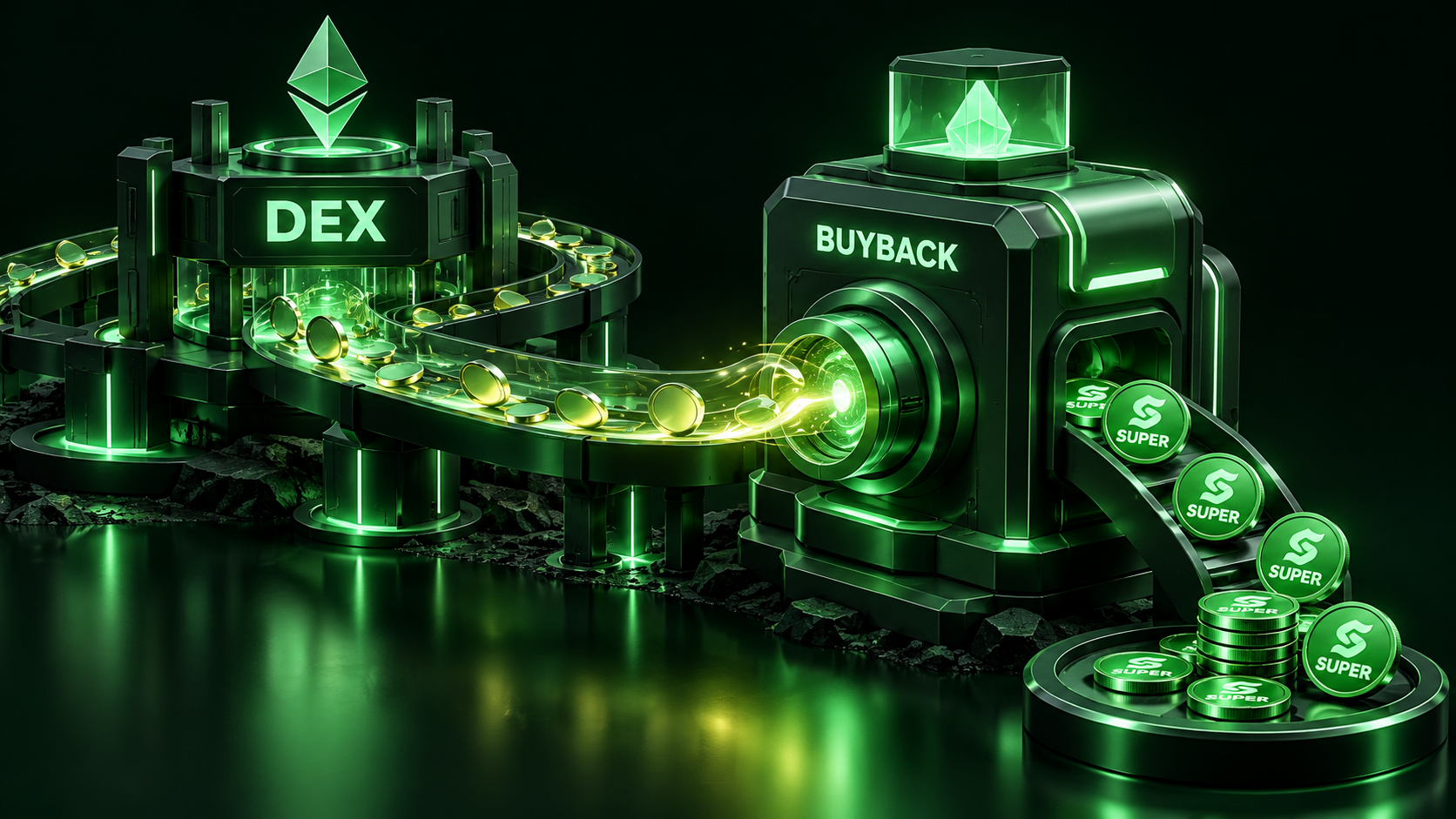
Blackhole is a ve(3,3) decentralized exchange on Avalanche that sends 10% of its protocol fees into buybacks of SuperVerse's SUPER token. It is the main way SuperVerse ties trading activity to demand for SUPER, and the size of that buyback depends entirely on how much volume Blackhole attracts.
Blackhole launched in mid-2025 and grew fast, reporting $260 million of total value locked and $5 billion of volume in its first month. By October 2026 its pools held a small fraction of that. Understanding the gap between those two numbers is the key to judging how much the buyback actually supports SUPER.
What Blackhole Is
Blackhole is an automated market maker on Avalanche that offers both classic constant-product pools and concentrated liquidity (CLMM) pools. It has its own token, BLACK, which runs the exchange's emissions and governance. SUPER is a separate asset whose only formal link to Blackhole is the fee share.
The SuperVerse documentation page on Blackhole describes it as the first of several liquidity protocols meant to extend SUPER's role across ecosystems. It lists integrations with LayerZero and several Avalanche and meme-token projects, and it gives holders of SuperVerse's SUPERMASSIVE NFT collection access to protocol rewards and fee-based incentives.
How the ve(3,3) Model Works on Blackhole
The ve(3,3) design, first popularized by Solidly-style exchanges, turns emissions into a voting game. On Blackhole the loop runs in four stages:
- Lock BLACK. Users lock BLACK tokens for a chosen period and receive a vote-escrow NFT (veNFT). Longer locks give more voting power.
- Vote on pools. veNFT holders vote each epoch on which liquidity pools receive BLACK emissions.
- Collect fees and bribes. Voters earn the trading fees from the pools they vote for, plus "bribes" that projects pay to attract votes to their own pools.
- Liquidity follows emissions. Liquidity providers move to pools with the highest emissions, which deepens liquidity where voters direct it.
This structure is good at bootstrapping liquidity quickly, which explains Blackhole's explosive first month. It also tends to shrink when emissions lose value, because liquidity providers chase the next highest yield.
Where the SUPER Buyback Comes From
SuperVerse says 10% of Blackhole's protocol fees are directed to SUPER buybacks programmatically, through smart contracts. Protocol fees are the share of trading fees the exchange keeps after paying liquidity providers and voters, so the buyback is 10% of a slice of total trading fees.
The table below shows how different levels of monthly protocol fees translate into buying pressure, compared with SUPER's spot volume of roughly $3.5 million a day (about $105 million a month) as of October 2026.
| Blackhole monthly protocol fees | Monthly SUPER buyback | Share of SUPER monthly spot volume |
|---|---|---|
| $100,000 | $10,000 | ~0.01% |
| $1,000,000 | $100,000 | ~0.1% |
| $5,000,000 | $500,000 | ~0.5% |
Even at the high end, the buyback is a small fraction of SUPER's normal trading. It cannot hold the price up against heavy selling, but it does create a steady bid that grows if Blackhole volume grows. For comparison, the roughly 38 million SUPER that left project vaults between August 2025 and October 2026 was worth around $6 to $7 million at current prices, as our SUPER tokenomics breakdown explains.
Blackhole Then and Now
The launch numbers came from a period of heavy BLACK emissions and strong interest in Avalanche DeFi. DefiLlama's Blackhole CLMM page began tracking the exchange in July 2025. In October 2026 it showed about $2 million locked in CLMM pools, with the classic AMM pools adding roughly $1.35 million, for a combined total near $3.4 million.
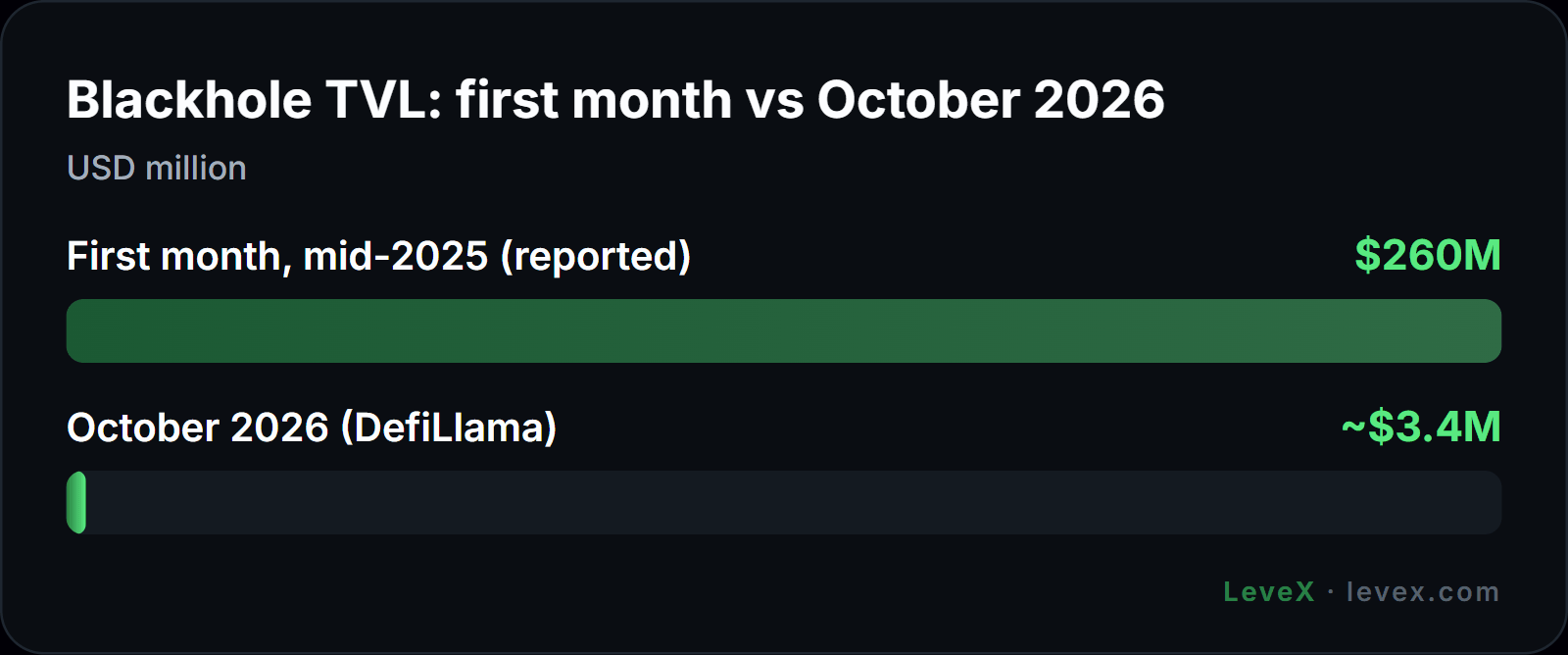
That is about 1% of the TVL SuperVerse reported for the first month. Lower TVL usually means lower volume and lower fees, so the buyback today is much smaller than it was in 2025. A revival in Avalanche DeFi activity or a new emissions push could reverse that, but holders should not assume the 2025 buyback figures still apply.
What Blackhole Means for SUPER Holders
Blackhole gives SUPER something many gaming tokens lack: a fee-funded buyer that does not depend on the team's treasury decisions. That counts in SUPER's favor. Its weakness is scale. At current volumes, the buyback is a rounding error next to vault releases and normal market flows.
For holders, the practical signal is Blackhole's TVL and volume trend. Sustained growth in both would strengthen the buyback and feed into any bullish SUPER price prediction. Holders who want a yield tied to SuperVerse's own revenue can look at how to stake SUPER for ETH rewards, which run on a separate revenue stream. Our explainer on crypto token buybacks covers how fee-funded buybacks compare with other models.
Frequently Asked Questions
Is Blackhole owned by SuperVerse?
Blackhole is a separate protocol with its own BLACK token, but SuperVerse lists it as part of its ecosystem and its docs describe it as SuperVerse's first liquidity engine. The formal link to SUPER is the 10% protocol fee share that funds SUPER buybacks.
Does Blackhole burn SUPER?
SuperVerse's documentation describes Blackhole's fee share as funding SUPER buybacks through smart contracts. It does not publish a fixed burn schedule, so holders should treat the mechanism as a buyback and check on-chain data for what happens to the purchased tokens.
What chain is Blackhole on?
Blackhole runs on Avalanche's C-Chain. SUPER has a bridged version on Avalanche, which is why the token can trade directly in Blackhole pools.
The Buyback Is Real but Small
Blackhole proves SuperVerse can connect a DeFi product to SUPER demand without manual treasury decisions. Its current size means the buyback matters more as a long-term option on Avalanche DeFi activity than as a price floor today.
Trade the token on the SUPER/USDT spot market at LeveX, or use SUPER perpetual futures to position around shifts in DEX activity. More quick protocol explainers are waiting in Crypto in a Minute.