
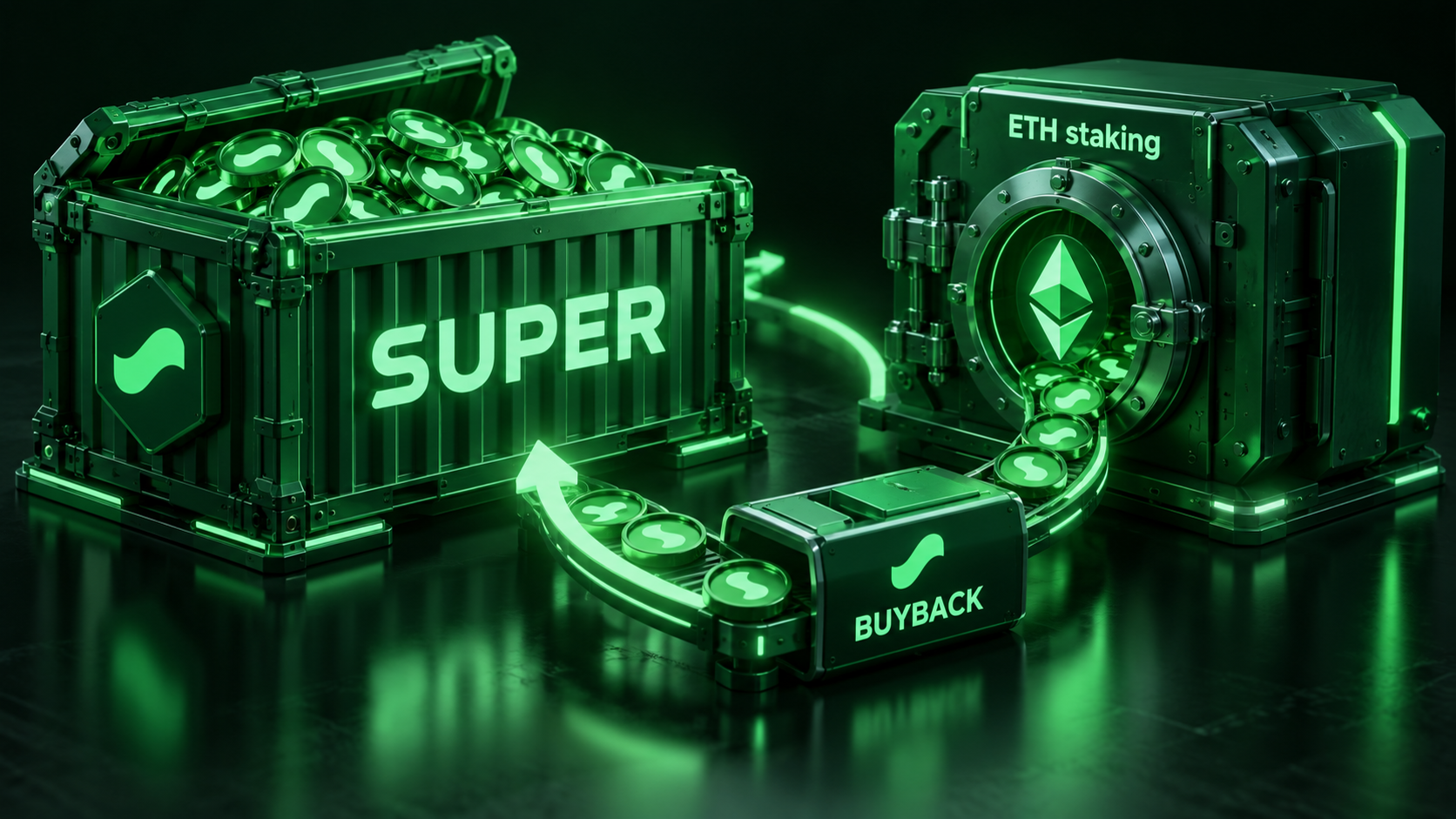
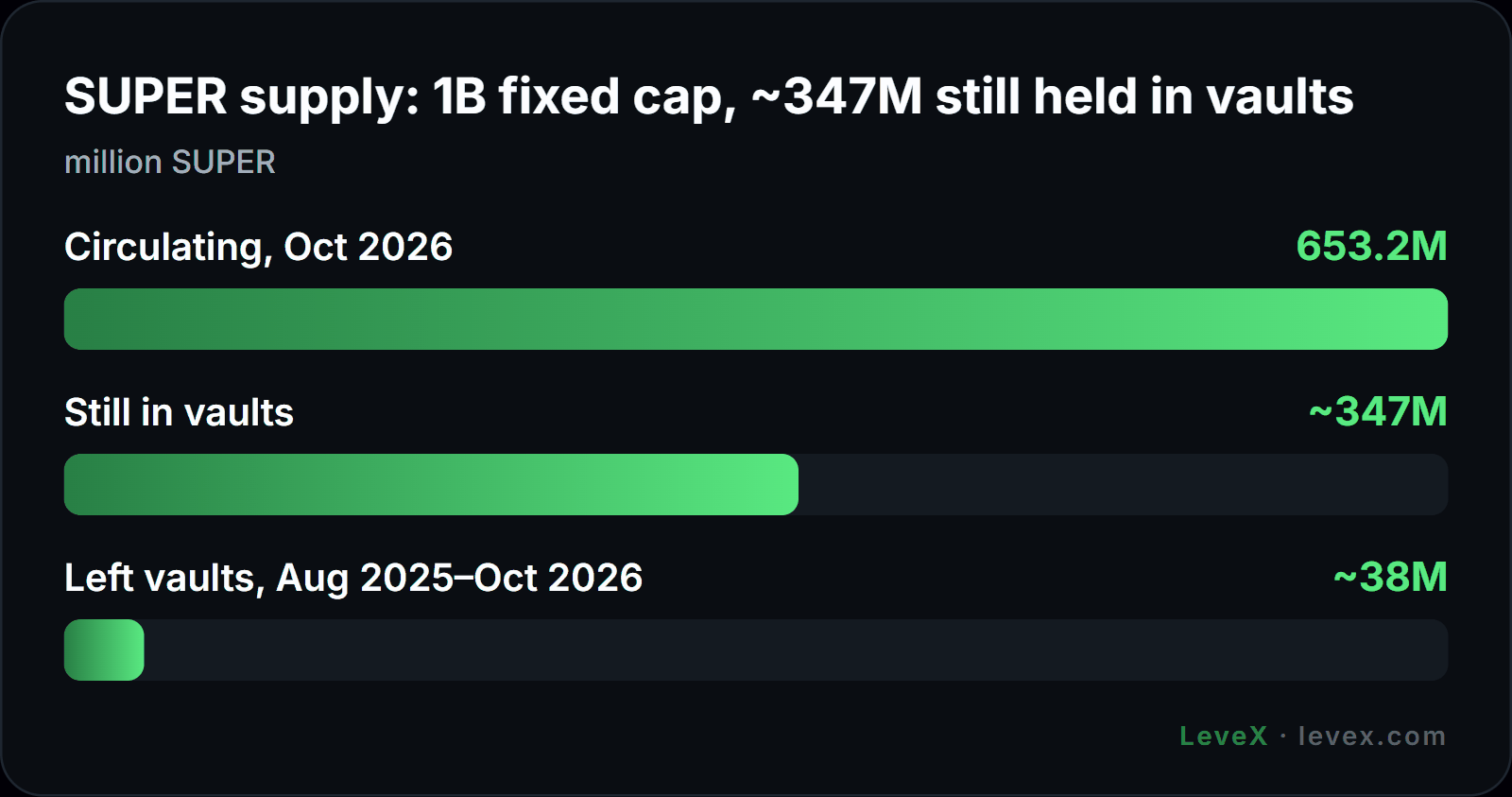
SUPER has a fixed supply of 1 billion tokens, every vesting schedule finished by early 2024, and yet only about 653 million tokens circulated as of October 2026. The remaining ~347 million sit in team, ecosystem and staking vaults that the SuperVerse team releases at its own pace, which makes vault movements the single most important supply signal for SUPER holders.
That structure is unusual. Most tokens have a published unlock calendar that traders can plan around. SUPER has no remaining calendar at all, only vault balances. This article walks through the original allocation, what has been released, where value flows back to the token, and what to watch.
Where the SUPER Supply Sits
SuperVerse publishes a transparency report with links to every vault on Etherscan. Its last update, dated August 4, 2025, showed about 614.7 million SUPER circulating. The table uses that snapshot, the most recent per-vault breakdown available.
| Allocation | Total | Circulating (Aug 2025) | Still in vault |
|---|---|---|---|
| Private rounds P1, P2, P3 | 340M | 340M | 0 |
| Community staking | 250M | ~93.5M | ~156.5M |
| Development, team and advisors (two vaults) | 200M | ~40.0M | ~160.0M |
| Ecosystem | 90M | ~37.8M | ~52.2M |
| Community incentives | 50M | ~33.4M | ~16.6M |
| Seed round | 50M | 50M | 0 |
| Liquidity | 10M | 10M | 0 |
| IDO | 10M | 10M | 0 |
By October 2026, CoinGecko's SUPER supply figures put circulation at 653.2 million, which means roughly 38 million more tokens left the vaults in the 14 months after the report. That works out to an average of under 3 million a month, a pace the market absorbed without obvious stress.
Why 100% Unlocked Is Not the Same as 100% Circulating
The token generation event happened on February 22, 2021. Private rounds unlocked within about eight months, the seed round within 30 months, and the team, development and ecosystem vaults finished their 12-month cliff plus 24-month release by early 2024. SuperVerse's own docs list the token as 100% unlocked by tokenomics.
Unlocked here means the tokens are available to the vault owner. It does not mean they have been sold or distributed. About 160 million SUPER in the two development and team vaults remains there, along with the bulk of the staking allocation. The team decides when those tokens move, for what purpose and in what size.
For a trader, this cuts both ways. There is no scheduled cliff that forces 50 million tokens onto the market on a known date. There is also no guarantee against a large discretionary transfer to an exchange. Watching the vault addresses on Etherscan is the closest thing SUPER has to an unlock calendar.
How Value Flows Back to SUPER
SUPER has four demand mechanisms, and they do not all work the same way.
- DAO staking with ETH rewards. Staking SUPER in the DAO pools earns ETH funded by DAO revenue, such as royalties on Impostors NFT sales and other product fees. The SVIP-3 proposal splits that revenue 80% to stakers and 20% to Super Studios. Because rewards are paid in ETH, staking removes SUPER from circulation without minting new tokens. Our guide on how to stake SUPER covers the steps.
- Blackhole buybacks. The Blackhole DEX on Avalanche routes 10% of protocol fees into SUPER buybacks by smart contract. The size of that bid depends entirely on Blackhole's trading volume.
- In-game and partner payments. SUPER is accepted for purchases inside Impostors and across partner integrations that SuperVerse lists as more than 100 titles. Payment use creates turnover, though most of it does not lock tokens long-term.
- Governance. One staked SUPER equals one vote, and submitting a proposal requires 15,000 staked SUPER. Governance demand is real but small compared with the other three.
None of these mechanisms burns supply on a fixed schedule, so SUPER is not deflationary by design. Whether demand outruns vault releases is the core question behind every SUPER price prediction, and right now the release side is larger.
Supply Events That Shaped SUPER
The move from farms to the DAO staker
SuperFarm originally paid rewards through NFT farms and an internal points token called GEMs. When the DAO staker went live, farms were phased out and GEM holders could convert at 2 SUPER per GEM. With about 10.2 million GEMs outstanding at the snapshot, that conversion drew up to roughly 20.4 million SUPER from reward reserves.
The BNB Chain migration
The 2023 shutdown of the Multichain bridge left the BNB Chain version of SUPER exposed. SuperVerse deployed a V2 contract on BNB Chain, swapped holders 1:1 using a snapshot and a hash tree, and opened a one-way bridge back to Ethereum. The migration did not change total supply, but it showed that bridged versions carry their own risk.
Frequently Asked Questions
Is SUPER deflationary?
No. SUPER has a fixed 1 billion cap and no automatic burn. Blackhole buybacks remove some tokens from the open market, but they are funded by DEX fees and are too small today to offset vault releases.
When is the next SUPER token unlock?
SUPER has no scheduled unlocks left because every vesting schedule ended by 2024. New supply reaches the market only when the team or DAO moves tokens out of the vaults, which can happen at any time.
How much SUPER does the team hold?
The two development, team and advisor vaults held about 160 million SUPER as of the August 2025 transparency report, roughly 16% of total supply. Exact current balances can be checked on Etherscan through the links in SuperVerse's report.
What SUPER Tokenomics Mean for Holders
SUPER's supply is fully unlocked on paper and only two-thirds circulating in practice. That gap gives the team flexibility to fund staking, integrations and development, and it leaves holders exposed to decisions they cannot schedule around.
You can hold SUPER on the LeveX spot market or hedge vault-release risk with a short on SUPERUSDT perpetual futures. Crypto in a Minute has more short breakdowns of how other tokens handle supply.