
SuperVerse (SUPER) and Immutable (IMX) have almost identical market caps, around $115 million and $125 million in late October 2026, but they are built on opposite bets. Immutable runs its own gaming blockchain and earns from every game that ships on it, while SuperVerse owns one game, integrates with many others, and ties its token to DAO revenue and a DEX buyback. IMX is the infrastructure play with deeper liquidity; SUPER is the smaller, community-driven play with a lower float and more supply held back.
Neither model is strictly better. The right choice depends on whether you think Web3 gaming value will be captured by the chain games run on or by the communities and products sitting on top.
SUPER vs IMX at a Glance
| Metric (Oct 30, 2026) | SuperVerse (SUPER) | Immutable (IMX) |
|---|---|---|
| Price | ~$0.177 | ~$0.138 |
| Market cap | ~$115M | ~$125M |
| Fully diluted valuation | ~$177M | ~$276M |
| Circulating / max supply | 653M / 1B (65%) | 904M / 2B (45%) |
| Perpetual open interest (all venues) | ~$12M | ~$77M |
| Core product | Impostors game, DAO staking, Blackhole fee share | Immutable Chain, Passport wallet, game publishing |
| Native chain | Ethereum ERC-20, bridged to five chains | Ethereum ERC-20, gas token on Immutable Chain |
Figures come from the CoinGecko SUPER page and the CoinGecko IMX page.
Two Different Bets on Web3 Gaming
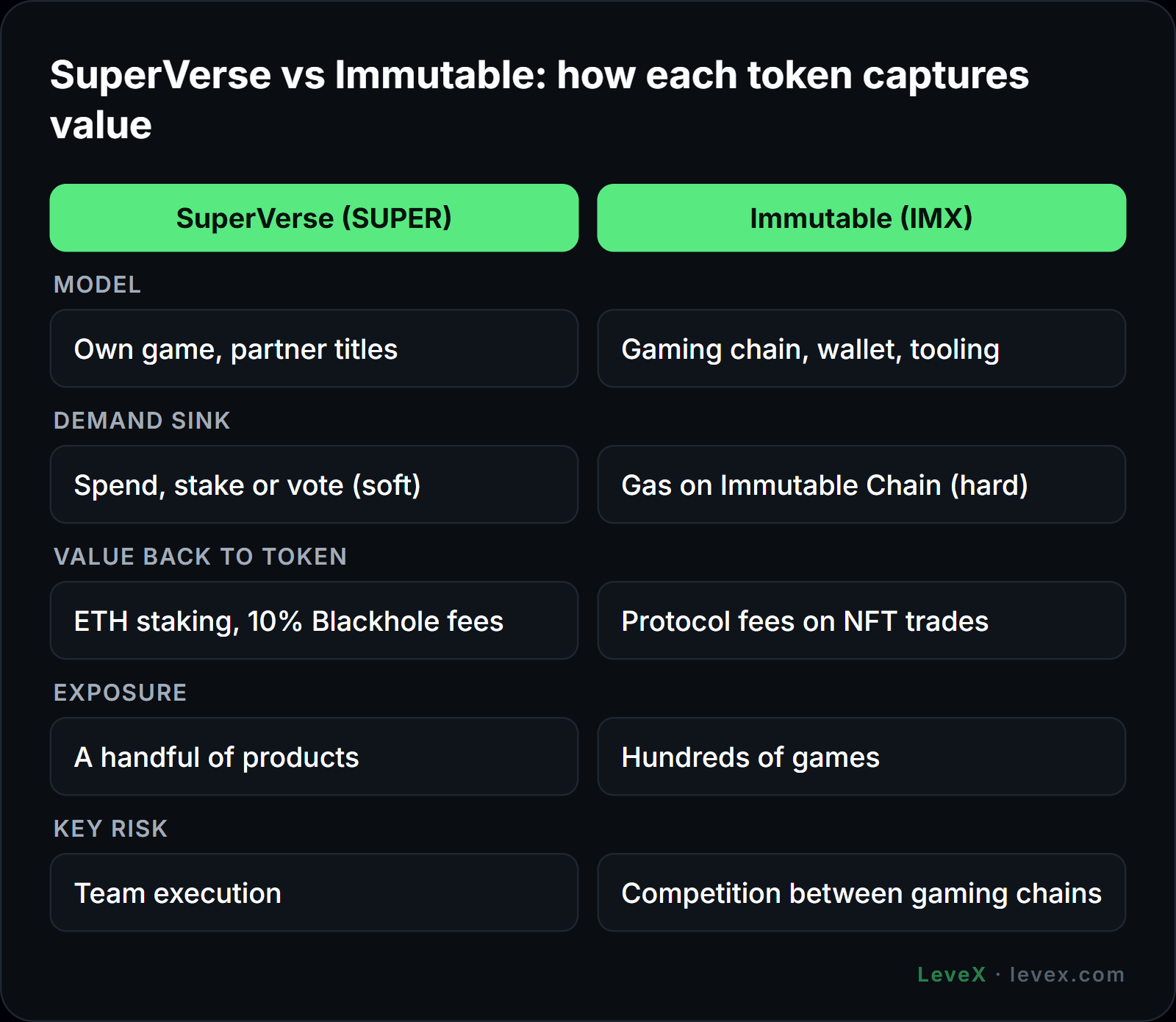
Immutable is a platform company. It builds the chain, the wallet and the developer tooling, then courts studios to launch on it. As of early 2026, its original Immutable X rollup merged into a unified Immutable Chain that combines the StarkEx and Immutable zkEVM technologies. The value of IMX rises when more games, players and trades run through that chain, regardless of which individual title succeeds. Our overview of Immutable games shows the breadth of that catalog.
SuperVerse is a community-and-product company. It grew out of SuperFarm, an NFT project launched by EllioTrades in 2021, and it relies on that audience to drive attention to its own social deduction game, Impostors, and to partner titles that accept SUPER. Instead of owning the rails, it routes revenue back to the token through two channels: ETH rewards for stakers and a 10% fee share from the Blackhole DEX on Avalanche.
The practical difference is concentration. IMX holders are diversified across hundreds of games but exposed to competition between gaming chains. SUPER holders are concentrated in a handful of products and in the team's execution.
How the Tokens Earn Their Keep
What IMX does
IMX pays for gas on the Immutable Chain, can be staked for rewards, and carries governance rights. Immutable also collects protocol fees on NFT trades across its ecosystem, which links token demand to activity from every game on the network.
What SUPER does
SUPER pays for in-game purchases in Impostors and partner games, gives DAO voting power at one staked SUPER per vote, and earns ETH when staked. Staking rewards come from DAO revenue such as Impostors NFT royalties, with 80% going to stakers under the SVIP-3 proposal. Our walkthrough on how to stake SUPER shows the process.
The key distinction is that IMX has a hard sink in gas fees, while SUPER's demand is softer and depends on users choosing to stake, vote or spend.
Supply Risk Compared
Both tokens still have large amounts outside circulation, but the overhang works differently. IMX has about 1.1 billion tokens yet to circulate, more than half of its 2 billion maximum, so its dilution ahead is larger in absolute terms and is released through Immutable's own token programs. SUPER finished all vesting by early 2024 and keeps about 347 million tokens in team, ecosystem and staking vaults that move at the team's discretion. That makes SUPER's supply risk smaller in total but harder to time, because there is no calendar to watch, only vault balances on Etherscan. The vault-by-vault picture is in our SUPER tokenomics analysis.
Which One Fits Which Trader
Liquidity-focused traders will find IMX easier to work with. Its perpetual open interest across venues is roughly six times SUPER's, which usually means tighter spreads and less slippage on larger positions.
Narrative traders may prefer SUPER. Its smaller float and influencer-driven community tend to produce sharper moves when gaming tokens rotate into favor, which cuts both ways during sell-offs.
A pair trade between the two is also possible. Traders who believe gaming infrastructure will outperform consumer gaming tokens can go long IMX and short SUPER, and vice versa. For scenario targets on the SuperVerse side, see our SUPER price prediction.
Frequently Asked Questions
Is SUPER or IMX a better investment?
Neither is objectively better, as they carry different risks. IMX offers diversified exposure to the Immutable gaming network and deeper liquidity, while SUPER offers a smaller, more volatile bet on SuperVerse's own products and community.
Does SuperVerse run on Immutable?
SuperVerse does not run on Immutable's chain. SUPER is an Ethereum ERC-20 token with bridged versions on Polygon, Base, Soneium, Avalanche and BNB Chain, though SuperVerse has listed Immutable among its gaming partners.
Which has a bigger market cap, SUPER or IMX?
As of October 30, 2026, Immutable's market cap was about $125 million against roughly $115 million for SuperVerse. On a fully diluted basis the gap is wider, at about $276 million for IMX versus $177 million for SUPER.
Infrastructure Versus Community
IMX gives broad exposure to gaming infrastructure with more predictable supply and deeper markets. SUPER gives concentrated exposure to one team's products, a fee-funded buyback and ETH staking, at the cost of discretionary supply risk and thinner liquidity.
Whichever side you take, SUPER is available on the LeveX SUPER/USDT spot market, and SUPER perpetual futures let you go long, short or pair it against other gaming tokens. Read more side-by-side token guides in Crypto in a Minute.