

SSV and Obol both let several independent operators run one Ethereum validator together, and both power Lido's Simple DVT module, but they make different design choices. SSV Network is an on-chain marketplace where stakers pick operators and pay fees through smart contracts, while Obol is middleware that operator groups install and coordinate themselves. SSV secures more ETH by its own count, and Obol leans on a community-funding model and close ties to home and small-group stakers.
For a trader, the comparison matters because the two compete for the same staking protocols, and every validator one of them wins is fee revenue the other does not collect.
Two Answers to the Same Problem
A normal Ethereum validator depends on one machine holding one key. Distributed Validator Technology (DVT) spreads that key across a cluster, so the validator keeps working when one machine fails and no single operator can sign alone. Both projects agree on the goal. They disagree on where coordination should live.
SSV puts coordination on Ethereum itself. Operators register in a public smart contract, stakers choose them, and the contract tracks every cluster's fees and balances. Obol keeps coordination off-chain. A group of operators forms a cluster, runs Obol's Charon client next to their normal validator software, and generates the shared key together in a distributed key generation ceremony, so the full key never exists in one place.
Side-by-Side Comparison
| Feature | SSV Network | Obol |
|---|---|---|
| Coordination | On-chain registry and fee contracts | Off-chain cluster software (Charon) |
| Choosing operators | Staker picks from ~1,800 public operators | Operators form clusters together |
| Fee model | Operator fees plus DAO network fee, paid in ETH | Share of staking rewards to a community fund |
| Token role | cSSV staking earns ETH network fees | OBOL governs the Obol Collective and its funding |
| Lido Simple DVT | 36 clusters plus 5 super clusters | 36 clusters plus 5 super clusters |
| Client diversity | Go client plus Rust-based Anchor | Charon, with a growing operator base |
The Lido figures come from Lido's own review of Simple DVT, which described an evenly split module with 82 clusters of seven participants each.
How the Architectures Differ in Practice
Permissionless entry versus group formation
SSV's design favors a staker who wants to spread a validator across strangers. Anyone can register as an operator, set a fee, and attract clusters, and the staker never needs to talk to the operators. That openness makes SSV easy for large protocols to plug into programmatically, which helps explain why liquid staking providers such as ether.fi, Puffer and Mantle built on it.
Obol suits operators who already know each other. A group of home stakers, a set of professional node runners, or a staking company spreading its own validators across regions can form a cluster and run it without a separate on-chain fee market.
Key handling
Both networks support distributed key generation. On SSV, many validators are created by splitting an existing key into encrypted shares, which is simple for an established staker moving validators onto the network. Obol's ceremony-first approach means the key is born split, which some security teams prefer.
Cost and payment
On SSV, a staker funds a cluster with ETH and pays each operator plus the network fee continuously. On Obol, clusters contribute a share of rewards to the Obol Collective's retroactive fund, which pays for public goods and ecosystem projects. The trade-off is transparency of pricing on SSV against a simpler, flat contribution on Obol.
Token Economics Compared
SSV's 2026 redesign tied its token directly to fees. Stakers lock SSV as cSSV and receive a share of the ETH network fees, and our SSV tokenomics breakdown explains how supply and governance fit around that. The process of locking tokens, claiming ETH and exiting is covered step by step in our guide on how to stake SSV.
Obol launched its OBOL token in 2025, as reported by Blockworks, mainly as a governance token for the Obol Collective, which directs the retroactive fund. OBOL holders influence where ecosystem funding goes, while SSV holders now hold a direct claim on protocol revenue.
That difference makes SSV easier to value on cash flow. It also makes SSV more exposed when fee volume drops.
Which One Matters More for Traders
For a trader holding SSV, Obol is the clearest competitive threat. Lido split its DVT module evenly between the two, which shows that large protocols are willing to use both and avoid depending on either.
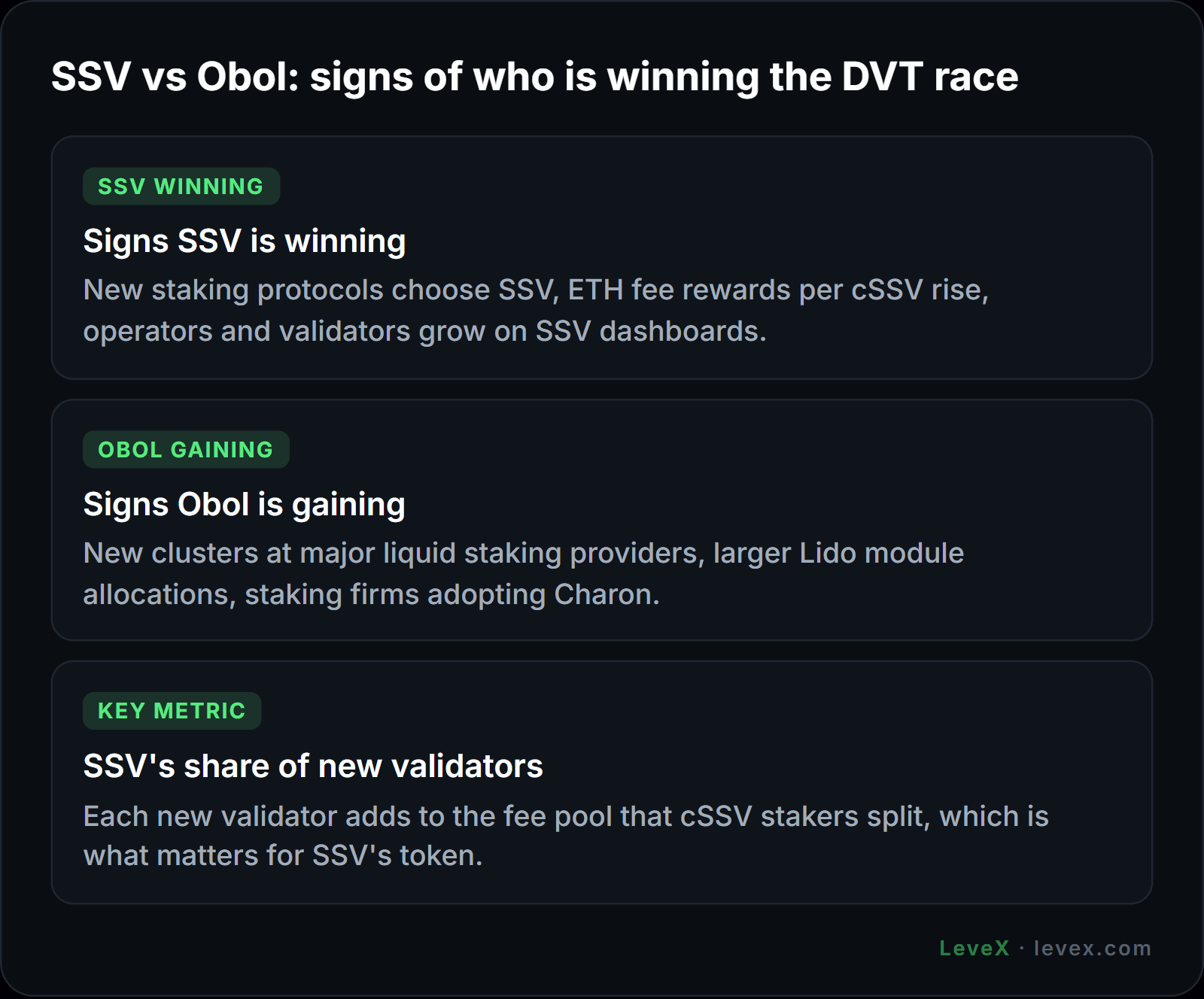
Signs SSV is winning: new staking protocols choosing SSV, rising ETH fee rewards per cSSV, and growth in operator count and validators reported on SSV dashboards.
Signs Obol is gaining: new clusters at major liquid staking providers, larger Lido module allocations, and institutional staking firms adopting Charon for internal redundancy.
Neither project has a monopoly, and Ethereum staking is large enough to support both for years. What matters for SSV's token is its share of new validators, because each one adds to the fee pool that cSSV stakers split.
SSV vs Obol FAQ
Is SSV bigger than Obol?
By its own dashboards, SSV secures more ETH and more validators than any other DVT network, with several million ETH and over 110,000 validators in 2026. Inside Lido's Simple DVT module, however, the two hold equal numbers of clusters.
Can a validator use SSV and Obol at the same time?
No. A single validator runs on one DVT network at a time. A staking protocol can split different validators between both, which is exactly what Lido does.
Which is safer, SSV or Obol?
Both are designed so no single operator can sign alone or move staked ETH. Each has its own audit history and client software, and using both across different validators reduces the impact of a bug in either one.
Two Paths to the Same Validator Goal
SSV and Obol share a mission and divide the market more than either would like, with SSV leading on scale and on-chain openness and Obol on cluster-level control. For SSV holders, the competition is the main factor behind the bear case in our SSV price prediction.
When you want exposure to the SSV side of the race, the SSV/USDT spot market and SSVUSDT perpetual futures are both live on LeveX. Find more side-by-side token breakdowns in Crypto in a Minute.