

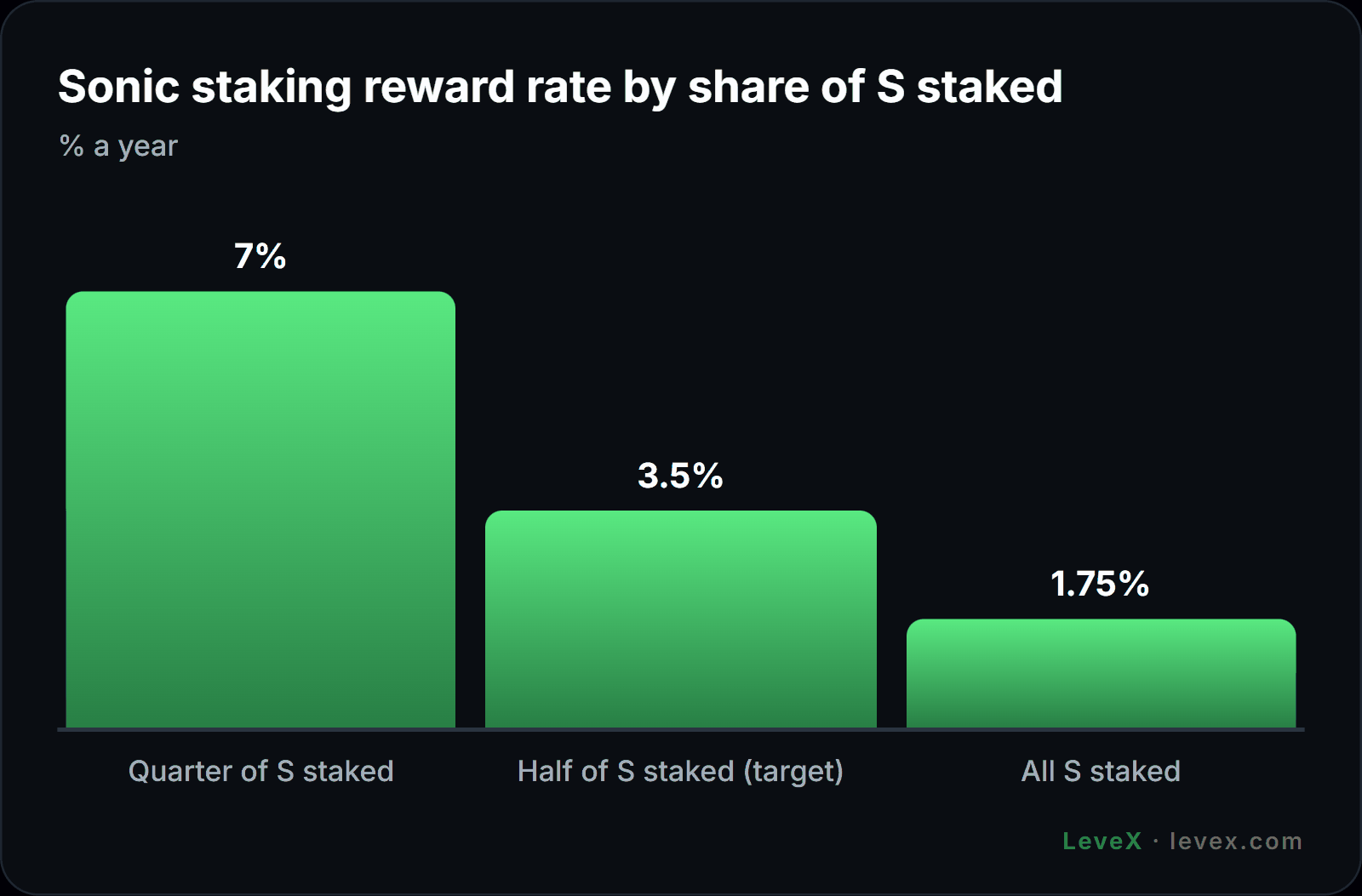
You can stake S by delegating it to a validator through the official MySonic portal, by swapping it for a liquid staking token such as stS or OS, or by running your own validator with at least 500,000 S. Delegation is the simplest route for most holders, and rewards follow a target rate of 3.5% a year when half of all Sonic (S) is staked, less your validator's commission. Unstaking takes 14 days.
Your Staking Options Compared
| Option | Minimum | Liquidity | Who it suits |
|---|---|---|---|
| Native delegation (MySonic portal) | Small amounts | 14-day withdrawal wait | Long-term holders who want simplicity |
| Liquid staking (stS, OS) | Any amount | Tradable at once, may trade at a discount | DeFi users who want yield plus flexibility |
| Running a validator | 500,000 S self-stake | 14-day withdrawal wait | Operators with infrastructure skills |
Each option draws on the same underlying validator rewards. The differences are custody, liquidity and how much technical work you take on.
Delegating S Step by Step
Native delegation keeps your S in your own wallet's control while a validator does the work. Before you start, your wallet needs the Sonic network added (chain ID 146), the same setup covered in our Fantom to Sonic upgrade guide.
- Move your S to a self-custody wallet such as Rabby or MetaMask, keeping a little extra for gas.
- Open the staking section of the official portal at my.soniclabs.com by typing the address yourself.
- Connect your wallet and browse the validator list, checking uptime, commission and how much stake each one already holds.
- Choose a validator, enter the amount and confirm the delegation transaction.
- Return periodically to claim or restake rewards, since compounding is manual.
To exit, you undelegate and then wait out the 14-day withdrawal period before claiming your S. The Sonic validator documentation sets out the operator-side rules, including the 500,000 S self-stake and a cap of 15 times self-stake on delegations per validator.
Liquid Staking With stS and OS
Liquid staking protocols stake your S on your behalf and hand you a token representing the position. The two most established on Sonic are stS from Beets and OS from Origin, which, according to Origin's staking documentation, delegates to a set of validators and passes rewards back to holders.
Why choose a liquid staking token?
Your capital stays usable. You can provide liquidity, lend or borrow against stS or OS while still earning staking rewards, and you can exit by selling the token on a DEX instead of waiting 14 days.
What do you give up?
You add smart contract risk and a possible discount: in stressed markets a liquid staking token can trade below the value of the S behind it. Our liquid staking explainer walks through these trade-offs in more detail.
How Much Can You Earn?
Sonic's reward rate moves inversely with participation. The protocol targets 3.5% a year when 50% of S is staked, falling toward 1.75% if every token were staked and rising toward 7% if only a quarter were. Validators keep 15% of the rewards earned by their delegators as commission, so a delegator's net rate sits below the headline figure.
Rewards come from two sources. The larger is the validator reward pool, which the documentation funds from roughly 70 million S a year of reallocated Fantom block rewards, a stream our Sonic tokenomics guide puts in context. The smaller is the validators' fixed 10% cut of gas under Sonic Fee Monetization, which grows only as network usage does. Check the live rate in the portal before staking, since it changes with the staked share.
Staking yield on S works much like it does on other proof-of-stake chains, though the numbers and lockups differ, as our Sonic vs Solana comparison shows for one of its larger rivals.
Risks Before You Stake
Staking S carries less risk than most DeFi strategies, but it is far from risk-free. Price volatility dwarfs everything else: a 3% yield does little against a token that has moved 50% in a few months, as our Sonic price prediction scenarios illustrate. The 14-day withdrawal period means you cannot react quickly to a sharp move unless you hold a liquid staking token instead. Validator downtime can reduce rewards, and liquid staking adds smart contract exposure on top.
Since validator rewards are paid with newly distributed S, staking mainly protects your share of the network from dilution. Treat the yield as a way to avoid falling behind unstaked supply, with any real return depending on the price of S itself.
Sonic Staking FAQ
What is the minimum to stake Sonic?
Delegators can stake small amounts of S through the MySonic portal, with no large minimum. Running your own validator requires a self-stake of at least 500,000 S.
How long does it take to unstake S?
Unstaking S takes 14 days. You undelegate first, wait out the withdrawal period and then claim your tokens, while liquid staking tokens can be sold immediately instead.
Can I stake S on an exchange?
Some platforms offer custodial S staking, but native delegation or liquid staking keeps you in control of your tokens. If you use a custodial product, check its fees and withdrawal terms against native staking first.
Making Staked S Work for You
For most holders, delegating through the official portal to a reliable validator is the cleanest way to earn Sonic's staking yield, while stS or OS suit anyone who wants to keep their capital active in DeFi. Whichever route you take, size the position for the price risk, since that matters far more than the reward rate.
Pick up S to stake on the LeveX S/USDT spot market, or hedge a staked position by shorting S perpetual futures. More staking and token guides live in Crypto in a Minute.