
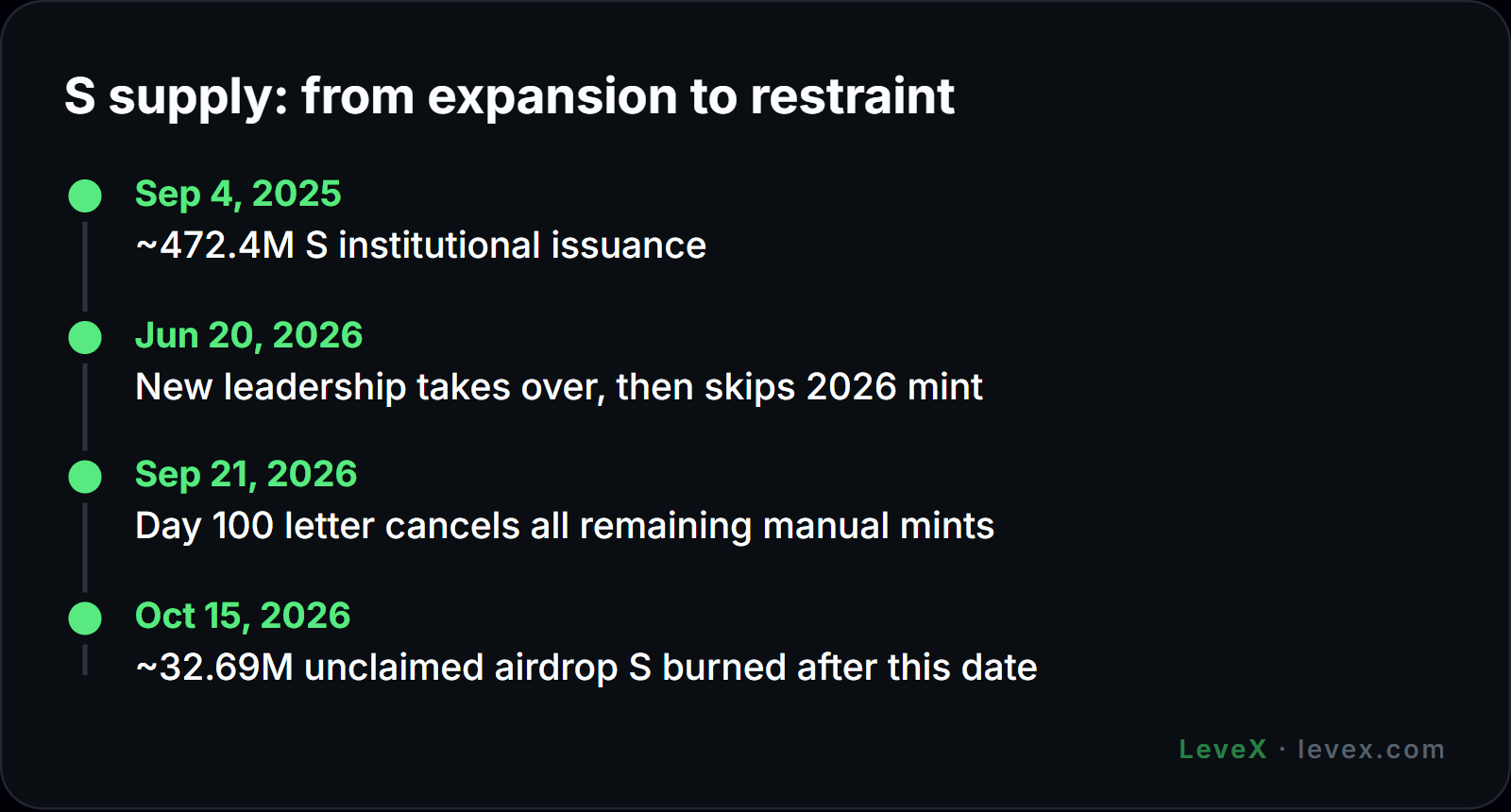
S has no hard cap, about 3.885 billion tokens in circulation as of October 2026, and a supply schedule that changed more in 2026 than in any year since launch. Sonic (S) started with roughly 3.175 billion tokens in December 2024, and the gap between that figure and today's count comes almost entirely from mints that the new leadership has now stopped. Validator rewards are the only issuance still running, and three separate burn mechanisms work against them.
The Launch Supply and What Was Added
Sonic's 2024 litepaper set the starting supply at about 3.175 billion S, matching the FTM supply that migrated 1:1. Everything above that number was minted later, under programs approved through governance.
| Issuance | Amount | Date | Status in October 2026 |
|---|---|---|---|
| Launch supply (migrated from FTM) | ~3.175B S | Dec 2024 | Complete |
| Ecosystem and operations mint | 47.625M S per year for 6 years | First on Jun 18, 2025 | 2026 mint skipped; program cancelled Sep 2026 |
| Airdrop | 190.5M S total, issued in phases | First 89.8M in Jul 2025 | Unclaimed S from seasons 1 and 2 burned after Oct 15, 2026 |
| Institutional expansion (Nasdaq treasury vehicle, Sonic USA) | ~472.4M S | Sep 4, 2025 | Issued; unused funds return to the foundation or are burned |
| Validator rewards | ~70M S per year from reallocated Fantom block rewards | Ongoing | Still running |
The September 2025 institutional issuance is the largest single addition and the one that drew the most criticism. It was approved to fund a US entity and a Nasdaq-listed digital asset treasury, with a further $50 million in S reserved for a possible ETF. According to the Sonic token documentation, any funds from that allocation that fail to reach their purpose go back to the foundation for reuse or burn.
How S Validator Rewards Work
Validator rewards follow a target-rate design. The protocol aims to pay stakers 3.5% a year when half of all S is staked, scaling the rate inversely with participation: about 1.75% if every token were staked and about 7% if only a quarter were. Validators and delegators also share a portion of network gas fees.
For the first four years, the documentation funds these rewards from roughly 70 million S a year of block rewards reallocated from Fantom Opera, with new issuance resuming at 1.75% a year after that. In practice, holders should treat validator rewards as ongoing dilution of a few percent a year that accrues to stakers. Sitting unstaked means owning a slightly smaller share of the network each year, which is why most long-term holders stake.
The Three Burns
Three mechanisms remove S from supply. None of them is large enough on its own to make S deflationary today, but together they offset part of the validator emission.
FeeM leftovers
Under Sonic's Fee Monetization program, developers receive part of the gas their apps generate. A model announced in November 2025 tiers the developer share between 15% and 90% by usage, gives validators a fixed 10%, and burns the remainder, as reported by The Block. The burn scales with network fees, which are small while on-chain activity stays low.
Airdrop forfeits and unclaimed tokens
Airdrop recipients received 25% of their allocation up front and the other 75% after a 270-day maturation period. Anyone who claimed the 75% early forfeited part of it, and the forfeited S was burned. On top of that, about 32.69 million S from the first two seasons that was never claimed is scheduled to be destroyed after October 15, 2026, close to 0.9% of circulating supply.
Unused ecosystem funding
The original design burned any part of each 47.625 million S ecosystem mint that went unspent within the year. With the program cancelled, this burn no longer has anything to act on.
What Changed in 2026
The tokenomics story of 2026 is a shift from expansion to restraint. Under founding leadership, Sonic minted aggressively to fund growth, incentives and institutional products. After the June 20 leadership change, the new team skipped the annual ecosystem mint and the price rose about 18% on the announcement. On September 21, CEO Matt Visser's "Day 100" letter cancelled every remaining manual mint and commissioned an independent audit of S supply and its reporting.
The letter also set a principle for value accrual: buybacks, burns and fee sharing come only after the business earns revenue. That rules out a near-term buyback program, but it makes any future one more credible. For a fuller view of how these supply changes feed into valuation scenarios, see our Sonic price prediction.
Sonic Tokenomics FAQ
What is the max supply of Sonic (S)?
Sonic has no maximum supply. Supply grows through validator rewards and shrinks through burns, and as of October 2026 the circulating and total supply both sit near 3.885 billion S.
Is S deflationary?
S is mildly inflationary in October 2026 because validator rewards still exceed burns. It could turn deflationary only if network fees grow enough for FeeM burns to outpace issuance, or if validator emissions are replaced.
Why is Sonic auditing its own token supply?
The new leadership commissioned an independent audit to verify S supply figures and the related reporting after several large mints under the previous team. The final report was expected within weeks of the September 21, 2026 letter.
Why Supply Discipline Matters for S
Sonic's supply schedule has gone from one of the more expansive among mid-sized layer-1s to one of the more restrained, at least on paper. The audit result and any plan to wind down validator emissions will decide whether that restraint becomes a lasting part of the S thesis.
Track how the market prices these changes on the S/USDT spot pair, or take a directional view through S perpetuals on LeveX. Crypto in a Minute has more tokenomics breakdowns across the market.