

Solana is the far larger and more liquid network, while Sonic offers comparable speed with full Ethereum compatibility and a fee model that pays developers. In October 2026, Solana's DeFi ecosystem held roughly 370 times more value than Sonic's, so the comparison is less about which chain is faster and more about which trade-offs suit a given builder or trader.
Sonic and Solana at a Glance
| Sonic (S) | Solana (SOL) | |
|---|---|---|
| Launched | December 2024 (Fantom successor) | March 2020 |
| Virtual machine | SonicVM, EVM-compatible | Solana Virtual Machine (SVM) |
| Smart contract languages | Solidity, Vyper | Rust, C |
| Finality | Under 1 second | About 12.8 seconds today; Alpenglow targets ~150 ms |
| Developer fee share | Up to 90% via FeeM | None |
| DeFi TVL (Oct 2026) | ~$17 million | ~$6.3 billion |
| Native Ethereum bridge | Sonic Gateway | None at protocol level |
TVL figures come from DefiLlama's chain rankings as of October 8, 2026.
EVM Compatibility vs a Custom Runtime
The deepest difference sits in the execution layer. Sonic runs an EVM-compatible engine, so a team with an Ethereum app can deploy the same Solidity code, use the same tooling and connect the same wallets. Solana uses its own virtual machine with programs written mostly in Rust, which enables parallel execution and very high throughput but requires a rewrite for most Ethereum-native teams.
That gives Sonic a porting advantage and Solana a performance-engineering head start. Sonic's lineage matters here too: it inherits years of EVM work from Fantom Opera, as our Fantom to Sonic explainer covers, while Solana has spent six years optimizing a design built from scratch.
Speed Claims and Real-World Performance
Both chains advertise numbers far beyond their everyday load. The Sonic documentation quotes up to 400,000 transactions per second with sub-second finality. Solana's theoretical throughput is similarly high, and its practical throughput is the highest of any major chain, sustained over years of heavy memecoin and DeFi traffic.
Finality is where Sonic currently leads. Its blocks are final in under a second, while Solana's full economic finality still takes roughly 12.8 seconds pending the Alpenglow consensus upgrade. On reliability, Solana carries the heavier record, with several full outages in 2021 and 2022 described in our Solana network outages explainer, and a much longer track record of stable operation since. Sonic has had fewer incidents, but it has also never faced Solana's level of demand.
Fees and Who Earns Them
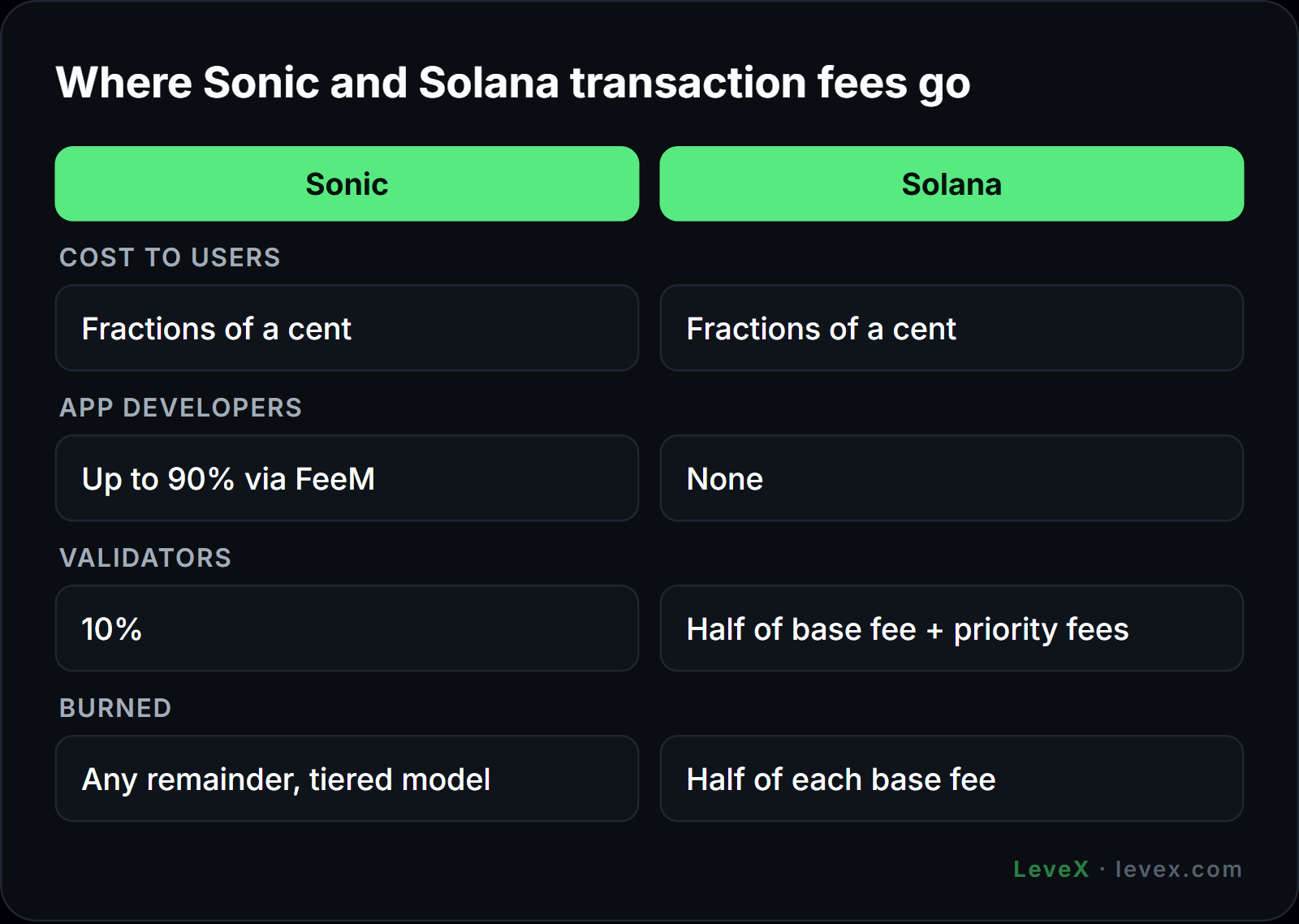
Both networks charge users fractions of a cent per transaction. The difference is where that money ends up. Solana burns half of each base fee and pays the rest, plus priority fees, to validators. Sonic routes up to 90% of fees to the apps that generated them through Sonic's FeeM program, gives validators 10%, and burns any remainder under its tiered model.
For a developer, Sonic's model is a direct revenue stream. For token holders, Solana's burn and Sonic's burn both depend on volume, and Solana's volume is orders of magnitude higher today.
Ecosystem, Liquidity and Token Supply
Solana's ecosystem dwarfs Sonic's on every activity measure. It hosts major DEXs, perpetual exchanges, liquid staking protocols, stablecoin payments, consumer apps and a large share of all memecoin trading. Sonic's ecosystem includes native DEXs, liquid staking (stS and OS), an Aave deployment and the USSD stablecoin launched in March 2026, but its TVL fell from about $1.14 billion in May 2025 to around $17 million in October 2026.
Token supply follows different philosophies:
- SOL runs a scheduled inflation rate that started at 8% and declines 15% a year toward a 1.5% long-term floor.
- S has no cap, but manual mints were cancelled in September 2026 and only validator rewards still add supply, with three burn mechanisms working against them. Full details sit in our Sonic tokenomics guide.
Which Network Fits Which User?
Builders porting from Ethereum get the easiest path on Sonic, plus fee revenue from day one. Builders chasing users and liquidity will find far more of both on Solana. Traders face a similar split. SOL is a large-cap asset with deep markets and lower volatility relative to S, while S is a small-cap token whose price reacts sharply to news about its turnaround, a dynamic explored in our Sonic price prediction.
Sonic vs Solana FAQ
Is Sonic faster than Solana?
Sonic reaches finality faster than Solana today, in under a second versus about 12.8 seconds. Solana processes far more real transactions every day, so in practical throughput under load Solana remains ahead.
Can Solana apps run on Sonic?
Solana programs cannot run on Sonic without a rewrite, because Sonic uses an EVM-compatible engine and Solana uses its own virtual machine. Ethereum apps, by contrast, can deploy on Sonic with little or no change.
Is S or SOL the better investment?
SOL and S carry very different risk profiles: SOL is a large-cap asset backed by one of crypto's busiest ecosystems, while S is a small-cap turnaround bet. Neither carries guaranteed returns, and position sizing should reflect how much volatility you can tolerate.
Two Fast Chains With Different Bets
Solana bet on a custom high-performance runtime and won the activity race. Sonic bet on EVM compatibility, fast finality and paying developers, and is now rebuilding its user base under new leadership. Watching whether that rebuild closes any of the liquidity gap is the clearest way to track the matchup.
You can trade the smaller of the two on LeveX through the S/USDT spot market or Sonic perpetual futures. Crypto in a Minute has deeper guides on other layer-1 networks.