

Fee Monetization (FeeM) is a Sonic protocol feature that pays app developers a share of the gas fees their users spend, up to 90%, with validators taking a fixed 10%. On most blockchains those fees go to validators or get burned, and the developers who generated the traffic receive nothing. Sonic (S) built FeeM to turn its developers into fee earners, the way a mobile app store shares revenue with app makers.
Where Gas Fees Go on Other Chains
FeeM makes most sense next to the alternatives. Every major chain has to decide who receives transaction fees, and each choice says something about whom the network is optimizing for.
| Chain | Base fee | Priority fee or tip | Share to app developers |
|---|---|---|---|
| Ethereum | Burned (EIP-1559) | Validators | None |
| Solana | 50% burned, 50% validators | Validators | None |
| Sonic | Split under FeeM | Split under FeeM | Up to 90% |
Ethereum gas fees reward ETH holders through the burn and validators through tips. Solana splits its base fee between a burn and the block producer. Sonic is the only one of the three that routes most of the fee to the application layer.
The idea has roots in Sonic's own history. Fantom Opera, the chain Sonic replaced, had no protocol-level revenue for builders, and the Fantom to Sonic upgrade was the moment the team chose to change that.
How a Fee Moves Through FeeM
The FeeM documentation describes a five-stage flow:
- A user sends a transaction and pays gas in S.
- The protocol sends 10% of that fee to validators and 90% to the FeeM contract, also called the fee treasury.
- Off-chain oracles trace how much gas each registered contract consumed, including sub-calls into other protocols.
- Rewards are split by gas share. If a 100,000-gas trade touches two registered apps that used 37,000 and 63,000 gas, they receive 37% and 63% of the reward.
- After an epoch is sealed and an oracle quorum confirms the usage, a developer submits a claim and receives S at a chosen recipient address. Unclaimed rewards never expire.
Developers register their contracts through the FeeM dashboard. Upgradeable contracts register the proxy address, since gas from delegate calls is attributed there.
The 2025 tiered model
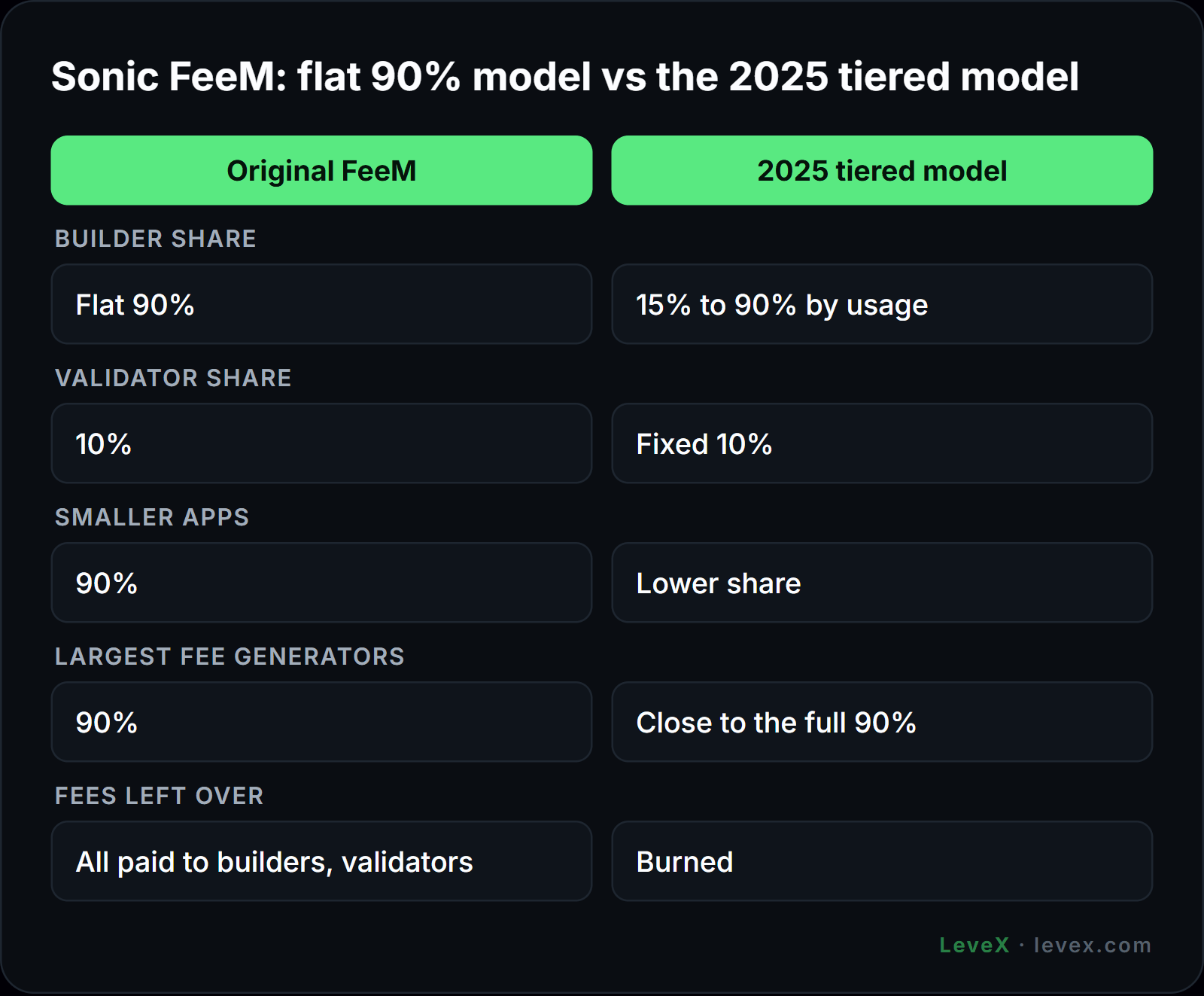
A refinement announced in November 2025 replaced the flat 90% with tiers. Builders earn between 15% and 90% of fees depending on their usage, validators keep a fixed 10%, and anything left over is burned. The Block's report on the change framed it as a move toward making S deflationary as activity grows. Smaller apps receive a lower share, while the largest fee generators keep close to the full 90%.
What FeeM Means for S Holders
For holders, FeeM matters through the burn. Every fee that is not paid out to a builder or validator leaves the supply permanently, which works against the validator emissions described in our Sonic tokenomics breakdown. The catch is scale. Sonic's DeFi activity in October 2026 is a small fraction of its 2025 peak, so the burn is currently minor.
That makes FeeM a leveraged bet on usage. If the payments, stablecoin and tokenisation strategy under the new leadership brings real transaction volume, the burn grows automatically and so does the incentive for developers to build on Sonic. If usage stays low, FeeM remains a well-designed feature with little economic weight. Our Sonic price prediction treats activity growth as one of the main variables for exactly this reason.
Limits and Open Questions
FeeM is generous, and it has known trade-offs:
- Self-dealing risk. A developer could generate fake activity to farm rewards, though paying gas to recapture 90% of it at most still loses money on every transaction.
- Oracle dependence. Attribution relies on off-chain oracles reaching quorum, which adds a trust layer beyond the base chain.
- Low fees mean low rewards. Sonic's fees are cheap by design, so meaningful developer income requires very high transaction counts.
- Governance changes. Tier thresholds and the burn share can be adjusted through governance, so today's split is not fixed forever.
FeeM FAQ
How much do developers earn with Sonic FeeM?
Developers earn between 15% and 90% of the gas fees their contracts generate, depending on their usage tier. The original model paid a flat 90%, and validators receive 10% in every version.
Is FeeM paid in S or in stablecoins?
FeeM rewards are paid in S, the same token users spend on gas. Developers who want stable income need to convert their rewards themselves.
How does an app join Sonic FeeM?
An app joins FeeM by applying through Sonic's Fee Monetization application page and registering its contracts in the FeeM dashboard at feem.soniclabs.com. Once registered, gas used by those contracts is tracked from the next epoch, and accrued rewards can be claimed at any time.
Does FeeM make transactions more expensive for users?
FeeM does not add any extra cost for users. It only changes where the existing gas fee goes after it is paid.
FeeM and the Case for Building on Sonic
FeeM gives Sonic a distinctive pitch to developers: build here and share in the fees your users generate. Its value to the network and to S holders grows with activity, which is why the feature's real test lies in whether Sonic's 2026 reset brings users back.
Take a position on that outcome through the S/USDT spot pair, or use Sonic perpetual futures for leveraged long or short exposure on LeveX. Fee models across other chains are covered in Crypto in a Minute.