
The Sandbox (SAND) is a blockchain game world where players build, own and monetize voxel games and virtual land, and SAND is the ERC-20 token that pays for everything inside it. Owned by Animoca Brands, The Sandbox sold its first LAND parcels in 2019, launched SAND in August 2020 and became one of the two flagship metaverse projects of the 2021 boom, when SAND peaked near $8.40.
Five years on, the picture is very different. As of October 2026, SAND trades around six to eight cents, almost the entire 3 billion supply is unlocked, staking has been switched off, and the company went through a major restructuring in 2025. This guide explains what The Sandbox is, how its economy works, what SAND actually does today and what changed along the way.
From Mobile Game to Metaverse
The Sandbox started life as a mobile game. Arthur Madrid and Sébastien Borget founded the studio Pixowl in 2011 and released The Sandbox for iOS and Android in 2012, a pixel-art creation game that drew more than 40 million downloads across its versions. Hong Kong's Animoca Brands bought Pixowl in 2018 and rebuilt the concept on Ethereum, turning player-made content into tradable NFTs and the in-game currency into a real token.
The key dates in that transition:
| Year | Milestone |
|---|---|
| 2018 | Animoca Brands acquires Pixowl; blockchain version announced |
| 2019 | First LAND presales on Ethereum |
| 2020 | SAND token launches through a public launchpad sale in August |
| 2021 | Alpha Season 1 opens in November; a SoftBank-led $93 million round follows |
| 2021–2022 | SAND bridged to Polygon to cut fees; staking launches there |
| 2024 | The Sandbox DAO launches with a 25 million SAND annual budget |
| 2025 | Founders step back, staff cut by more than half, SANDchain Layer 2 announced |
| 2026 | Season 7 adds browser play; bridge exploit on Base and BNB Chain in August |
The 2021 peak was driven by brand deals as much as gameplay. Snoop Dogg, Adidas, Gucci and Warner Music all bought or built on LAND, and plots near celebrity estates changed hands for hundreds of thousands of dollars.
How Does The Sandbox Work?
The Sandbox is three layers stacked together: land, creation tools and a game client that runs time-limited Seasons.
LAND and ESTATEs
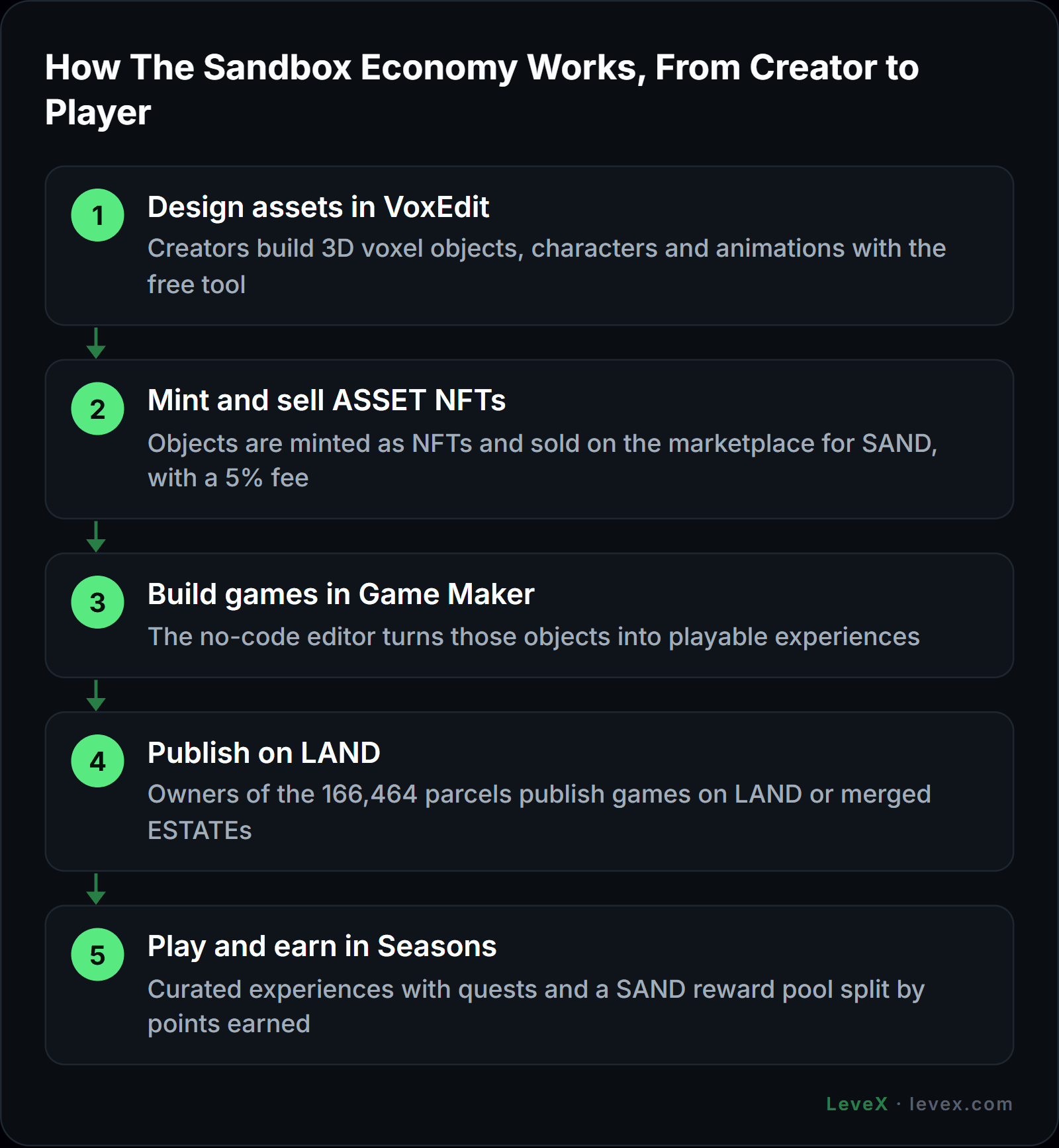
The map is a fixed grid of 166,464 LAND parcels, each an ERC-721 NFT. Owners can merge adjacent parcels into ESTATEs, rent them out, or publish their own games on them. Because supply is capped, LAND was marketed as scarce digital real estate. The floor price tells the story of the cycle: parcels that sold for thousands of dollars in late 2021 traded at roughly 0.02 to 0.03 ETH (about $50 to $60) in 2026.
VoxEdit and Game Maker
Creators use two free tools. VoxEdit builds 3D voxel objects, characters and animations, which can be minted as ASSET NFTs and sold on the marketplace. Game Maker is a no-code editor for turning those objects into playable experiences. The Sandbox says its ecosystem passed 400,000 creators and 8 million registered users by the end of 2025.
Seasons
Players do not roam a persistent open world most of the time. Instead, The Sandbox runs Alpha Seasons: curated batches of experiences with quests and a SAND reward pool split by points earned. Season 6 (September 2025) featured Cirque du Soleil and a 250,000 SAND pool, while Season 7 launched on February 25, 2026 with browser access, so new players could join without a download or wallet.
What SAND Is Used For
SAND has a fixed maximum supply of 3 billion tokens. As of October 2026, about 2.94 billion (roughly 98%) are in circulation according to CoinGecko, so new unlocks no longer weigh on the market. The token's roles:
- Payments: buying LAND, ASSETs, avatars and access passes on the marketplace
- Fees: the marketplace takes a 5% fee on transactions, historically split between the Foundation and a staking fund
- Rewards: Season pools, Game Jams and creator challenges pay out in SAND
- Governance: SAND and LAND holders voted on Sandbox Improvement Proposals through the DAO
- Gas (planned): SAND is slated to be the gas token on SANDchain, the project's Ethereum Layer 2
Two of those roles have weakened. SAND staking on Polygon closed on June 26, 2025, per The Sandbox's official staking documentation, and the DAO was reportedly paused in early 2026. That leaves SAND as a payment and reward token whose demand depends on how many people buy things inside the game.
The Sandbox in 2025 and 2026
The most consequential change happened off-chain. In August 2025, Animoca Brands took direct control: Robby Yung became CEO, Madrid moved to non-executive chairman, Borget became global ambassador, and more than half of roughly 250 staff were let go, as Blockworks reported. Several regional offices closed.
The roadmap that followed has two threads. One is a leaner content model that leans on community-built experiences, which made up more than half of Season 7. The other is SANDchain, an Ethereum Layer 2 announced at TOKEN2049 in October 2025. Its testnet went live in late 2025, and mainnet was still a 2026 target as of this writing.
Then came a security incident. On August 21 and 22, 2026, an attacker abused a configuration flaw in SAND's Base and BNB Chain bridge contracts, minted a huge amount of unbacked SAND on those chains and drained about 14.7 million real SAND (around $700,000) from an Ethereum vault, according to Cointelegraph. SAND on Ethereum and Polygon was unaffected. The team retired the compromised contracts and pledged 1:1 repayment from its treasury, without minting new tokens.
Korean exchanges placed SAND under trading caution after the exploit and lifted it on October 2, 2026. SAND rallied more than 50% that day, from about $0.045 to $0.069, a reminder of how sensitive a small-cap token is to liquidity headlines.
Where SAND Fits Among Gaming Tokens
SAND belongs to the first generation of GameFi tokens, alongside Axie Infinity and Gala. All three rode the 2021 play-to-earn wave and all three have lost more than 95% from their highs. The Sandbox's distinguishing feature is its creator economy: other gaming projects mostly publish their own titles, while The Sandbox sells land and tools so outsiders build the games. Infrastructure-focused projects like Immutable took a different route, offering a chain and SDK for studios rather than a single world.
| Strength | Weak spot |
|---|---|
| Large creator base and brand partnerships | Low engagement outside Season windows |
| Supply fully unlocked, no vesting overhang | Staking and DAO governance switched off |
| Browser play lowers the entry barrier | August 2026 bridge exploit dented trust |
| SANDchain could add gas demand | Mainnet still unlaunched as of October 2026 |
Frequently Asked Questions
Is The Sandbox still active in 2026?
Yes. The Sandbox launched Season 7 in February 2026 and continues to run creator Game Jams, though with a much smaller team after the 2025 layoffs. Activity is concentrated in Season windows, so player numbers rise and fall with each event.
Who owns The Sandbox?
The Sandbox is a subsidiary of Animoca Brands, which acquired developer Pixowl in 2018. Since August 2025, Animoca executive Robby Yung has served as CEO, with co-founders Arthur Madrid and Sébastien Borget in non-executive roles.
What blockchain is SAND on?
SAND is an ERC-20 token native to Ethereum, with a bridged version on Polygon that the game uses for low-cost transactions. Versions on Base and BNB Chain had their bridges disabled after the August 2026 exploit.
Can you still stake SAND?
No official SAND staking pool pays rewards anymore. The Sandbox closed its Polygon staking pools on June 26, 2025, and stakers can only withdraw their tokens.
How many SAND tokens are there?
The maximum supply is 3 billion SAND. Roughly 2.94 billion were circulating as of October 2026, and the vesting schedule for team, investor and reserve allocations ended in 2025.
Is SAND the same as LAND?
No. SAND is the fungible currency used across the platform, while LAND is a non-fungible parcel of the map. LAND is bought and sold with SAND (or ETH on secondary markets), but the two are separate assets.
SAND After the Metaverse Boom
The Sandbox still has assets few gaming projects can match: a recognizable brand, a fixed map that thousands of people own pieces of, and a toolset that has onboarded hundreds of thousands of creators. What it lacks is a steady reason for SAND demand between Seasons. SANDchain is the project's answer, and whether it ships and attracts real usage is the variable most worth watching.
Traders who want exposure can buy SAND on the LeveX spot market, or use SAND perpetual futures to go long or short. If the spot-versus-derivatives choice is new to you, our spot vs futures trading guide covers the trade-offs, and Crypto in a Minute has more project explainers.