
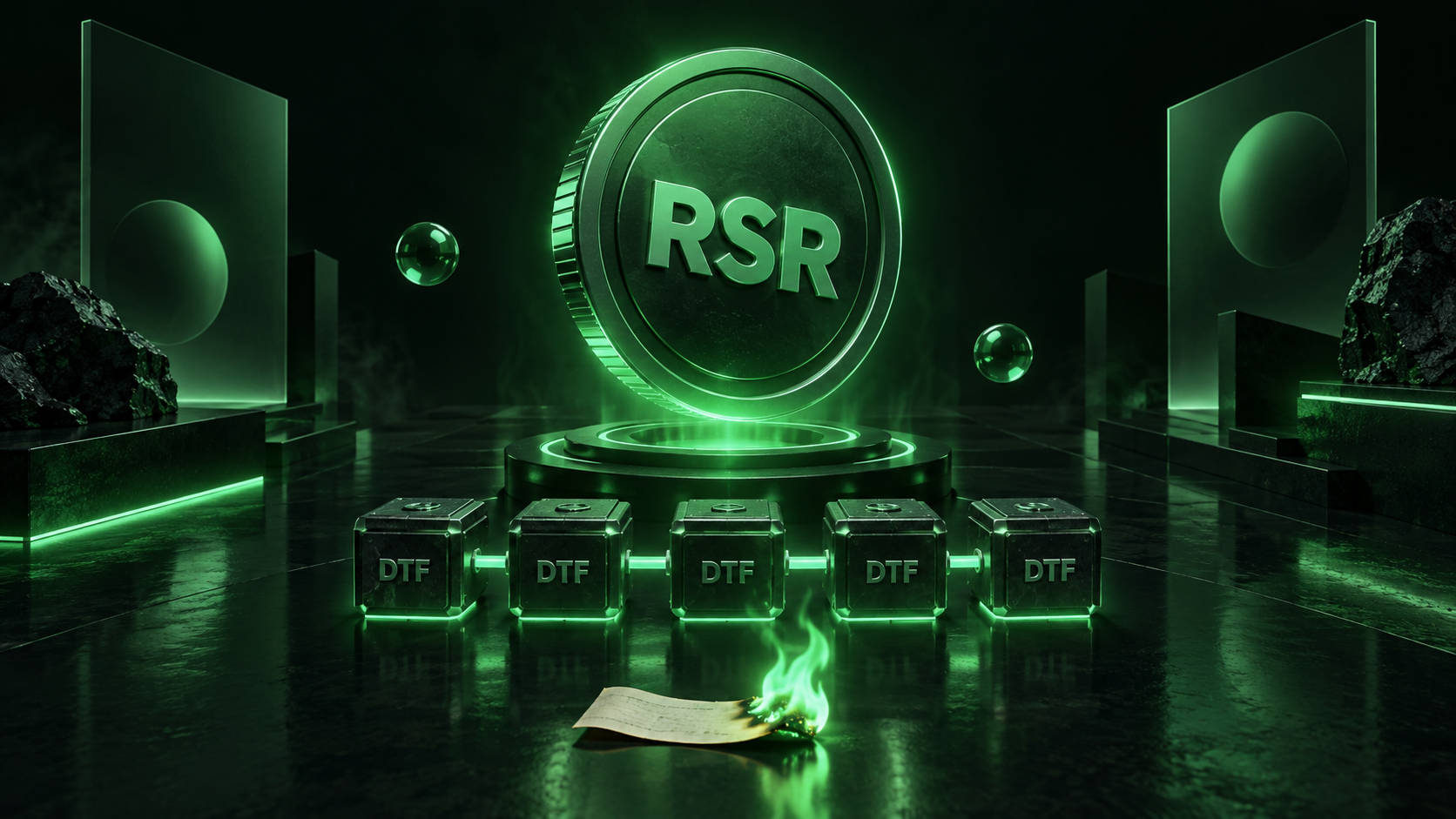
Reserve Rights (RSR) is the governance, staking and burn token of the Reserve Protocol, a system for issuing Decentralized Token Folios (DTFs): single tokens that hold a fully backed basket of other assets, much like an onchain ETF. RSR holders govern those baskets, stake behind the yield-bearing ones as first-loss insurance, and see a share of protocol fees used to buy RSR on the open market and burn it.
As of early October 2026, RSR trades near $0.0017, with roughly 62.5 billion tokens circulating out of a 100 billion maximum and a market capitalization of about $107 million, according to CoinGecko. That price sits more than 98% below the token's April 2021 peak, which makes the current question for RSR a simple one: can fee income from DTFs grow fast enough to matter against a very large supply?
Three Jobs the RSR Token Does
Most governance tokens have one function and a vague promise of future utility. RSR has three concrete roles, and each one ties the token to a different part of the protocol.
Staking as overcollateralization for Yield DTFs
Yield DTFs (originally called RTokens) are asset-backed tokens such as the ETH+ basket of liquid staking tokens. Each one can have RSR staked behind it. If a collateral asset defaults or depegs, staked RSR is seized and sold to make holders whole. In exchange, stakers receive a share of the yield the basket earns, paid by raising the value of their staked RSR position over time. The full process, including unstaking delays and slashing, is covered in our guide on how to stake RSR.
Vote-locking to govern Index DTFs
Index DTFs are passive or actively managed baskets, from crypto indexes to tokenized stock portfolios. Each one is governed by holders of a vote-locked token chosen by its creator. The Reserve documentation names RSR as the default. Locked RSR votes on basket weights, new assets, fee settings and rebalances through an optimistic governor, where routine proposals pass unless holders veto them.
Absorbing protocol fees through burns
Index DTFs charge a mint fee (under 1%) and an annual TVL fee (under 5%). The platform's cut of those fees is converted into RSR on the open market and sent to a burn address every month. More than 125 million RSR had been destroyed this way by August 2026. The burn schedule, the treasury and the open supply questions are laid out in the RSR tokenomics breakdown.
Yield DTFs and Index DTFs Side by Side
The two product lines share a protocol but do very different things, which is why RSR's role changes depending on which one you look at.
| Yield DTFs | Index DTFs | |
|---|---|---|
| Original name | RTokens | Launched in 2025 as the Reserve Index Protocol |
| What they hold | Yield-bearing collateral (staked ETH, lending positions, stable assets) | Baskets of crypto tokens or tokenized equities |
| Example | ETH+ | CMC20, MAG7, BUILDOUT |
| RSR's role | Staked as first-loss capital | Vote-locked for governance; fees burn RSR |
| Who earns | RSR stakers share the basket's yield | All RSR holders, indirectly, through burns |
The Index side is where most of the recent growth has come from. In 2025, Reserve and CoinMarketCap launched CMC20, a token on BNB Chain that tracks the top 20 crypto assets. On July 9, 2026, Reserve added a set of AI-themed baskets built from tokenized U.S. equities issued through Ondo Global Markets, including a Magnificent 7 basket. How each product is minted, rebalanced and redeemed is explained in our guide to Reserve DTFs.
From a Venezuelan Payments App to an Index Protocol
Reserve was founded by Nevin Freeman and Matt Elder with a mission to give people in high-inflation countries a stable alternative to their local currency. Its 2018 seed round drew backing from Peter Thiel and several crypto venture funds, and RSR itself began trading in 2019.
The first product people actually used was a phone app. The Reserve app let users in Venezuela swap bolivars for a dollar-pegged stablecoin, a launch The Block covered as the company moved into the country. By March 2021 it was among the most downloaded finance apps in Venezuela, and in April 2021 that excitement helped carry RSR to its all-time high of about $0.12.
The protocol that gives RSR its current job reached Ethereum mainnet in 2022, letting anyone launch an RToken backed by a basket of collateral and protected by staked RSR. Growth was slower than the early hype implied, and the team widened the product into DTFs, adding Base and BNB Chain deployments and the index products described above. That shift, and why it happened, is the subject of our Reserve Protocol history.
RSR Supply at a Glance
Supply is the single biggest factor in RSR's price, and it moves on four levers:
- Maximum supply: 100 billion RSR, with about 62.5 billion circulating as of October 2026.
- Treasury holdings: the remaining tokens sit with the project and are released only through governance-approved plans. A revised milestone framework, voted on from August 27 to September 3, 2026, ties future treasury releases to protocol revenue.
- Monthly burns: fee-funded buybacks have ranged from about 3.9 million to 16.3 million RSR per month in 2026.
- The Burn Gauge: a quarterly holder vote on the ratio between treasury unlocks and burns. In the first one, which closed September 25, 2026, 86% of votes chose the "High Burn" setting: zero unlocks for the quarter and treasury burns at four times the fee-funded amount.
A separate proposal, RFC-1269, would burn roughly 30 billion RSR from the treasury and cut the maximum supply to about 70 billion. It was still under discussion as of October 2026. Burns of this kind follow the same logic as other crypto token buybacks, and their effect depends entirely on whether they are large relative to supply.
Risks Behind the Burn Story
The burns sound large in token terms but are small in dollar terms. The roughly 125 million RSR destroyed through August 2026 was worth about $182,000 at the time, against a market value above $100 million. The protocol's total value locked was about $39.5 million on DefiLlama in early October 2026, so fee income is modest and burns would need to grow many times over to change the supply picture on their own.
Yield DTF stakers carry a specific risk on top of price swings: if a basket's collateral fails, their RSR is the first thing sold to cover it. Index DTFs that hold tokenized stocks depend on outside issuers and on the legal standing of those tokens. And the treasury still controls a large share of supply, so governance decisions about unlocks can move the market as much as anything the protocol earns. Where these factors could take the price, under different assumptions, is mapped out in our RSR price prediction.
Frequently Asked Questions
What is RSR crypto used for?
RSR is used to stake behind Yield DTFs as first-loss capital, to vote-lock for governance of Index DTFs, and as the asset bought and burned with Reserve Protocol fees. Stakers earn a share of yield, while all holders benefit indirectly when burns reduce supply.
Is RSR a stablecoin?
No. RSR is a volatile governance and staking token. The Reserve Protocol can issue asset-backed tokens, some of them dollar-stable, and RSR's job is to govern and protect those tokens.
What blockchain is RSR on?
RSR is an ERC-20 token native to Ethereum, with bridged versions used on Base and other networks where Reserve DTFs run. The wallets that support each version are compared in our guide to the best RSR wallets.
How many RSR tokens are there?
The maximum supply is 100 billion RSR. About 62.5 billion were circulating as of October 2026, and a pending proposal would burn around 30 billion from the treasury.
Who created Reserve Rights?
Reserve Rights was created by the Reserve team led by co-founders Nevin Freeman and Matt Elder. Development is now steered by contributors and RSR governance.
Can RSR reach $1?
Reaching $1 would require a market capitalization in the tens of billions of dollars even after a 30 billion token burn, hundreds of times its October 2026 value. Most forecasts focus on fractions of a cent, and the bull and bear cases are weighed in our article asking is RSR a good investment.
Why RSR Is a Bet on DTF Adoption
RSR's design is now clear: every function of the token depends on people holding Reserve DTFs. More basket TVL means more fees, larger burns and more demand to stake or vote-lock RSR. The tokenized stock baskets and the CMC20 index are the first real test of whether those products can find a market outside crypto natives.
That leaves RSR as a high-supply, low-priced infrastructure token whose biggest moves tend to come from governance votes and product launches.
Follow those catalysts on the RSR/USDT spot market, or take a long or short view with RSR perpetual futures on LeveX. More quick explainers on the projects behind each ticker are waiting in Crypto in a Minute.