

At the end of September, with Bitcoin near $84,000 and the Fear & Greed Index at 74, an investor who had bought heavily in the $60,000s asked r/CryptoCurrency what everyone else was doing. He was keeping cash in reserve, saw "at least a decent possibility" of a big sell-off over the next couple of months, and planned to sit and wait for one.
We read all 126 top-level replies in the thread and sorted the 84 that said what their authors were actually doing. Then we checked the three weeks since against CoinGecko's hourly prices. The sell-off he was waiting for never came, and neither did the moon one seller joked about on his way out.
What Reddit Is Doing With Its Crypto
The two most upvoted answers set the tone: "DCA and chilling" with 117 upvotes and "Hodl'ing for the long-term" with 100. Third, at 66, came "I just sold all the last of mine this morning. Enjoy your moons tomorrow," and fourth, at 61, "Avoiding crypto entirely."
| What they are doing | Replies | Share |
|---|---|---|
| Holding, not adding | 25 | 30% |
| Buying now | 18 | 21% |
| Buying on a schedule | 16 | 19% |
| Selling or taking profits | 9 | 11% |
| Waiting on the sidelines | 7 | 8% |
| Trading actively | 7 | 8% |
| Out of crypto | 2 | 2% |
The other 42 replies gave advice, made predictions or told jokes.
Buyers outnumbered sellers about three to one, 34 to 11 if you count the two who left crypto altogether. The schedule buyers wrote the calmest lines in the thread: "Buying $10 of BTC everyday. Im on day 19," "Buying weekly like I have been since 2020," and an auto-buyer on a 20-year plan who said he never looks. Holding and buying on a schedule together collected 56% of the upvotes among replies that said what their authors were doing.
The Sell-Off That Never Came
The poster asked on September 28, when bitcoin traded at $84,014. Here is what the next three weeks delivered:
- The dip: the lowest hourly price was $80,117 on October 15, 4.6% below where he asked, and still 14% above the top of the $60,000s he had bought in.
- The rally: the high was $86,790 on October 2, 3.3% above. The seller's "moons" amounted to that one bump four days later.
- The net: bitcoin stood at $82,827 on October 21, down 1.4% after three weeks inside an 8.3% band.
- The mood: the Fear & Greed Index slid from 74 when he posted to a neutral 53 on October 15 and 18, and was back at 63 on October 21.
The schedule buyers ended up almost exactly where they started. Ten dollars a day from September 29 bought bitcoin at an average of $83,243, and the $230 put in was worth $228.85 on October 21. The reserve did no better and no worse. It is still waiting for prices that, so far, have not come close.
Three weeks of waiting bought the poster nothing, and three weeks of buying cost the buyers almost nothing.
What the Waiting Is For
The sharpest reply in the thread was a question, with 2 upvotes: "what price action would actually make you deploy that reserve instead of waiting?"
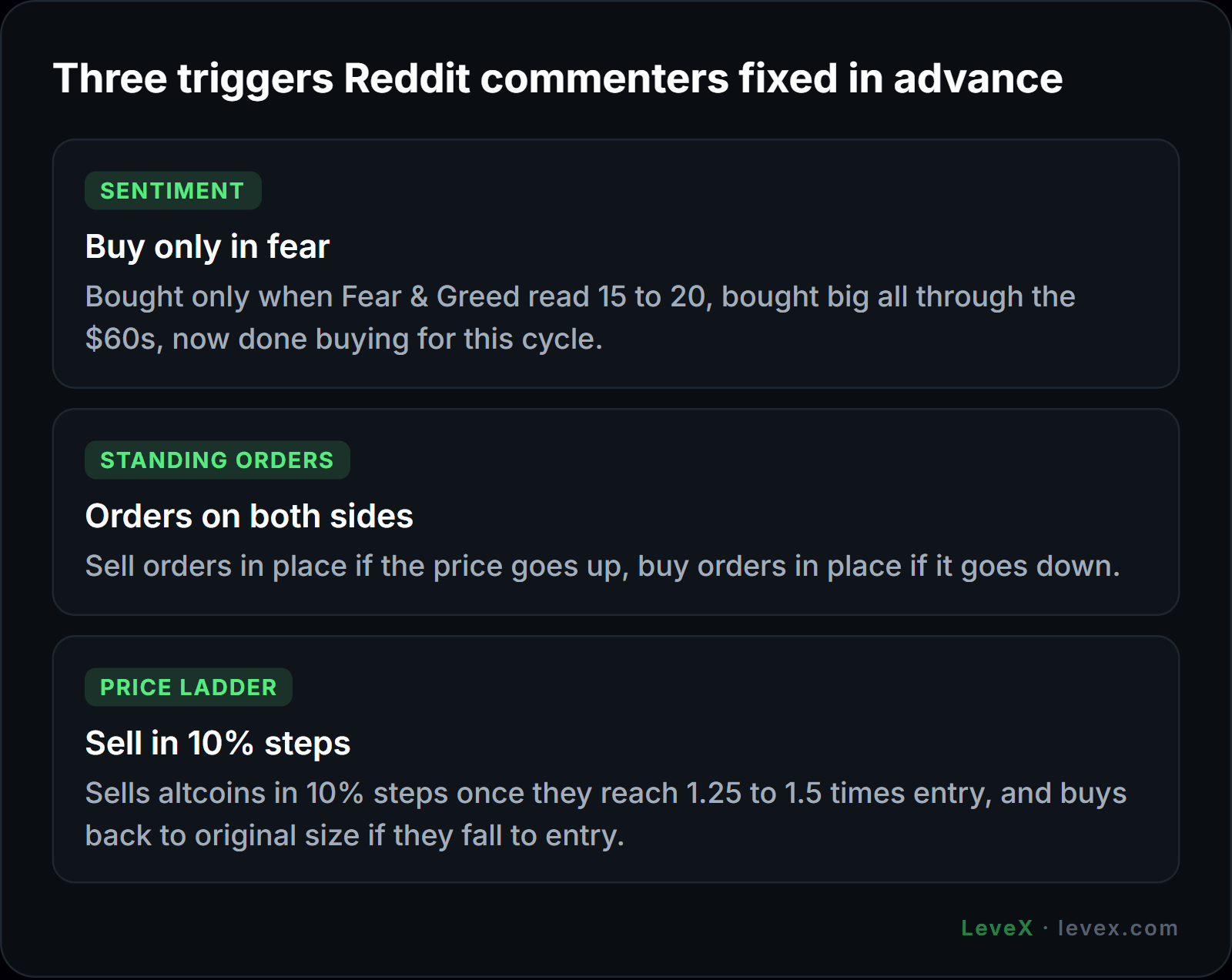
A few commenters had answered it for themselves before anyone asked. One bought only when Fear & Greed read 15 to 20, made "big purchases all throughout the $60s," and is now "done buying for this cycle." Another keeps standing orders on both sides: "If it goes up, I have sell orders. If it goes down I have buy orders." A third sells altcoins in 10% steps once they reach 1.25 to 1.5 times his entry, and buys back to his original size if they fall to where he bought.
The LeveX Take
Cash in reserve is a position, and the poster's has no exit rule. "Wait and hope for a sell-off" can run for a whole cycle, because the market owes nobody a dip back to where they last bought. The commenters who sounded calm had all fixed their trigger in advance, as a sentiment reading, a price ladder or a standing order, while the poster has a feeling about greed and a vague window of "the next couple months."
That points to a better way to hold a reserve: split it by trigger. One part goes in at a set price, entered as a standing order today, another when sentiment reaches fear, and the rest waits for a deeper drawdown with a date by which it goes in regardless. A date keeps patience from turning into sitting out the whole cycle.
For a trader who wants a short-term view on that same sell-off without touching the reserve, Futures Credit is built for a dated window. LeveX pays it out through Quests as bonus capital for futures, used alongside your own margin. It covers up to half of trading and funding fees and absorbs losses up to its value, and any profit is yours. It has to be used within seven days of redeeming and is voided if you move funds out of your futures account, which turns an open-ended wait into a trade with a deadline. Leverage still magnifies losses on your own funds, so size the position for being wrong about the sell-off.
Three Weeks in an 8% Band
Reddit's answer to "what are you doing?" was mostly "nothing new," and the market spent three weeks agreeing with it: an 8.3% range, a 1.4% net move, and sentiment that cooled and then recovered. The poster's sell-off may still come. Even the top of the $60,000s he bought in sits 15% below today's price, so the question the thread leaves him with is whether his reserve has a number attached yet.
For the same crowd's view of their own entry prices, see what Reddit's bitcoin holders actually paid on average. Our guide to dollar-cost averaging for bitcoin beginners covers the schedule-buying habit, and setting take-profit and stop-loss orders on LeveX covers the standing-order one. You can trade BTC on LeveX spot or BTC perpetual futures, and Crypto in a Minute explains the basics in short reads.