
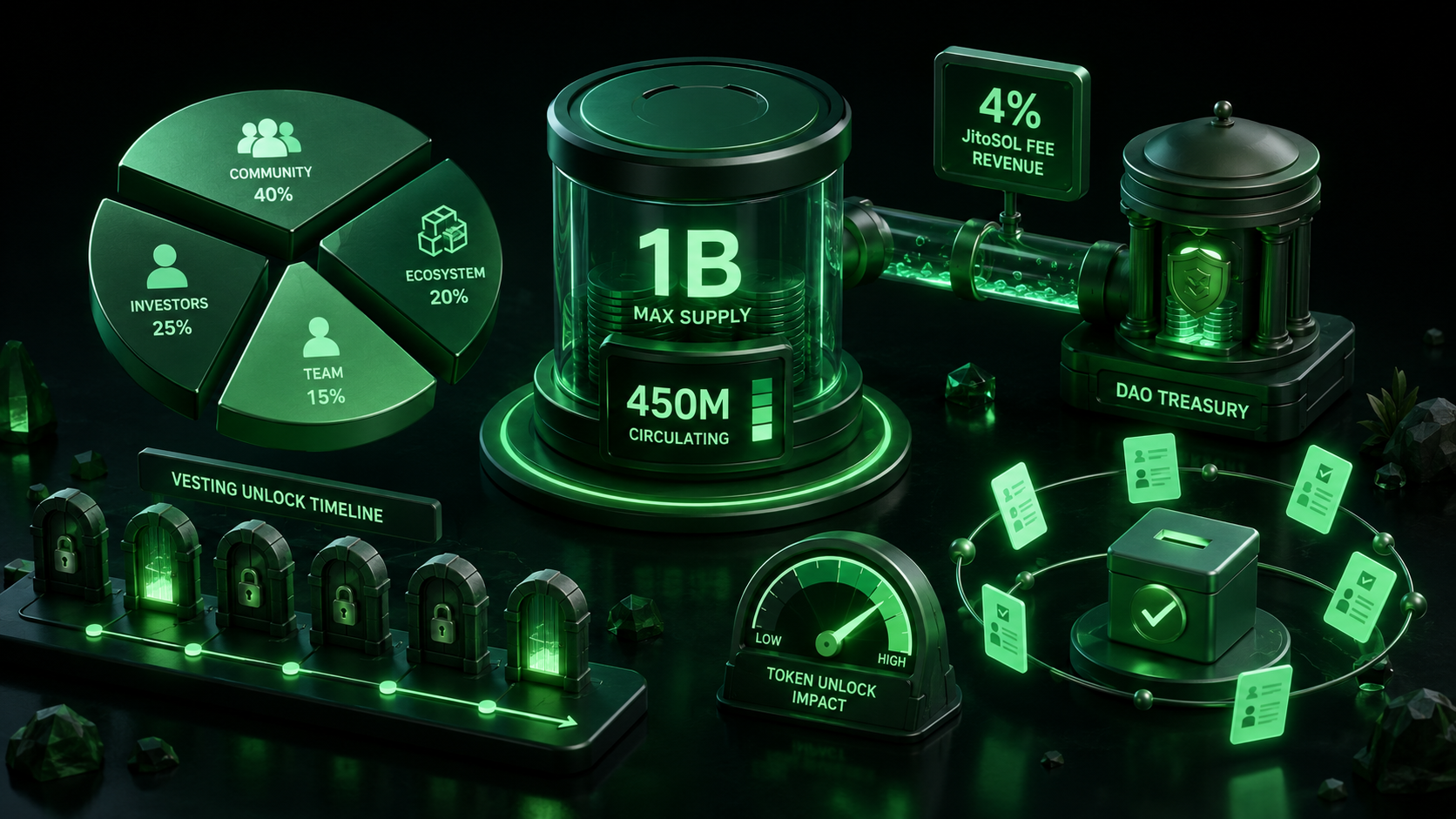
Jito operates on a carefully designed tokenomics framework that determines how JTO tokens are distributed, vested, and used to fund protocol operations. With a 1-billion-token maximum supply and a circulating supply of approximately 450 million JTO as of early 2026, the token allocation directly impacts both immediate price dynamics and long-term governance control.
Total Supply and Allocation Breakdown
Jito's token distribution spans five main categories. According to CoinGecko's Jito profile, the allocation is:
| Allocation | Percentage | Amount (tokens) | Purpose |
|---|---|---|---|
| Community Growth | 34.3% | 343 million | Airdrops, community incentives, participation rewards |
| Ecosystem Development | 25.0% | 250 million | Protocol development, partner integrations |
| Core Contributors | 24.5% | 245 million | Team salaries, operational expenses, talent |
| Investors | 16.2% | 162 million | Venture capital, early supporters, liquidity |
| DAO Treasury + Reserves | ~0% | Funded by protocol fees | Governance treasury, insurance |
Community Growth forms the largest allocation, reflecting Jito's emphasis on rewarding early participants. Ecosystem Development supports infrastructure, while Core Contributors ensures the team has multi-year resources. Investors received stakes through funding rounds with vesting schedules designed to prevent sudden dumps while allowing capital providers to realize returns.
Vesting Schedules and Unlock Timeline
Token vesting follows different timelines depending on allocation category, creating a predictable increase in circulating supply throughout 2026 and beyond.
Community Growth entered with a 50/50 split: half available at genesis (October 2023) and half unlocking linearly over 12 months. The six-year estimated vesting on the remaining allocation extends rewards into 2029.
Ecosystem Development follows a 48-month linear vesting from genesis, unlocking at roughly 5.2% per quarter. This measured pace aligns incentives with long-term ecosystem health.
Core Contributors use similar multi-year schedules (typically four to six years depending on hire date), distributing compensation over timeframes that encourage retention.
Investors experienced their first significant unlock in January 2026, releasing approximately 2.5% of their allocation (4.05 million tokens). According to CryptoRank's vesting tracker, monthly unlock events continue throughout 2026, adding measurable supply pressure traders factor into positioning.
The 4% JitoSOL Fee and DAO Revenue
JitoSOL, Jito's liquid staking derivative on Solana, charges a 4% fee on staking rewards. This fee accumulates in the DAO treasury, creating a direct link between protocol activity and governance resources. Users see a 4% haircut on rewards but receive governance rights and exposure to treasury value appreciation.
JIP-24 fundamentally restructured how Block Engine fees flow to governance. Previously, MEV extraction fees split evenly: 3% to Jito Labs and 3% to the DAO. Under JIP-24's fee redirect proposal, the full 6% plus all future Block Assembly Marketplace (BAM) revenues route to the DAO treasury. This shift gives token holders full control over an estimated $15-50M in annual protocol revenue. The DAO treasury now captures all Jito MEV value extraction, fundamentally changing JTO's cash-flow characteristics.
How Token Unlocks Affect Price Dynamics
Linear vesting creates continuous supply expansion. Each unlock event represents new tokens entering circulation. Markets typically price in expected unlocks weeks in advance, so monthly releases don't necessarily crater prices on execution day. However, large unlocks during bull markets often create volatility as traders reassess risk-reward.
JTO's circulating supply expanded from ~180 million tokens at launch to ~450 million by early 2026, a 150% increase. Despite this dilution, the token has recovered and appreciated from post-launch lows, indicating token holders perceive growing protocol value as offsetting supply expansion. This value comes from increased MEV revenue flowing to the DAO and growing adoption of JitoSOL and Block Engine services.
The real price signal emerges from comparing supply growth to revenue growth. If protocol fees accelerate faster than tokens unlock, each JTO holder's claim on treasury value increases even as total supply dilutes. Conversely, if unlocks outpace revenue growth, JTO holders face negative carry until new revenue sources compensate.
JTO's Role in Solana's MEV Ecosystem
Jito captures the lion's share of Solana's MEV, making JTO a bet on Solana's transaction throughput and validator economics. Block Engine validators earn Jito rewards in addition to Solana's baseline staking yield, incentivizing validators to run Jito infrastructure. This creates a virtuous cycle: more validators running Block Engine → more bundles processed → more MEV → higher JTO treasury value.
Validators who run Block Engine software receive MEV rewards (in SOL), while JTO holders govern treasury deployment. This creates alignment: validators benefit from protocol success, and token holders benefit from validator adoption. Unlike Marinade's approach to staking, Jito's structure directly rewards protocol builders through MEV capture rather than staking participation alone.
Why Jito's Tokenomics Shape Long-Term Value
JTO tokenomics reflect sustainable protocol development funded by recurring revenue rather than token dilution. The JIP-24 shift represents a watershed: instead of VC returns flowing to Jito Labs, 100% of MEV revenues fund community-governed decisions. This balances short-term incentives (community rewards, validator support) with long-term protocol health.
Monthly unlocks from investor and team allocations continue throughout 2026 and into 2027, adding 4-5% to circulating supply each month until vesting cliffs relax. This supply expansion pairs with increasing on-chain activity and revenue, giving JTO holders confidence dilution carries upside.
For traders evaluating JTO price movements, these mechanics matter. Token unlocks create predictable volatility windows; protocol revenue provides value floors; governance determines treasury deployment. Explore how to stake JitoSOL to earn rewards, review the best JTO wallets for secure holdings, or consult the JTO governance and airdrop guide for token holder control context.
Trade JTO on spot markets or explore JTO futures on LeveX. Browse Crypto in a Minute for more token guides.