
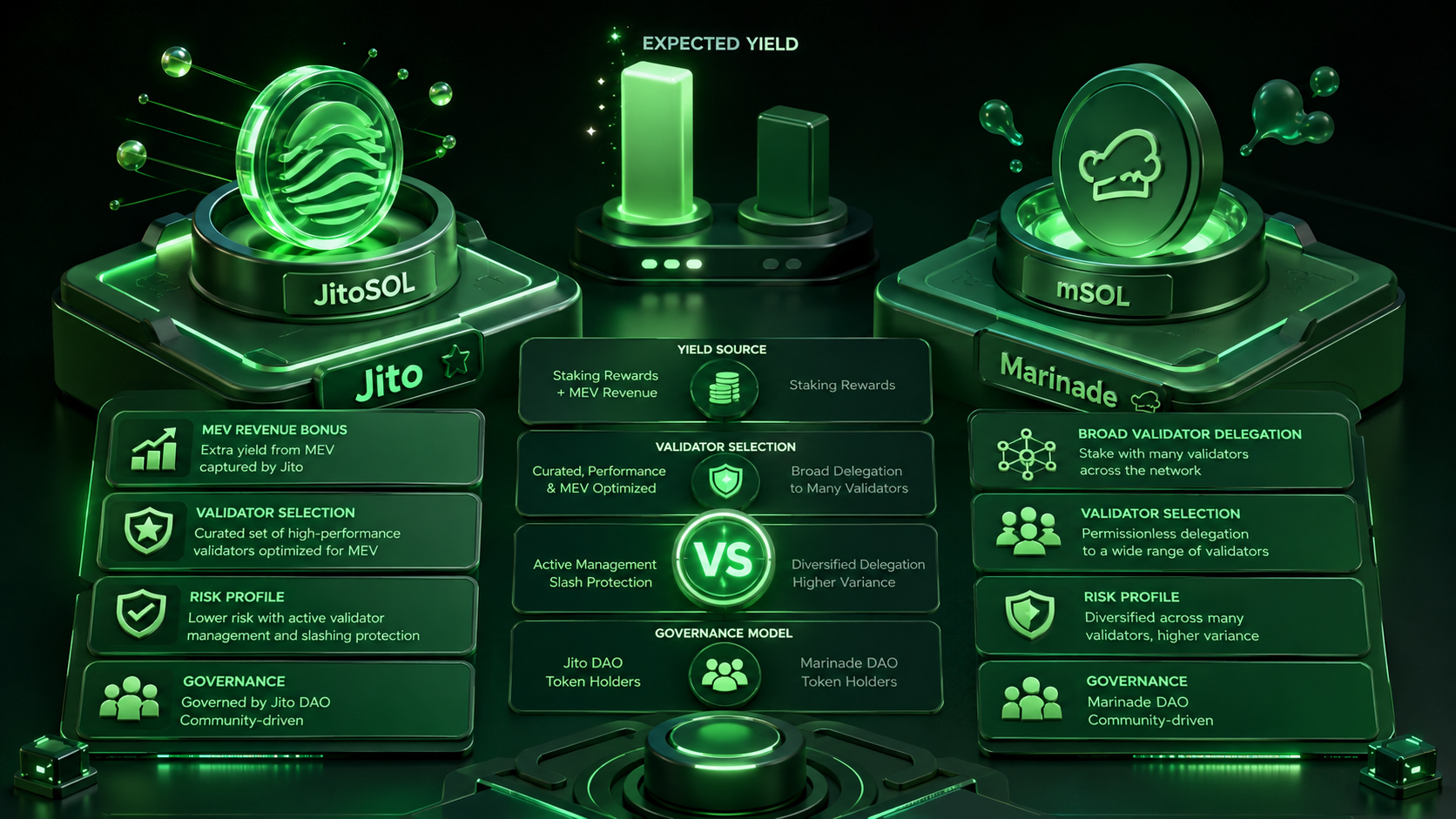
Jito and Marinade Finance dominate Solana's liquid staking market, but they compete through fundamentally different product strategies. Jito focuses exclusively on liquid staking powered by MEV (maximal extractable value) rewards, while Marinade offers a broader ecosystem combining native staking, liquid derivatives, and institution-grade options. Understanding their differences helps traders and stakers choose the right protocol for their goals.
Staking Products: Liquid-Only vs. Native and Liquid
Jito and Marinade address different segments of Solana's staking market through distinct product designs.
| Feature | Jito | Marinade |
|---|---|---|
| Liquid Staking Token | JitoSOL | mSOL |
| Native Staking | No | Yes (Marinade Native) |
| Staking Variants | JitoSOL only | mSOL, Marinade Native, Marinade Select |
| Institutional Product | No | Marinade Select (vetted validators, compliance) |
| Primary Focus | MEV-optimized liquid staking | Multi-tier staking flexibility |
Jito's singular focus on liquid staking through JitoSOL means users get one option: a liquid derivative that captures MEV rewards. Marinade's multi-product approach targets different user segments. Marinade Native appeals to those who want direct validator delegation without wrapping tokens. Marinade Select caters to institutional stakers requiring compliance verification and strict risk controls. This breadth explains why Marinade captured broader market adoption early, while Jito's specialized MEV-centric model attracted traders seeking maximum yield.
Yield Sources and APY Comparison
Both protocols generate yield through base Solana staking rewards, but their total returns differ due to reward composition and fee structures.
Jito's MEV Advantage
Jito liquid staking includes two revenue streams: standard Solana staking rewards plus MEV tips collected by Jito's Block Engine and delegated validators. Over 95% of Solana's active stake runs Jito's client, concentrating MEV flow to the protocol. This MEV component historically boosts JitoSOL yields above base staking rates.
Marinade's Yield Model
Marinade offers higher nominal APYs around 11.8% on mSOL but applies a performance fee. As of February 2026, Marinade moved to a conditional fee model: charges apply only when Marinade's yield exceeds the Solana Staking Index (SSI), a transparent benchmark. Marinade Native staking offers similarly competitive rates without the liquid token premium decay.
Real Yield Comparison
Current metrics show Jito's instantaneous APY around 7.46%, combining staking and MEV rewards. Marinade's mSOL APY typically ranges 9–11%, depending on network conditions and fee calculations. The gap reflects Jito's newer market position and fee structure, though MEV participation can compound significantly over time on Jito. For a practical comparison, check CoinGecko for live APY rates before staking, as both protocols' yields fluctuate with Solana's validator set and network activity.
Validator Selection and Risk Management
Each protocol manages validator risk through distinct strategies.
Jito's StakeNet Approach
Jito delegates SOL to its StakeNet, a curated set of validators optimized for MEV capture and performance. By concentrating stake on validators running the Jito client, the protocol maximizes MEV extraction. This concentration is also a risk: if StakeNet validators underperform or face downtime, JitoSOL holders absorb losses directly.
Marinade's Diversified Delegation
Marinade spreads stake across 400+ validators selected by an open-source formula emphasizing decentralization, performance, and low commission. This approach prioritizes Solana's censorship resistance and network health over MEV optimization. Marinade Select adds a further layer: validators in the Select tier undergo identity verification, maintain bonding requirements, and adhere to ethical MEV behavior standards. This appeals to institutional stakers prioritizing compliance and risk mitigation over yield maximization.
Marinade's Protected Staking Rewards mechanism insures stakers against certain slashing risks. This feature reduces downside exposure, contrasting with Jito's approach of accepting validator-specific risk in exchange for MEV upside.
Governance Tokens and Community Control
Both protocols distribute governance authority through distinct token mechanisms.
| Aspect | JTO (Jito) | MNDE (Marinade) |
|---|---|---|
| Token Type | Pure governance | Governance plus revenue sharing |
| Primary Function | Vote on JIPs (Jito Improvement Proposals) | Vote via veMNDE lock; treasury access |
| Revenue Distribution | 100% of protocol fees to DAO treasury | 50% buyback program; 50% governance allocation |
| Voting Mechanism | JTO holder governance | Locked MNDE (veMNDE) for voting power |
| Treasury Control | JTO holders approve fee allocation | MNDE holders direct treasury use |
JTO governance focuses on protocol parameters: staking fees, validator delegation strategy, and MEV tip distribution. JTO is purely a governance token without yield; revenues flow to a community-managed treasury. MNDE functions as both governance and value accrual: holders lock tokens to gain veMNDE voting rights, and the protocol returns value through a 50% token buyback program rather than direct staking yields.
Market Position and TVL
As of March 2026, Jito has surpassed Marinade in liquid staking TVL following its December 2023 airdrop and subsequent market traction. Jito Liquid Staking commands approximately $1.135 billion in TVL, representing roughly 9.2 million SOL. Marinade's combined TVL across mSOL, Marinade Native, and Marinade Select approaches similar magnitudes, though distributed across three product lines. Marinade Select alone surpassed 3.1 million SOL in TVL by late 2025, signaling strong institutional adoption. Marinade's broader product range captures stakers outside the liquid-staking-focused segment, while Jito's concentrated focus on MEV-optimized liquid staking appeals to yield-focused traders.
Choosing Between Jito and Marinade
Jito and Marinade serve different trader and staker profiles. Jito's approach maximizes yield through MEV participation, making it ideal for yield-focused traders willing to accept validator concentration risk in exchange for higher returns. The protocol's governance structure and 100% fee distribution to the DAO treasury ensure that communities benefit directly from protocol success. Marinade appeals to stakers prioritizing diversification, compliance, and risk mitigation. Its multi-product ecosystem accommodates diverse risk appetites and use cases.
For traders evaluating JTO as an asset, the protocol mechanics inform whether the token's governance value aligns with your strategy. Explore how to stake JitoSOL to understand the yield mechanics firsthand. For insight into JTO's competitive edge, read Jito MEV explained and JTO tokenomics. Check JTO price prediction to assess market sentiment, and secure your holdings with the best wallets for JTO. Explore governance mechanisms with the JTO governance and airdrop guide for comprehensive context.
Ready to trade JTO? Stake JitoSOL on LeveX's spot market or explore JTO futures trading for leveraged exposure. For more token guides, browse Crypto in a Minute.