
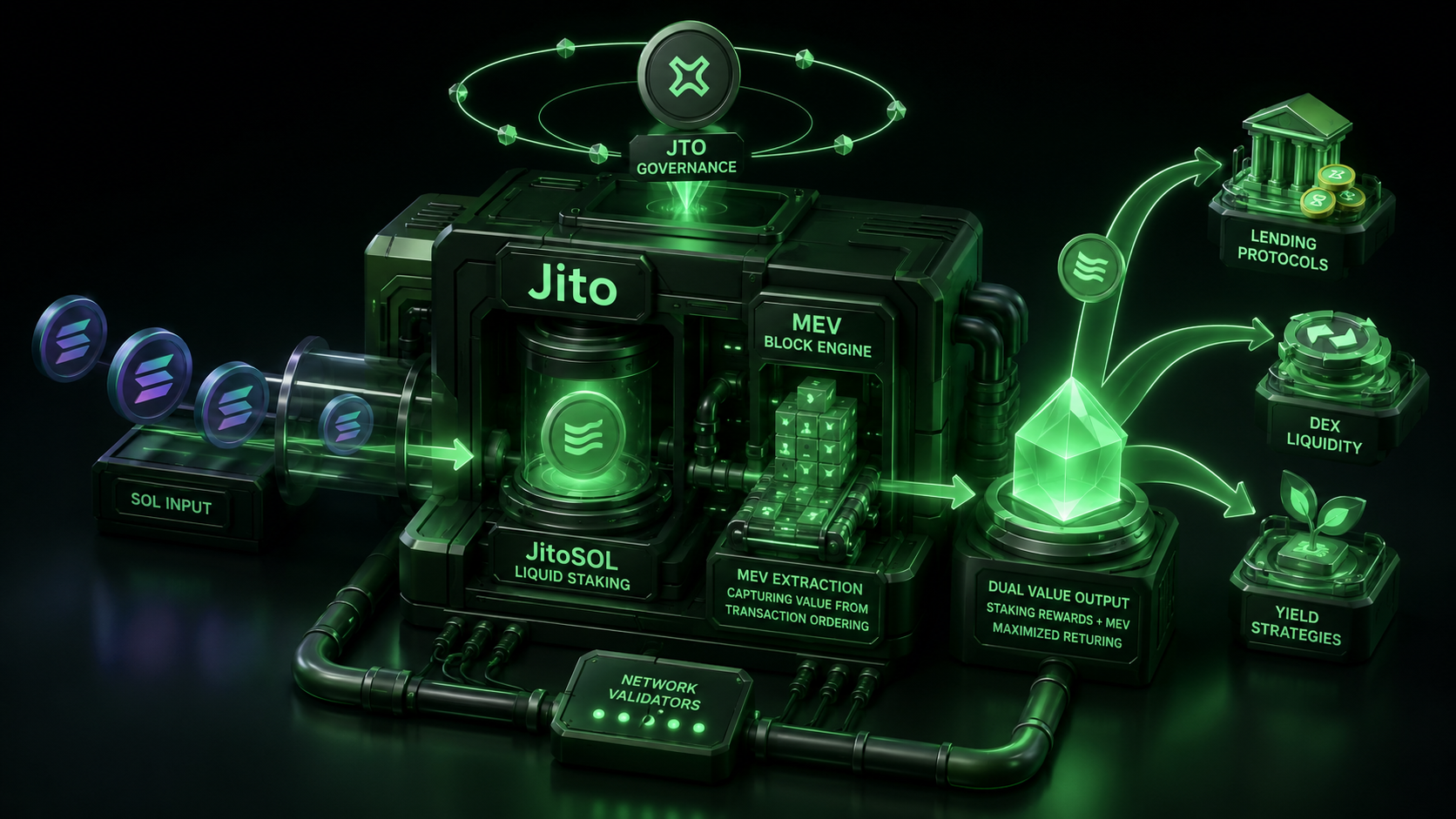
Jito is the dominant infrastructure protocol on Solana, combining liquid staking and MEV (maximum extractable value) optimization into a single ecosystem that has captured over 90% of Solana's staked SOL. According to Jito Foundation data, the protocol operates on two core pillars: liquid staking through JitoSOL, which lets traders maintain liquidity while earning enhanced yields, and MEV infrastructure through the Block Engine and bundling system.
What Is Jito?
Jito is a non-custodial infrastructure protocol solving two critical Solana problems: illiquid staking and inefficient MEV management.
When you stake SOL with Jito, you receive JitoSOL, a liquid receipt token that appreciates as rewards compound. Unlike traditional staking, which locks SOL, JitoSOL remains tradable, usable as collateral, or eligible for further DeFi activity.
Current metrics:
- 14.5+ million SOL staked across Jito's pool (~$2.92 billion TVL)
- 90%+ market dominance in Solana liquid staking
- Over 90% of Solana validators running the Jito-Solana client
The protocol's growth reflects its focus on delivering measurable economic benefits. Jito Labs raised $62 million in total funding, with a recent $50 million round in October 2025.
How JitoSOL Liquid Staking Works
JitoSOL is a reward-bearing token that accrues value simply by sitting in your wallet. When you stake SOL with Jito, you receive JitoSOL at a 1:1 ratio. The token's value increases relative to SOL as rewards compound.
JitoSOL earns from two sources:
Staking Rewards (6-8% annual) flow from Solana's consensus layer. Validators earn SOL for producing blocks, and Jito's stake pool claims a proportional share that distributes to JitoSOL holders.
MEV Rewards (1-3% additional) come from Jito's transaction infrastructure. As documented by Jito Labs, traders and searchers pay fees for bundle prioritization and MEV protection. A portion of these revenues flows to the stake pool, boosting JitoSOL yields beyond standard staking.
This dual-reward structure explains JitoSOL's dominance. Traders get enhanced returns while retaining full liquidity. They can use JitoSOL as lending collateral, sell it on exchanges, or hold it indefinitely while earning compounding rewards.
Jito's MEV Infrastructure
Jito's Block Engine processes Solana transactions through an auction system that reduces harmful practices like sandwich attacks while distributing MEV profits fairly.
Core components:
The Jito-Solana validator client is a modified Solana validator with integrated MEV features. Over 90% of Solana validators now run this client, according to on-chain data.
The Block Engine functions as a transaction marketplace. Searchers and traders submit transactions with bundle tips (fees). The engine simulates every possible transaction ordering, selects the highest-paying combinations, and forwards them to block leaders for inclusion.
Bundles are atomic transaction packages of up to five transactions that execute together or fail together. This guarantee prevents front-running and sandwich attacks. Traders pay tips for bundle priority, creating protocol revenue that flows to JitoSOL stakers.
This infrastructure makes MEV extraction transparent and incentive-aligned. Rather than validators or in-network actors extracting value opaquely, Jito's auction ensures MEV capture is competitive and a portion always returns to the broader community through staker rewards.
The JTO Governance Token
JTO is a pure governance token, not a fee-bearing asset. The 1-billion-token supply was allocated:
- Community Growth (34.29%): Airdropped to early participants
- Ecosystem Development (25.00%): Reserved for partnerships and ecosystem grants
- Core Contributors (24.50%): Team vesting over 3 years with 1-year cliff
- Investors (16.21%): Funding allocations
Token holders vote on Jito Improvement Proposals (JIPs) that control protocol parameters: fee structures, delegation strategies, and treasury allocation. A governance milestone in August 2025 saw JIP-24 redirect 100% of protocol MEV fees to the DAO treasury, rather than founder distributions.
Why Jito Matters for Solana
Jito's impact extends across three dimensions:
Liquid staking dominance: Jito eliminated the choice between earning staking rewards and maintaining liquidity. JitoSOL captures 90%+ of all SOL staking because it delivers both, attracting capital that might otherwise migrate to Ethereum scaling solutions and competing staking mechanisms.
MEV democratization: MEV historically flowed to sophisticated traders and validators. Jito's infrastructure makes MEV extraction accessible to all traders while ensuring a predictable portion returns to the network through staker rewards. This alignment reduces harmful transaction manipulation and improves security.
Validator economics: Jito's revenue from bundles and tips has made validator operations significantly more profitable. This attracted more validators to run the Jito client, improving network decentralization and resilience.
The 2025 Block Assembly Marketplace expansion and filing of VanEck's JitoSOL ETF (the first Solana LST ETF) signal continued institutional adoption and ecosystem deepening.
FAQs
How does JitoSOL compare to solo staking SOL?
JitoSOL offers 1-3% higher APY through MEV rewards plus full liquidity. Solo staking locks SOL and offers only base network rewards. JitoSOL is superior for traders seeking both yield and flexibility.
Why is Jito's MEV structure different from Ethereum's?
Ethereum's MEV mechanisms are primarily captured by block builders. Solana's MEV, through Jito, is distributed more transparently to stakers and the DAO. Additionally, Solana's 400ms block time creates fundamentally different MEV dynamics.
Does JTO earn rewards?
JTO is purely governance. It does not accrue fees or protocol revenue. Rewards flow through JitoSOL. JTO's value derives from governance power and speculative appreciation.
Can retail traders use Jito bundles?
Yes. Jito's infrastructure is available to all traders. Bundling protects against front-running on high-value trades and guarantees transaction ordering, which is valuable for both retail and institutional participants.
Jito as Solana's MEV Foundation
Jito has evolved from a liquid staking solution into the core MEV and validator economic layer for Solana. Its dominance reflects genuine utility: enhanced yields, MEV protection, and infrastructure reliability that competitors haven't replicated.
As Solana's throughput and adoption grow, Jito's role as the primary MEV manager and staking pool becomes more critical. For traders on Solana, engagement with Jito (whether through JitoSOL staking or MEV-protected bundles) is increasingly essential.
Ready to explore Solana's ecosystem? Start by trading JTO spot or trading JTO perpetual futures on LeveX. Discover more foundational guides in LeveX's Crypto in a Minute collection.