
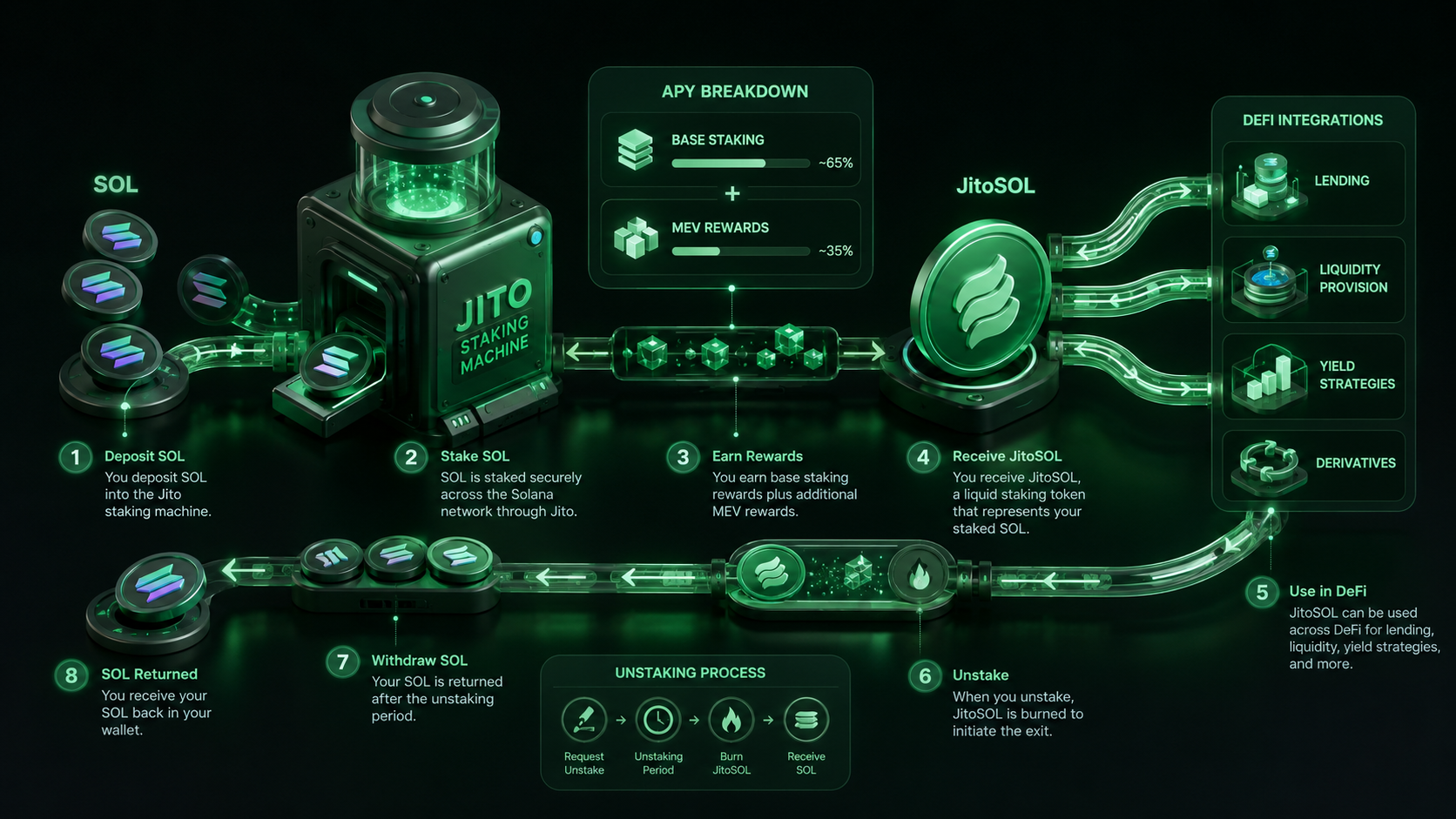
JitoSOL is a liquid staking token that represents your staked SOL while you earn passive income. When you stake SOL through Jito's staking service, you receive JitoSOL tokens at a 1:1 ratio initially, then the token's value grows as you accumulate staking rewards and MEV (maximum extractable value) earnings. Unlike traditional staking that locks your SOL, liquid staking with JitoSOL lets you deploy that capital across DeFi protocols simultaneously, creating multiple yield streams from a single asset.
Solana's blockchain requires a 32 SOL minimum to run a validator node, which puts direct staking out of reach for most traders. Jito's stake pool aggregates deposits from thousands of users, delegating SOL across over 200 validators while distributing rewards proportionally. This setup removes the operational burden while maintaining the security guarantees of Solana's proof-of-stake network.
How to Stake SOL for JitoSOL
The staking process takes just a few minutes and requires only a Solana-compatible wallet:
- Connect your wallet , Visit jito.network/staking and select your wallet (Phantom, Solflare, Magic Eden, or any Solana-compatible option). Approve the connection prompt.
- Enter your staking amount , Input how much SOL you want to stake. There's no minimum beyond what your wallet holds; you can stake 1 SOL or 1,000 SOL. The form shows your JitoSOL output in real time.
- Review the exchange rate , JitoSOL trades at a slight premium to SOL as rewards accumulate. The rate displayed is current; as staking rewards accrue, future JitoSOL will be worth slightly more SOL over time.
- Approve the token transfer , Your wallet will prompt a transaction to approve the Jito program to withdraw SOL from your account. This is a standard Solana security step.
- Confirm the stake , Submit the final stake transaction. Solana's network processes this within seconds.
- Receive JitoSOL , Once confirmed, your wallet displays JitoSOL tokens. Rewards begin accruing immediately and are reflected in JitoSOL's price, not as separate token transfers.
APY Breakdown: Staking Rewards and MEV
JitoSOL's annual percentage yield comes from two sources. Base Solana staking rewards currently hover around 6–8% yearly, paid from network inflation to validators who process blocks. On top of that, Jito's MEV infrastructure captures additional value from transaction ordering and bundle optimization, typically adding 1–3 percentage points.
According to Jito's staking dashboard, JitoSOL's blended APY ranged between 5.89% and 7.46% as of March 2026 depending on network conditions. This variance occurs because Solana's validator rewards fluctuate based on voting participation (higher participation = lower individual validator yield), while MEV depends on network demand and search activity. When Solana experiences high transaction volume, MEV rewards spike. During quieter periods, base rewards dominate.
Unlike staking tokens that mint new tokens daily, JitoSOL accrues value by increasing in price. When you hold 100 JitoSOL, the amount stays constant, but each token becomes worth slightly more SOL as rewards accumulate. This is economically equivalent to receiving daily rewards, but the mechanism is cleaner: rewards are never distributed, they're embedded in the redemption price. This creates a powerful dynamic for DeFi composability. Your JitoSOL maintains constant token count across all protocols you use, simplifying tracking and rebalancing.
The Jito MEV on Solana Explained article dives deeper into how Jito's block engine and searcher ecosystem generate this additional yield. For traders, the practical takeaway is that JitoSOL holders receive MEV rewards automatically without running infrastructure or managing complex positions.
Using JitoSOL in DeFi Protocols
JitoSOL unlocks capital efficiency by letting you earn staking rewards while deploying capital in yield-generating strategies across Solana's largest DeFi platforms.
Kamino Finance offers concentrated liquidity vaults built around JitoSOL, with the JitoSOL-SOL pair being the largest liquidity vault on the platform. Kamino manages the position through active rebalancing and fee compounding, handling the tedium of manual liquidity management. Traders can deposit JitoSOL to earn liquidity provider fees while staking rewards continue accruing in the background, creating a dual-yield strategy.
Meteora launched a stable dynamic pool with JitoSOL-SOL that earns both trading fees and lending fees. The pool rebalances between revenue sources based on demand, optimizing returns without requiring manual intervention.
MarginFi, Solana's largest lending protocol with over 400 million dollars in deposits, accepts JitoSOL as collateral for loans. You can deposit JitoSOL, borrow SOL or other assets, and use borrowed capital for leverage trading or other strategies. MarginFi's loan-to-value ratios are competitive for blue-chip collateral, and borrowing costs are often lower than alternative protocols.
Raydium's concentrated liquidity CLMM pairs frequently include JitoSOL-SOL and JitoSOL-USDC pairs, providing LP fee opportunities and access to Raydium's native incentive programs.
Unstaking and Managing Risk
If you need to convert JitoSOL back to SOL, the unstaking process has a delay due to Solana's protocol design. Initiate unstaking on the Jito website, pay a 0.1% protocol fee, wait for Solana's next epoch boundary (24–48 hours), then claim your SOL. An alternative is selling JitoSOL directly on Jupiter, which gives instant liquidity and bypasses the unstaking fee, though you'll face normal DEX slippage.
Validator slashing is possible if validators behave maliciously, but Jito mitigates this through diversification across 200+ validators. Smart contract risk exists but has become very low after millions in TVL and multiple security audits. Liquidity risk during market stress could increase slippage if you need to sell JitoSOL quickly on DEXes. These risks are statistically low but real, understanding them helps you manage position sizing and holding periods.
For comparison with other liquid staking options, review the Jito vs Marinade Comparison to see how JitoSOL stacks up against alternatives. If you're interested in JitoSOL's price dynamics, the JTO Price Prediction article covers technical analysis and market sentiment. Understanding JTO governance is valuable for long-term staking strategy, read the JTO Governance and Airdrop Guide and JTO Tokenomics Explained for deeper insight into the protocol's direction and token economics.
Building Yield Through Staked SOL
Staking SOL through JitoSOL is one of the most capital-efficient ways to earn yield on Solana. Base rewards of 6–8% already outpace most alternatives, and MEV adds meaningful incremental returns. The liquid staking design unlocks DeFi composability, letting you earn staking rewards while farming yields on Kamino or lending through MarginFi.
For traders holding longer-term SOL positions, the choice between staking and trading is increasingly a false dichotomy. JitoSOL lets you do both simultaneously. As the Solana ecosystem matures, expect staking rewards to compress slightly, but the MEV infrastructure will likely expand, keeping total yields competitive.
Start with the Jito guide for broader context, then explore Best Wallets for JTO if you need guidance on secure storage and trading. Stake SOL on LeveX by trading JTO on spot markets to manage your positions. For leveraged exposure to Jito's success, explore JTO futures on LeveX. Browse the Crypto in a Minute category for guides on other Solana tokens and staking projects.