
The best wallet for SAND depends on what you do with it: MetaMask is the most practical choice for playing The Sandbox and trading LAND, a Ledger or Trezor hardware wallet is the safest place for SAND you plan to hold, and Rabby suits users who move SAND between Ethereum and Polygon often. Whatever you choose, keep SAND on Ethereum or Polygon, the two networks the August 2026 bridge exploit did not touch.
The Sandbox uses SAND as an ERC-20 token on Ethereum, with a bridged version on Polygon for in-game transactions. Any wallet that handles both networks and connects to web apps will work, but the trade-offs between convenience and security differ a lot.
Before You Pick: Which Network Is Your SAND On?
This is the step most new holders skip. SAND exists on several chains, and sending it to the wrong network is the most common way to "lose" tokens that still technically exist.
- Ethereum SAND is the original token. Exchanges usually support it, and it is what you hold if you bought SAND and withdrew it.
- Polygon SAND is the version the game uses for marketplace purchases and was the version used for staking. Fees are a fraction of a cent.
- Base and BNB Chain SAND had their bridges disabled after the August 2026 exploit. Avoid acquiring SAND on those networks until The Sandbox deploys new contracts.
Before every transfer, confirm that the sending network and receiving network match. If you are withdrawing leftover tokens from the old pools, our SAND staking explainer walks through the Polygon steps.
The Best Wallets for SAND
MetaMask: best for playing and trading LAND
MetaMask is the wallet The Sandbox has supported since its earliest LAND sales. It connects to sandbox.game in one click, holds SAND on Ethereum and Polygon, and displays LAND, ESTATEs and ASSET NFTs. It is free and available as a browser extension and mobile app.
The downside is that it is a hot wallet: your keys sit on an internet-connected device, so a malicious approval or a compromised computer can drain it. Use it as a spending account for in-game activity, a role our hot wallet guide explains in more detail.
Ledger and Trezor: best for long-term holding
Hardware wallets keep private keys offline and require a physical button press to sign transactions. Ledger and Trezor both support ERC-20 SAND and work with MetaMask or Rabby as the interface, so you can still connect to The Sandbox while signing on the device.
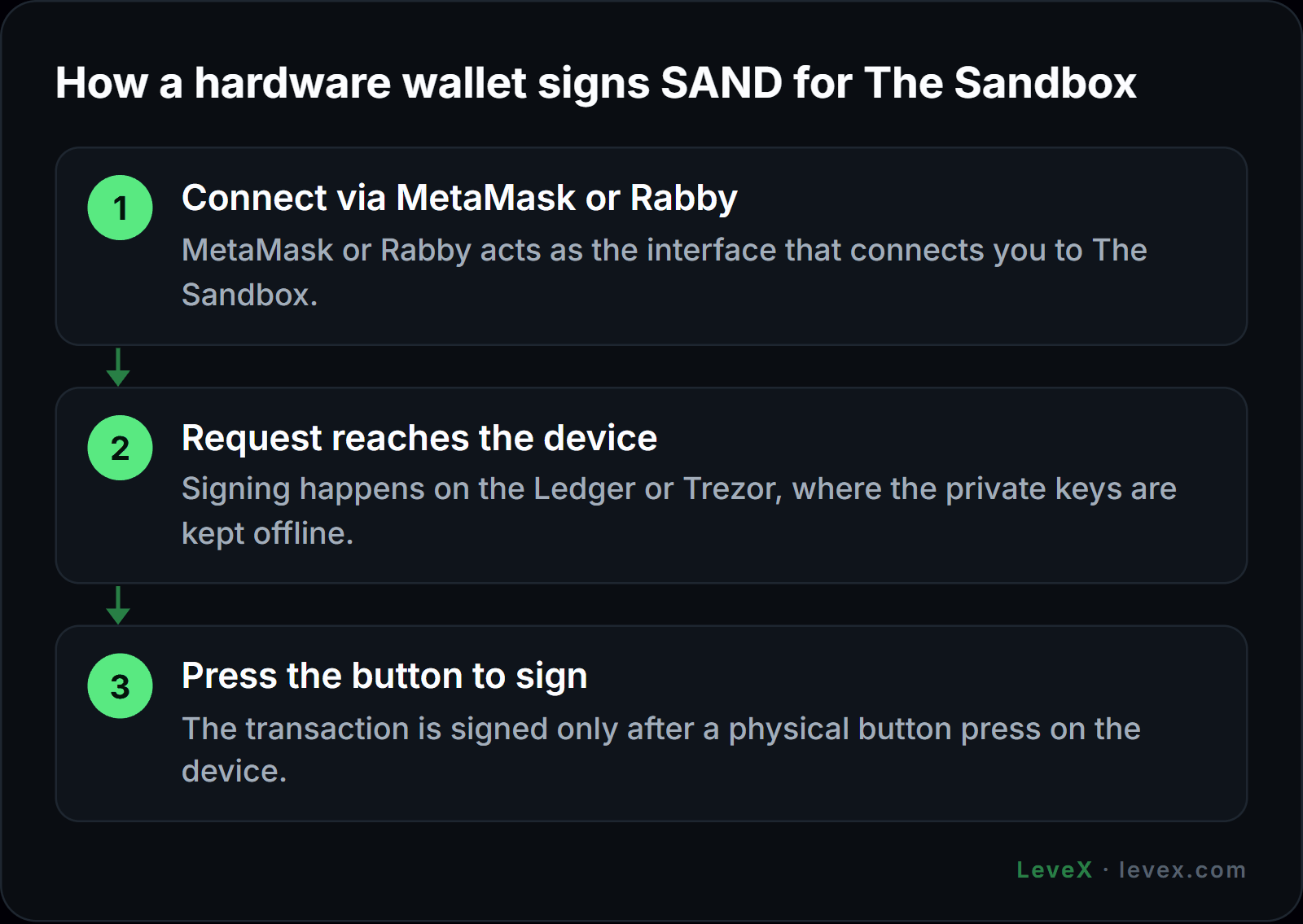
That setup is the right home for valuable parcels too. If you hold Sandbox LAND with real value, a hardware-backed wallet protects the NFT the same way it protects tokens. A device costs roughly $60 to $250.
Rabby: best for multi-chain users
Rabby is a free browser wallet that switches networks automatically and shows a simulation of each transaction before you sign it, flagging risky approvals. It is a strong choice for holders who bridge SAND between Ethereum and Polygon or use DeFi protocols with it.
Quick Comparison
| Wallet | Type | Cost | Best for | Main trade-off |
|---|---|---|---|---|
| MetaMask | Hot (browser, mobile) | Free | Playing, buying LAND | Keys online |
| Ledger | Hardware | ~$80–$250 | Long-term SAND and LAND | Upfront cost |
| Trezor | Hardware | ~$60–$220 | Open-source cold storage | Upfront cost |
| Rabby | Hot (browser) | Free | Multi-chain and DeFi users | Fewer mobile features |
Security Lessons From the 2026 Bridge Exploit
The August 2026 incident did not touch user wallets. An attacker abused a configuration flaw in the Base and BNB Chain bridge contracts to mint unbacked SAND on those chains, and drained about 14.7 million SAND from a bridge vault on Ethereum, according to Cointelegraph. Ethereum and Polygon SAND balances were unaffected, and the unbacked tokens cannot be bridged, so the 3 billion cap described in our SAND tokenomics breakdown still holds for legitimate SAND.
The practical lesson for holders is about bridges and token contracts. Keep SAND on its home networks, check token contract addresses before you accept or buy SAND on a new chain, and treat any "claim" link that arrives by message with suspicion, since exploit headlines bring phishing campaigns. For a deeper look at offline storage, see our cold wallet guide.
How much effort you put into storage should scale with the size of the position. Our SAND price prediction shows how wide the token's range can be, which is a good reason to protect a long-term stack properly.
Frequently Asked Questions
What is the best wallet for The Sandbox?
MetaMask is the most widely used wallet for The Sandbox because it connects directly to the game and holds SAND and LAND on Ethereum and Polygon. Pair it with a Ledger or Trezor for larger holdings.
Can I store SAND on a hardware wallet?
Yes. Ledger and Trezor both support SAND as an ERC-20 token, and you can connect the device through MetaMask or Rabby to use it with The Sandbox.
Do I need a wallet to play The Sandbox?
Not to start. Since Season 7 in February 2026, new players can enter experiences in the browser without a wallet, but you need one to hold SAND, own LAND or claim rewards on-chain.
Matching the Wallet to the Job
Use a hot wallet such as MetaMask or Rabby for the SAND you spend in the game and a hardware wallet for the SAND and LAND you plan to keep, and keep both on Ethereum or Polygon. If you are deciding between metaverse tokens before you store anything, our Sandbox vs Decentraland comparison lays out the differences.
Want SAND without managing keys at all? You can buy it on the LeveX SAND spot market or trade price moves with SAND futures on LeveX. More token guides are in Crypto in a Minute.