
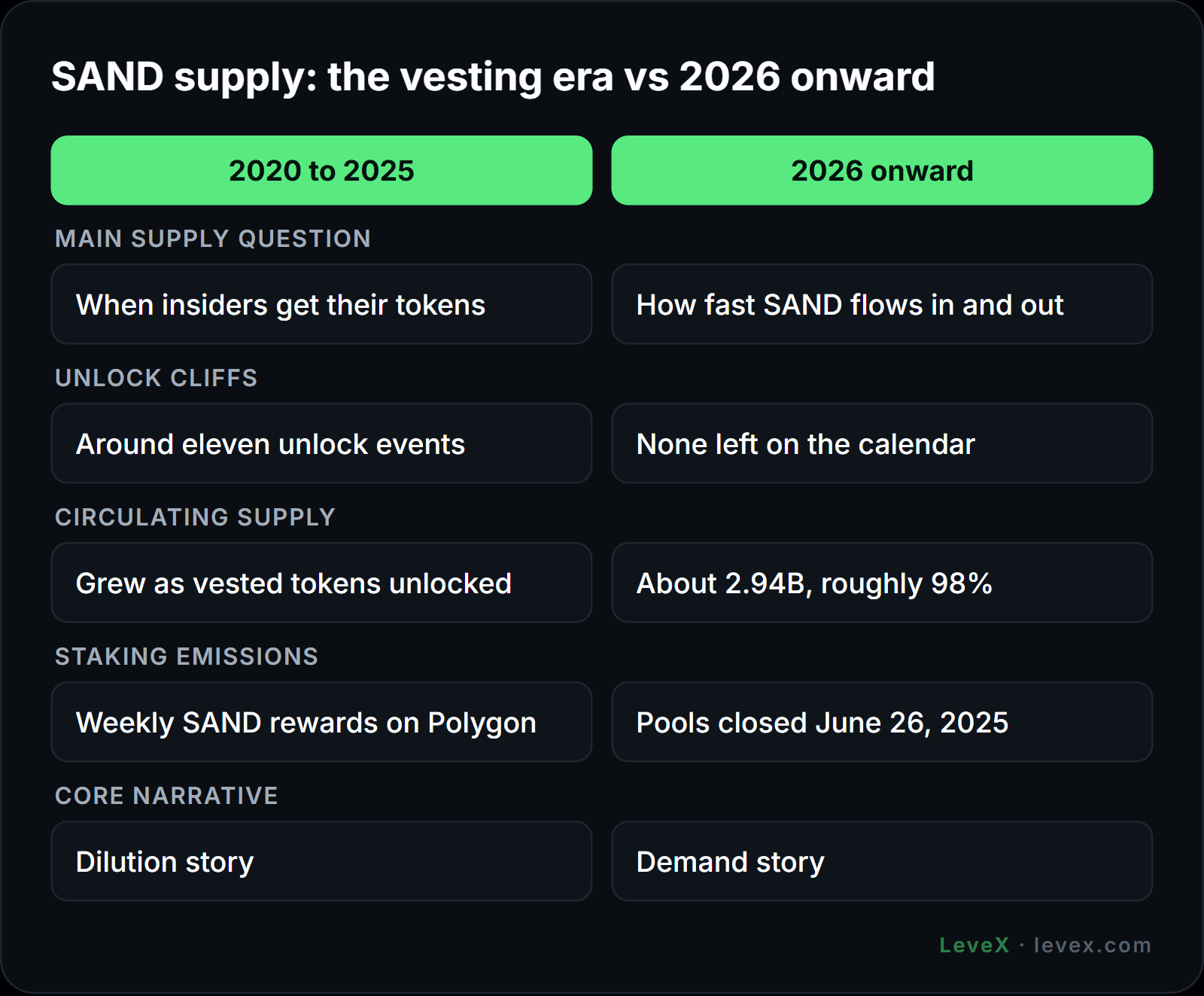
SAND has a hard cap of 3 billion tokens, and as of October 2026 about 2.94 billion (roughly 98%) are circulating, so the token's long vesting era is over. The 3 billion were split across seven buckets at launch, with the company reserve, team and seed investors holding about 62% between them, and the last scheduled unlocks landed in 2025.
That shift changes how The Sandbox (SAND) should be analyzed. For five years, SAND's biggest supply question was when insiders would receive their tokens. From 2026 onward, the questions are how fast SAND flows into and out of the game and what the company does with its treasury.
How Was SAND's Supply Allocated?
The allocation below comes from the original token sale documents, as tracked by Tokenomist. Token counts are calculated from the 3 billion cap.
| Allocation | Share | Approximate SAND | Purpose |
|---|---|---|---|
| Company reserve | 25.82% | 775 million | Operations, partnerships, ecosystem deals |
| Team | 19.00% | 570 million | Founders and employees |
| Seed sale | 17.18% | 515 million | Early private investors |
| Launchpad public sale | 12.00% | 360 million | 2020 public token sale |
| Foundation | 12.00% | 360 million | Grants, creator funds, Game Jams |
| Advisors | 10.00% | 300 million | Strategic advisors |
| Strategic sale | 4.00% | 120 million | Later private round |
Only 12% of supply went to a public sale. Everything else started with the company, its people or its investors, which is typical for a 2020 launch and explains why unlock dates moved the market so much in later years.
The Vesting Schedule, 2020 to 2025
SAND launched in August 2020 with a small float. Team, advisor, reserve and investor tokens then unlocked in large, infrequent cliffs rather than a smooth daily stream. Trackers count around eleven unlock events between August 2020 and August 2025, several of them worth hundreds of millions of SAND at a time.
Those cliffs left a visible mark. In February 2024, for example, a single release of roughly 332 million SAND (about 11% of supply) arrived during a weak market, and SAND weakened in the weeks around it. Unlocks of that size forced the market to absorb large blocks of newly liquid tokens, often from holders with a cost basis near zero. How those supply shocks fed into the chart is covered in our SAND price prediction, which also maps the post-unlock scenarios.
With the schedule finished, roughly 60 million SAND remain outside circulation, and those sit in company-controlled wallets. No future cliff remains on the calendar.
Where SAND Enters and Leaves the Economy
A fixed cap does not mean fixed liquid supply. What matters now is the balance between SAND paid out and SAND spent.
Sources (SAND flowing to users): - Season reward pools, such as the 250,000 SAND pool in Season 6 - Game Jams and creator challenges; one 2025 Builders' Challenge winner earned more than 110,000 SAND - Foundation grants and partner programs
Sinks (SAND flowing back to the company or locked up): - Purchases of LAND, avatars, ASSETs and passes on the marketplace - The 5% marketplace fee on each trade - Planned gas spending on SANDchain, the project's Ethereum Layer 2
Until mid-2025, staking was another source: The Sandbox paid weekly SAND rewards to stakers on Polygon, funded partly by marketplace fees. Those pools closed on June 26, 2025, which removed one of the largest recurring emissions. SAND has no programmatic burn, so fees recycle into the treasury and back out as rewards.
Governance and the Treasury in 2026
SAND carries governance rights. When The Sandbox DAO launched in 2024, SAND and LAND holders could vote on Sandbox Improvement Proposals through Snapshot, and the DAO received a 25 million SAND annual budget. According to a Blockworks token-transparency filing, a proposal in February 2026 paused the DAO and it entered dormant mode on April 1, 2026, with treasury decisions returning to the company.
The treasury faced an unplanned test in August 2026. An attacker exploited SAND's Base and BNB Chain bridge contracts, minted unbacked SAND on those chains and drained about 14.7 million real SAND from an Ethereum vault. The Sandbox committed to repay eligible holders 1:1 in Ethereum SAND from its treasury, as Cointelegraph reported, without minting new tokens. The unbacked tokens on Base and BNB Chain were isolated and cannot be bridged, so the 3 billion cap on legitimate SAND still holds. Current circulating figures are tracked on CoinMarketCap.
Frequently Asked Questions
Is SAND inflationary?
No. SAND has a fixed maximum of 3 billion tokens and no ongoing minting on its main chains. Circulating supply grew for five years as vested tokens unlocked, but that schedule ended in 2025.
Does The Sandbox burn SAND?
The Sandbox has no regular burn mechanism. Marketplace fees go to the company and Foundation, which redistribute them through rewards and grants, so tokens recycle instead of leaving supply.
Who holds the most SAND?
The largest holders are company and Foundation wallets, followed by exchange wallets that custody tokens for customers. Together the team, reserve and seed allocations made up about 62% of supply at launch.
What Fixed Supply Means for SAND Now
SAND's tokenomics have moved from a dilution story to a demand story. No new cliffs are coming, the staking emissions are gone and the cap is intact after the bridge exploit. The open variable is whether SANDchain gas fees and in-game spending can absorb the SAND that Seasons and creator programs keep paying out.
Ready to act on the supply picture? You can buy SAND on LeveX spot, hedge or speculate with SAND futures, or keep learning through Crypto in a Minute.