
The Sandbox leads on creator tools, brand partnerships and event-driven player numbers, while Decentraland leads on decentralized governance and an always-open, browser-first world. As of October 2026 their tokens are almost the same size: SAND has a market cap of about $187 million and MANA about $184 million, so the market treats the two as near equals.
Both projects launched virtual land on Ethereum, both peaked in the 2021 metaverse boom and both lost more than 95% from those highs. Where they differ is in who controls the world, how content gets made and how each token is used.
Two Different Ideas of a Virtual World
Decentraland went live to the public in February 2020 as a social space first. Users walk around a continuous map, visit galleries, concerts and casinos, and the whole world stays open at all times. Most decisions about the platform, from content policies to grant funding, run through the Decentraland DAO, which has controlled key smart contracts since 2020.
The Sandbox took a game-studio approach. Owned by Animoca Brands, it ships creator tools (VoxEdit and Game Maker), signs brand partners and runs curated Seasons where players complete quests for SAND rewards. Its world feels busiest during those Season windows and quieter between them. Governance through The Sandbox DAO started later, in 2024, and was reportedly paused in 2026.
Side-by-Side Comparison
| Feature | The Sandbox | Decentraland |
|---|---|---|
| Token | SAND | MANA |
| Max supply | 3 billion | About 2.19 billion |
| Market cap (Oct 2026) | ~$187 million | ~$184 million |
| LAND parcels | 166,464 | About 90,600 |
| Visual style | Voxel (blocky 3D) | Low-poly 3D |
| Main chains | Ethereum, Polygon | Ethereum, Polygon |
| Content model | Curated Seasons plus creator games | Open world built by landowners |
| Governance | Company-led; DAO paused in 2026 | DAO controls treasury and key contracts |
| Owner | Animoca Brands | Decentraland Foundation and DAO |
SAND vs MANA as Tokens
The two tokens play similar roles: both buy land, wearables and items, and both carry voting power. The differences are in supply history and what holders can do with them.
SAND's vesting schedule ended in 2025, and about 98% of supply now circulates. Its staking program closed in June 2025, a change covered in our SAND staking explainer, so holders earn nothing for holding. The planned SANDchain Layer 2 would make SAND its gas token, adding a new source of demand if it launches.
MANA, tracked on CoinGecko, has about 1.94 billion tokens circulating out of roughly 2.19 billion. Decentraland burned MANA spent on land in its early sales, and MANA holders vote directly on DAO proposals, which keeps governance utility alive in a way SAND currently lacks. For the full SAND supply picture, see our SAND tokenomics breakdown.
On price, both trade as high-beta proxies for metaverse sentiment. They tend to rally and fall together, and project-specific news (such as The Sandbox's August 2026 bridge exploit) creates temporary gaps between them. Our SAND price prediction covers the scenarios for the SAND side.
Land, Users and Activity
The Sandbox's map is larger, with 166,464 parcels against roughly 90,600 in Decentraland, and both have seen land floors collapse from the 2021 peak. In 2026, cheap parcels in each world trade for tens of dollars rather than thousands. How The Sandbox's parcels and ESTATEs work is covered in our guide to Sandbox LAND.
User numbers are the most disputed metric in this comparison. In October 2022, on-chain data showed only 38 daily active wallets for Decentraland and around 522 for The Sandbox, a figure CoinDesk reported under the headline that the metaverse was lonely. Both projects pushed back, as Blockworks covered, arguing that most visitors never touch a smart contract. Decentraland cited about 8,000 daily users, and The Sandbox reported tens of thousands during Seasons. The Sandbox now claims more than 8 million registered users and 400,000 creators, but registered accounts say little about daily engagement.
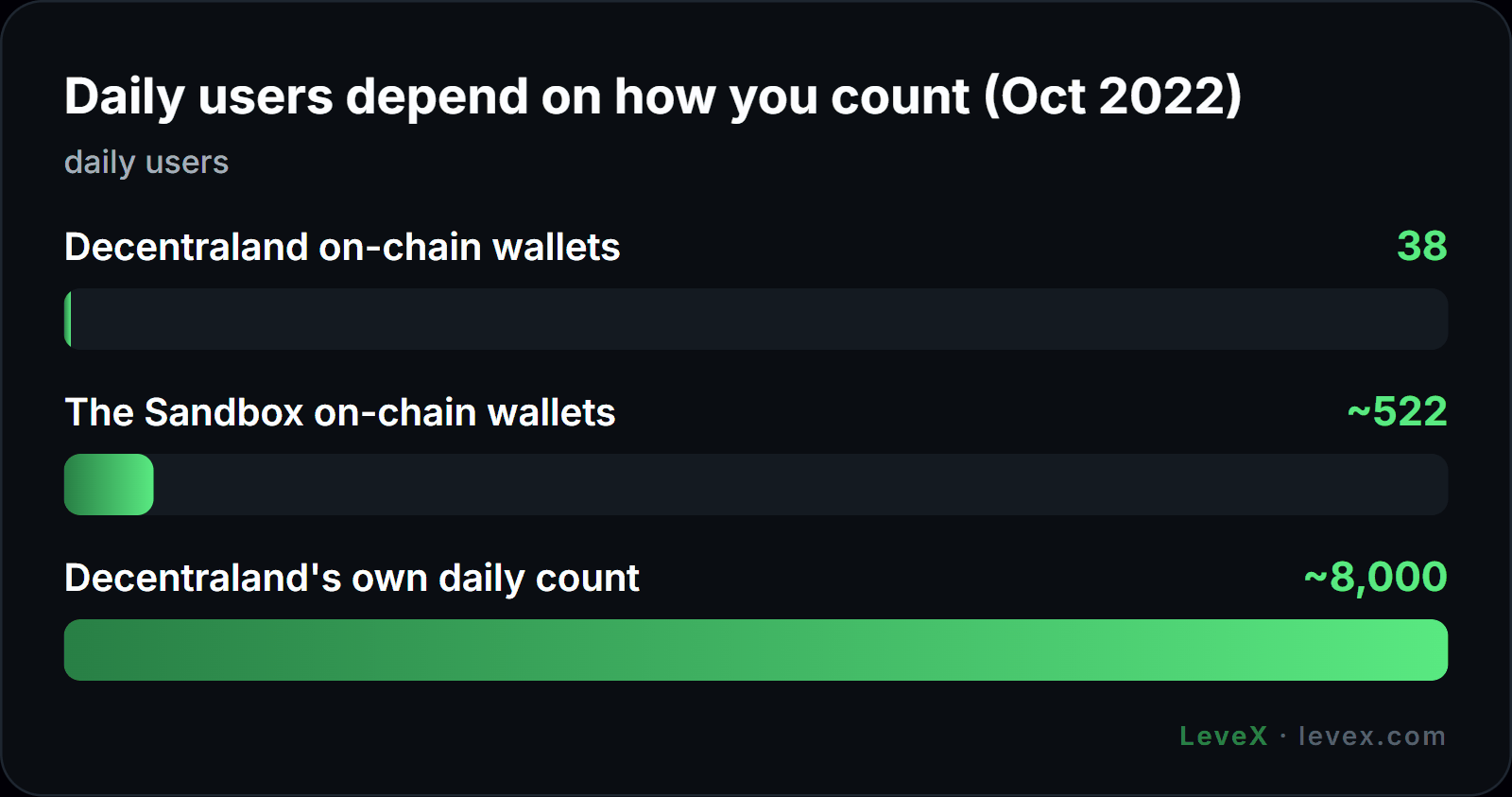
The practical reading: The Sandbox draws bigger, spikier crowds around Seasons; Decentraland has a smaller, steadier social community.
Which One Suits Which Trader?
- Prefer SAND if you want exposure to a specific catalyst (SANDchain) and to a company that can move fast and sign big partners.
- Prefer MANA if you value working DAO governance and a project whose direction does not depend on one corporate owner.
- Treat both as a pair if your view is on metaverse sentiment as a whole, since their correlation is high and their market caps are nearly identical.
Frequently Asked Questions
Is The Sandbox bigger than Decentraland?
By market cap they are almost tied, at roughly $185 million each as of October 2026. The Sandbox has a larger map, more registered users and more brand partners, while Decentraland has a longer-running DAO.
Which is cheaper to buy land in, The Sandbox or Decentraland?
Entry-level parcels in both worlds cost tens of dollars in 2026, with floors moving in a similar range. Location matters more than platform, since parcels near popular districts sell at a premium in each.
Can you use SAND in Decentraland?
No. SAND works only inside The Sandbox ecosystem and MANA only inside Decentraland. You would need to trade one for the other to move between the two economies.
Choosing Between Two Metaverse Veterans
The Sandbox and Decentraland reached the same market value from opposite directions: one through a company-run studio model, the other through community governance. SAND carries the clearer near-term catalyst in SANDchain, and MANA carries stronger holder rights.
If SAND is your pick, LeveX lists the SAND/USDT spot pair for direct buys and SAND/USDT perpetual futures for leveraged or short positions. More head-to-head explainers live in Crypto in a Minute.