
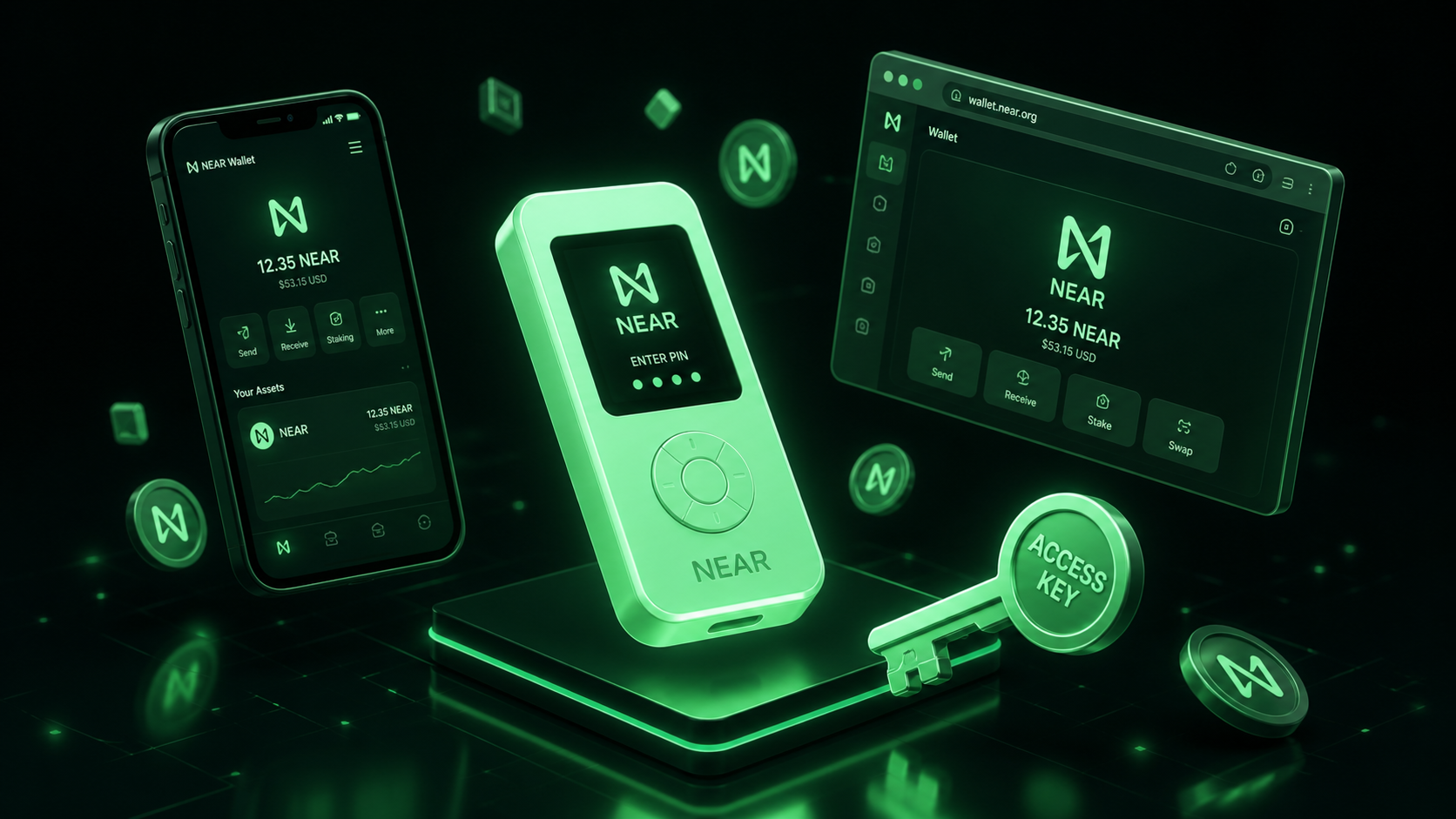
Meteor Wallet is the practical default for daily use on NEAR, a Ledger device paired with MyNearWallet is the standard for long-term storage, and HOT Wallet dominates mobile by transaction count. All three support staking natively, and none of them lock you in, because a NEAR account is a name rather than a key.
That last detail is the one that makes NEAR wallet selection different from every other chain. Your account survives the wallet you chose to open it with.
The Options at a Glance
| Wallet | Form factor | Best for | Native staking | Hardware pairing |
|---|---|---|---|---|
| Meteor Wallet | Browser extension and mobile | Everyday dApp use | Yes | Yes |
| MyNearWallet | Web | Recovery and Ledger workflows | Yes | Yes |
| HOT Wallet | Telegram mini-app and mobile | Mobile-first, low friction | Yes | No |
| Bitte Wallet | Web, multichain | Cross-chain accounts | Yes | Partial |
| Ledger device | Hardware | Long-term storage | Through a paired wallet | Not applicable |
What Each One Is Good At
Meteor Wallet
Meteor has become the NEAR-native browser extension most active users reach for, with a mobile companion app and a clean staking interface that lists validator pools with commission and uptime side by side. It handles NFTs, connects reliably to NEAR dApps through the standard wallet selector, and supports Ledger pairing for users who want hardware signing without leaving the extension. For anyone who intends to actually use applications rather than hold, this is the sensible starting point.
MyNearWallet
MyNearWallet is the web wallet that carried forward the functionality of the original NEAR Wallet after it was retired. It is the most reliable path for Ledger users, exposes access key management directly, and remains the tool of choice when recovering an account or auditing which applications hold function-call permissions on it. The interface is plainer than the alternatives, and the transparency is the point.
HOT Wallet
HOT Wallet is a Telegram-native wallet that generated roughly 28 million NEAR transactions in Q2 2026, about 65% of the network's total across 291,000 users, according to Nansen's quarterly data. Onboarding takes seconds inside a chat app, which explains the numbers. That convenience comes with the usual caveat for custody inside a messaging platform, so treat it as a spending wallet rather than a vault.
Bitte Wallet
Bitte leans into NEAR's chain signatures, letting one NEAR account control addresses on other chains and sign transactions there without separate seed phrases. If you use NEAR Intents for cross-chain swaps regularly, a multichain-native wallet removes several steps from the workflow.
Ledger Hardware
A Ledger device keeps signing keys offline and is the appropriate choice for balances you intend to hold through a cycle. Route it through MyNearWallet or Meteor for staking and dApp access. Ledger's own wallet interface added NEAR Intents-powered cross-chain swaps via SwapKit in 2026, so hardware users can move between more than 30 chains with on-device confirmation of destination and amount.
Why NEAR's Account Model Changes Wallet Choice
On most chains, your address is derived from your key. Lose control of the key and the address is gone; switch wallets and you carry the same key with you.
NEAR separates the two. An account like alice.near holds a set of access keys, each with its own permissions, and any key can be rotated or revoked without touching the account or its balance. Three consequences follow for wallet selection.
Full-access keys and function-call keys do different jobs. A function-call key can be scoped to one contract with a fixed gas allowance, which is how NEAR apps let you click through a session without approving every action. Reviewing which of these you have granted is basic hygiene, and MyNearWallet exposes the list plainly.
Switching wallets is not a migration. Add a key from the new wallet, remove the old one, and your account, balance, staking delegations, and NFTs stay exactly where they were. Nothing needs to be transferred.
Key rotation also made NEAR's post-quantum upgrade painless. When the protocol added the NIST-approved FIPS-204 signing scheme in 2026, existing accounts could move to quantum-safe keys through a single rotation, and hardware wallet makers are working through support for the larger signature sizes involved.
Matching a Wallet to How You Use NEAR
Long-term holders should be on hardware. If your NEAR position is a multi-year view on the network rather than a trading position, and if you have read NEAR's price outlook and concluded you are holding through volatility, a Ledger paired with MyNearWallet gives you cold storage that still stakes.
Active users want Meteor. Frequent dApp interaction, NFT activity, and validator switching all favor a browser extension with a good staking tab and reliable dApp connections.
Mobile-first users get HOT, with limits. Keep the balance you actively spend there and hold the rest elsewhere.
Whichever you choose, the running cost is negligible. NEAR fees are fractions of a cent and 30% of every gas fee is rebated to the contract that was called, a structural quirk of NEAR's tokenomics that keeps application-level costs low regardless of which wallet signs the transaction.
Frequently Asked Questions
Which NEAR wallet supports staking?
Meteor Wallet, MyNearWallet, HOT Wallet, and Bitte all support native staking, and each lets you delegate to a validator pool directly from the interface. Hardware users stake by pairing a Ledger device with Meteor or MyNearWallet. The mechanics are identical across all of them, since delegation happens at the protocol level. Full detail is in the guide on how to stake NEAR.
Can you store NEAR on a Ledger?
Yes. Ledger devices support NEAR through Ledger Live and through third-party interfaces including MyNearWallet and Meteor Wallet, which lets you stake, hold NFTs, and interact with applications while every signature happens on the device.
What happens if you lose access to your NEAR wallet?
Because NEAR accounts hold multiple access keys, you can recover an account using any remaining full-access key, and you can add a backup key from a second wallet in advance. If every full-access key is lost, the account is unrecoverable, so adding a second full-access key from a different device is worth doing before you need it.
Custody Decisions Are Cheap to Get Right
NEAR makes the wallet decision less permanent than most chains do, which lowers the cost of starting somewhere reasonable and adjusting later. Add a key, remove a key, and the account carries on. That flexibility is worth using deliberately: a hardware key for the balance you are not touching, a hot wallet key for the balance you are, and a periodic review of the function-call keys applications hold on your account.
The one decision that stays expensive is leaving a large balance in a custodial or messaging-app wallet because it was convenient to set up. Convenience and custody pull against each other, and the split-key approach is how you get most of both.
For the portion of your NEAR exposure that belongs in a trading account rather than cold storage, NEAR spot pairs on LeveX and NEAR perpetual futures cover long and short views alike. Wallet guides for other networks sit in Crypto in a Minute.