
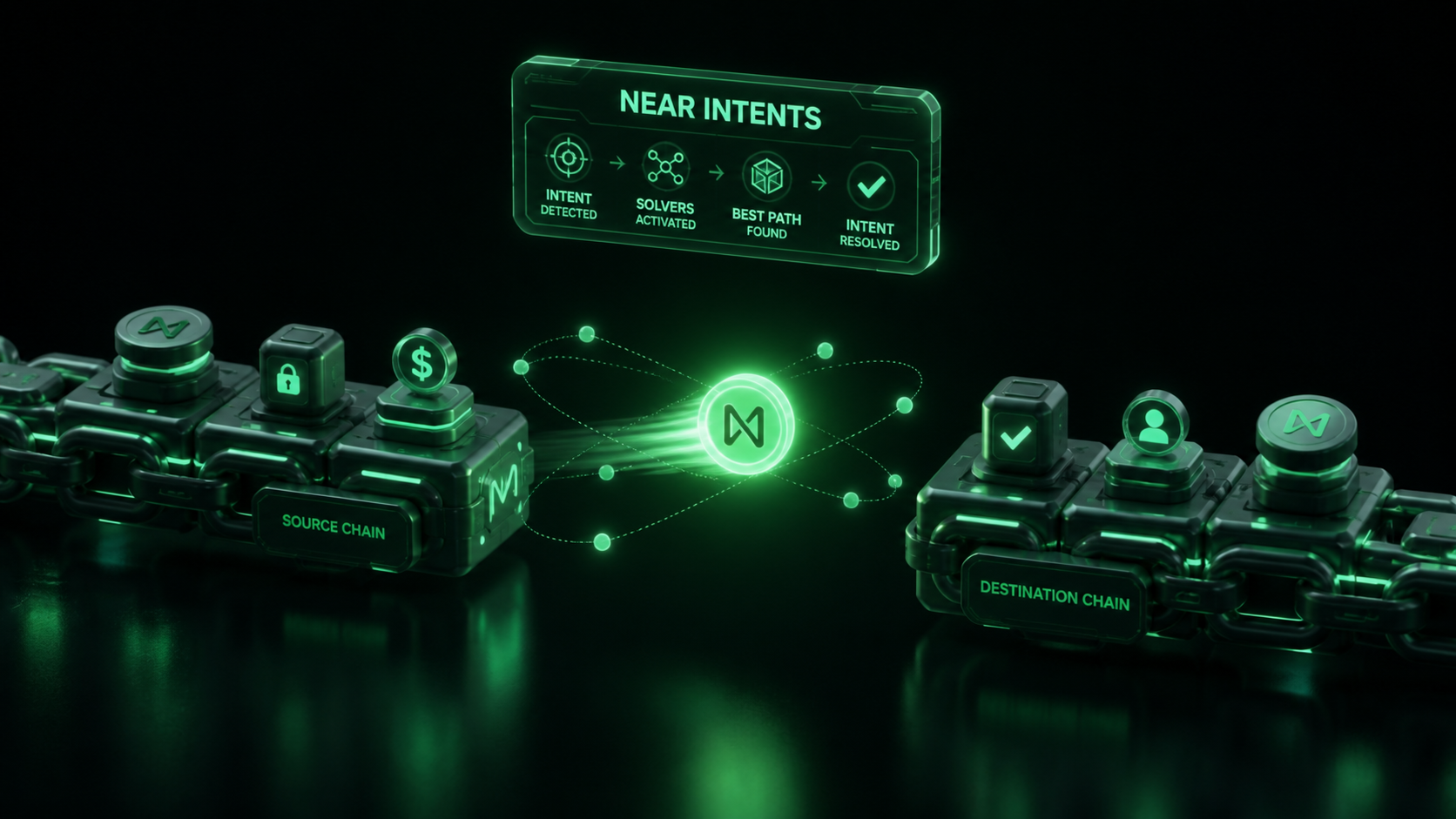
NEAR Intents is NEAR Protocol's cross-chain settlement layer, where a user declares the outcome they want and a network of competing solvers delivers it. Swapping Bitcoin for a Solana token takes one signature, settles in roughly 30 seconds, and never touches a bridge contract. Cumulative volume passed $24 billion across 34 chains by August 2026, up from $5 billion nine months earlier.
The design borrows from order routing in traditional markets. You do not tell a broker which venue to use; you say what you want to end up holding, and someone competes for the right to fill it.
How an Intent Becomes a Settled Swap
The flow has four steps, and the user only participates in the first and last.
- You declare an outcome. Send 1 ETH on Ethereum, receive USDC on Solana. No route, no bridge, no gas token on the destination chain.
- Solvers quote. Independent market makers holding inventory across chains compete to fill the request, each returning a price. The best quote wins.
- The verifier settles. A contract on NEAR enforces atomicity: every leg of the swap completes, or none of them do. Partial fills do not exist here, which removes the half-bridged-asset failure mode that has cost users heavily elsewhere.
- You receive the asset. Typically in about 30 seconds, depending on destination chain finality.
Solvers absorb the inventory risk and the bridging complexity, and they price it. Competition among them is what keeps the spread honest, so the quality of an intent system tracks the depth of its solver network more than anything in its documentation.
From $5 Billion to $24 Billion in Nine Months
The volume curve has roughly doubled at every checkpoint since late 2025.
| Milestone | Cumulative swap volume |
|---|---|
| November 2025 | $5 billion |
| January 2026 | $10 billion |
| June 2026 | $20 billion |
| August 2026 | Over $24 billion |
Growth came from distribution rather than from users seeking the protocol out. SimpleSwap, a self-custodial aggregator with over 10 million users, wired NEAR Intents into its liquidity provider network. Ledger's wallet UI routes cross-chain swaps through it via SwapKit, letting hardware wallet holders move between 30-plus chains with on-device confirmation and no manual bridging. Sui integrated it for inbound liquidity. Most of the people using NEAR Intents in 2026 have no idea they are using it, which is the point of chain abstraction.
Coverage now spans 34 chains and more than 100 assets, according to reporting on the $20 billion milestone. Fees collected are used to buy NEAR on the open market, which is the mechanism connecting swap volume to token demand.
Confidential Intents and the Private Shard
The March 2026 addition routes trades through a dedicated private shard operated by permissioned validators, connected to NEAR mainnet through a trusted execution environment bridge. Token pair, size, direction, and timing stay hidden from the public chain.
The target is MEV. A large swap visible in a public mempool invites frontrunning and strategy copying, which is a reason size migrates to centralized venues. NEAR's approach leans on TEE hardware rather than zero-knowledge proofs, so users skip client-side proof generation entirely, and the system supports selective disclosure for institutions that need an audit trail. NEAR's technical breakdown of confidential intents walks through a demonstration where 0.1 ETH moved from a confidential NEAR account to an Ethereum address with no visible on-chain link between the two.
Adoption has been quick. Confidential TVL crossed $30 million during Q2 2026, and 42% of swap volume on near.com now runs privately by default, per Nansen's quarterly review.
Where the Risk Actually Sits
Atomic settlement removes bridge risk, and it does not remove every risk. Three deserve attention.
The dependency surface is wide. In April 2026 a zero-day bug in Litecoin created roughly $600,000 of exposure through NEAR Intents, and the team covered the losses. The failure originated on a connected chain rather than in NEAR's own contracts, which is the structural cost of touching 34 networks: you inherit a slice of each one's problems.
Solver concentration matters for pricing. If a handful of firms provide most inventory on a given route, quotes on that route reflect their appetite rather than a competitive market. Thin pairs behave worse than headline volume suggests, and the honest test is quoting the size you actually intend to trade.
Confidential mode substitutes one trust assumption for another. TEE hardware from Intel and NVIDIA is trusted rather than verified through mathematics, and side-channel attacks against enclaves are a live research area. That trade buys speed and usability, which for most swap sizes is a reasonable exchange, though it deserves stating plainly.
Frequently Asked Questions
Is NEAR Intents a bridge?
No. Bridges lock an asset on one chain and mint a wrapped claim on another. NEAR Intents matches you with a solver who already holds the destination asset, and a verifier contract settles both legs atomically, so no wrapped representation is created and no bridge contract holds pooled funds.
How long does a NEAR Intents swap take?
Around 30 seconds for most routes. The variable is destination chain finality, so a swap terminating on a fast chain settles quicker than one landing on Bitcoin, where confirmations take longer.
Do I need NEAR tokens to use NEAR Intents?
No. Gas abstraction lets fees be paid in the asset you are already holding, and the multichain gas relayer covers the destination side. Fee revenue is used to buy NEAR on the open market, so the token benefits from volume without users having to hold it.
Why Intents Change What a Chain Competes On
For most of a decade, chains competed on where liquidity lived. Intent settlement moves the competition to who can route across all of it fastest and cheapest, which suits a network that treats other chains as peripherals rather than rivals. NEAR's account model, cheap blockspace, and MPC signing were built for exactly that job, and the volume curve suggests the thesis is landing.
The number worth tracking is not cumulative volume, which only goes up, but the fee capture rate and confidential TVL. Those measure whether the system converts routing activity into value for the token, and both were climbing through Q2 2026. Cross-chain aggregation is a competitive category, and durable share goes to whoever holds solver depth as the field crowds.
Trading the thesis is simple enough: NEAR spot pairs give you direct exposure, NEAR perpetuals add leverage in either direction, and Crypto in a Minute covers the projects NEAR now settles against.