
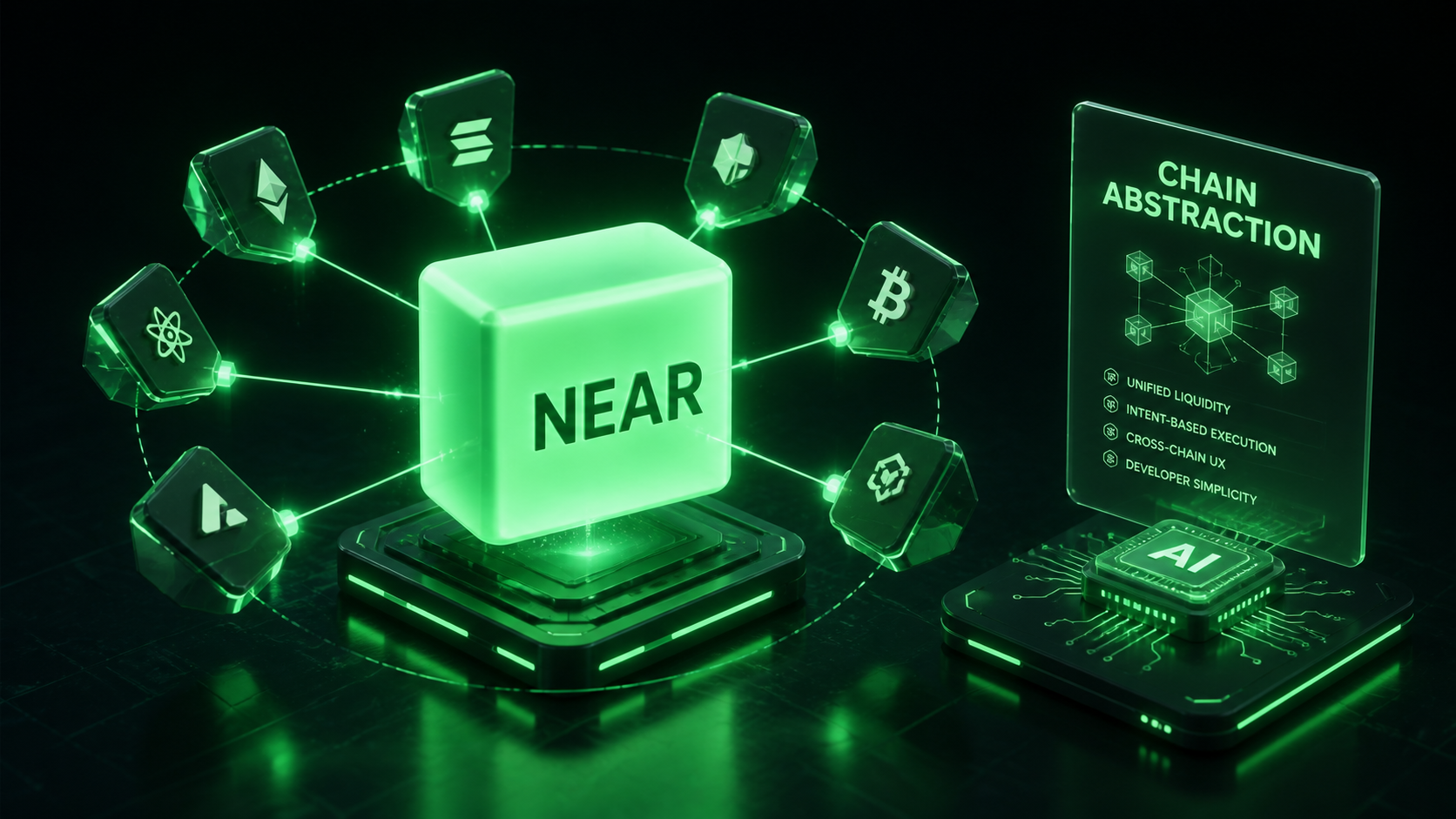
NEAR Protocol is a sharded proof-of-stake layer 1 blockchain whose native token, NEAR, pays for gas, secures the network through delegated staking, and settles cross-chain swaps through a system called NEAR Intents. Mainnet launched in April 2020. As of August 2026 the network runs nine shards that split and merge on their own as demand shifts, averages around 121,000 daily active addresses, and carries a market capitalization near $2.5 billion.
The project started life as an artificial intelligence company, and that detail explains most of what it has built since.
From Program Synthesis to a Sharded Blockchain
Illia Polosukhin and Alexander Skidanov founded NEAR.ai in 2017 to teach machines to write code from plain-language descriptions. Polosukhin had spent three years at Google Research, where he co-authored "Attention Is All You Need," the paper that introduced the transformer architecture sitting underneath every large language model in production today.
The AI work hit a payments problem. Paying thousands of contributors small amounts across dozens of countries was slow and expensive through banks, so the founders looked at blockchains, found the developer experience unusable, and decided to build the chain they wanted instead. Mainnet shipped in April 2020, and control passed from the founding team to the validator set in October of that year.
Skidanov brought the sharding thesis. He had worked on distributed database internals at MemSQL, and the 2019 Nightshade whitepaper reads more like database engineering than cryptography: split the state, split the workload, and keep a single logical chain on top so applications never have to think about which shard they live on.
Nightshade Sharding, and What Changed in 2026
Most chains scale by asking validators to buy bigger machines. Nightshade splits the state into shards and gives each validator responsibility for a slice, which means capacity grows by adding participants rather than hardware.
Stateless validation
The version shipped as Nightshade 2.0 removed the requirement that a validator store the full state of the shard it secures. Each block carries a compact state witness proving only the slice a chunk touches, so any validator can verify work without holding the entire trie locally, as the protocol team documented at launch. Decoupling validation from storage is what let the network expand from six shards to nine in late 2025 without pushing validator hardware requirements up.
Dynamic resharding
Shard boundaries used to be a governance decision. The v2.13 upgrade in June 2026 handed that job to the protocol: when a shard's state crosses a size threshold, the network splits it at the next epoch boundary and merges underused shards back together, deterministically and without a vote. The announcement of dynamic resharding moved the token 27% to 30% within a day, which says something about how long the market had been waiting for the original 2019 design to arrive in full.
SPICE
The next upgrade separates consensus from execution entirely, so validators stop having to execute a block before agreeing on it. The target is 200 millisecond blocks against the current 600, with final confirmation around 0.4 seconds. That is roughly an order of magnitude faster than the three seconds a card network takes to authorize a payment, and it is aimed squarely at software agents transacting with each other at machine speed.
Accounts That Read Like Names
A NEAR account is a human-readable name such as alice.near, and the cryptography attached to it is swappable. Accounts hold multiple access keys, each with its own permissions, and any key can be rotated without creating a new account or moving funds.
Three practical consequences follow. Applications can issue a limited function-call key that spends a fixed gas allowance on one contract, which is how NEAR apps let users click through a session without signing every action. Recovery works through key rotation rather than seed-phrase archaeology. And when NEAR added the NIST-approved post-quantum signing scheme FIPS-204 in mid-2026, existing users could reach quantum-safe keys through a single rotation transaction, a migration that address-derived chains like Ethereum and Solana cannot perform without moving assets.
Chain Abstraction and NEAR Intents
Chain abstraction is NEAR's answer to a user experience problem it did not create. Someone holding assets on four chains needs four gas tokens, several bridges, and a tolerance for bridge risk. NEAR's approach hides all of it behind a single account.
Three pieces do the work. Chain Signatures use a multi-party computation network so a NEAR account can produce valid signatures for Bitcoin, Ethereum, and other chains without holding keys on them. The multichain gas relayer lets a third party cover fees in a token the user already owns. NEAR Intents sits on top: a user states the outcome they want, competing solvers bid to deliver it, and a verifier contract settles all legs atomically or none of them.
The system launched in late 2024 and passed $10 billion in cumulative volume by January 2026, $20 billion by June, and more than $22 billion across 35 or so chains by the time Nansen published its Q2 2026 review. Settlement typically completes in about 30 seconds. A confidential version routing trades through a private shard backed by trusted execution environments crossed $30 million in TVL during the same quarter, with 42% of near.com swap volume running privately by default.
What the NEAR Token Actually Does
NEAR pays gas, backs validators through delegated staking, and votes on protocol changes. The economics changed materially in October 2025, when a governance vote permanently cut annual issuance from 5% to 2.5% of supply. Circulating supply sat near 1.3 billion tokens in August 2026, with genesis allocations almost entirely unlocked, so new supply now comes overwhelmingly from staking rewards rather than scheduled vesting.
| Flow | Destination |
|---|---|
| Annual issuance (2.5% of supply) | 90% to validators and delegators, 10% to the protocol treasury |
| Base-layer gas fees | 70% burned permanently, 30% rebated to the contract that was called |
| NEAR Intents fees | Used to buy NEAR on the open market |
That 30% developer rebate is unusual and deliberate: a contract that gets used earns a share of the fees it generates, which turns gas into a revenue line for builders instead of pure cost. The burn side matters more as usage grows, since heavy activity can offset issuance and push net supply growth toward zero. Protocol fee capture climbed from an 11.5% lifetime average to 30.5% over the 30 days ending in Q2 2026, so the mechanism is beginning to bite.
Who Uses NEAR Today
Q2 2026 saw 43.2 million transactions from roughly 403,000 unique users, averaging 854,000 transactions a day. Activity concentrates heavily in a handful of applications.
| Application | Q2 2026 transactions |
|---|---|
| HOT Wallet | 28.0 million |
| Ref Finance (now part of RHEA) | 6.95 million |
| Native NEAR operations | 4.48 million |
| Pyth oracle feeds | 1.17 million |
| Tether | 1.06 million |
HOT Wallet, a Telegram-native wallet, accounts for about 65% of transactions from 291,000 users, a per-user frequency typical of gaming and social apps. Its volume fell 26.9% quarter over quarter, so the concentration is loosening. RHEA Finance, formed by merging the DEX Ref Finance with the lending market Burrow, anchors DeFi. Aurora runs a full EVM on NEAR for teams porting Solidity contracts across. Tether's 1.06 million transactions from fewer than 20,000 accounts point at stablecoin settlement rather than retail speculation.
Frequently Asked Questions
What is NEAR Protocol used for?
NEAR Protocol is used to run decentralized applications, settle cross-chain swaps through NEAR Intents, and pay for confidential AI inference through NEAR AI Cloud. The NEAR token covers gas on all of it, secures the network through staking, and carries governance rights.
Is NEAR an AI coin?
NEAR is a general-purpose layer 1 with a substantial AI product line rather than a pure AI token. Its founder co-authored the transformer paper, and the project ships confidential inference infrastructure and agent tooling, though the majority of on-chain activity today is wallets, DeFi, and cross-chain swaps. Compare that with Bittensor's decentralized AI network, where the token is tied directly to model training incentives.
How many NEAR tokens are there?
Roughly 1.3 billion NEAR were circulating as of August 2026, with no fixed maximum supply. Annual issuance runs at 2.5% of total supply following the October 2025 reduction from 5%, and a share of gas fees is burned, so net growth depends on network usage.
Can Ethereum applications run on NEAR?
Yes, through Aurora, an Ethereum Virtual Machine deployed as a contract on NEAR. Solidity code, MetaMask, and standard Ethereum tooling work without modification, while transactions settle on NEAR's shards at NEAR's fees.
What is the difference between NEAR and Cosmos?
Both target a multi-chain world, from opposite directions. Cosmos gives every application its own sovereign chain connected by IBC messaging, while NEAR keeps applications on one sharded chain and abstracts other ecosystems away behind account-level signatures and intent settlement.
NEAR's Bet on Invisible Infrastructure
NEAR spent six years solving the problems that show up when a blockchain is used by people who do not care that it is a blockchain: readable account names, gas someone else can pay, keys that rotate, and swaps that cross ecosystems without a bridge screen. None of it photographs well. All of it matters more as software agents rather than humans start initiating transactions, which is the market NEAR AI is now building for directly.
The open question is commercial rather than technical. Fee capture is rising and Intents volume is compounding, though the token still trades far below its 2021 highs and competes for attention against faster-moving narratives. Watching Intents volume, confidential TVL, and the fee capture rate gives a cleaner read on progress than watching price alone.
Want exposure? NEAR spot pairs are live on LeveX for a straight long position, NEAR perpetual futures let you trade either direction with leverage, and Crypto in a Minute breaks down the rest of the market the same way.