
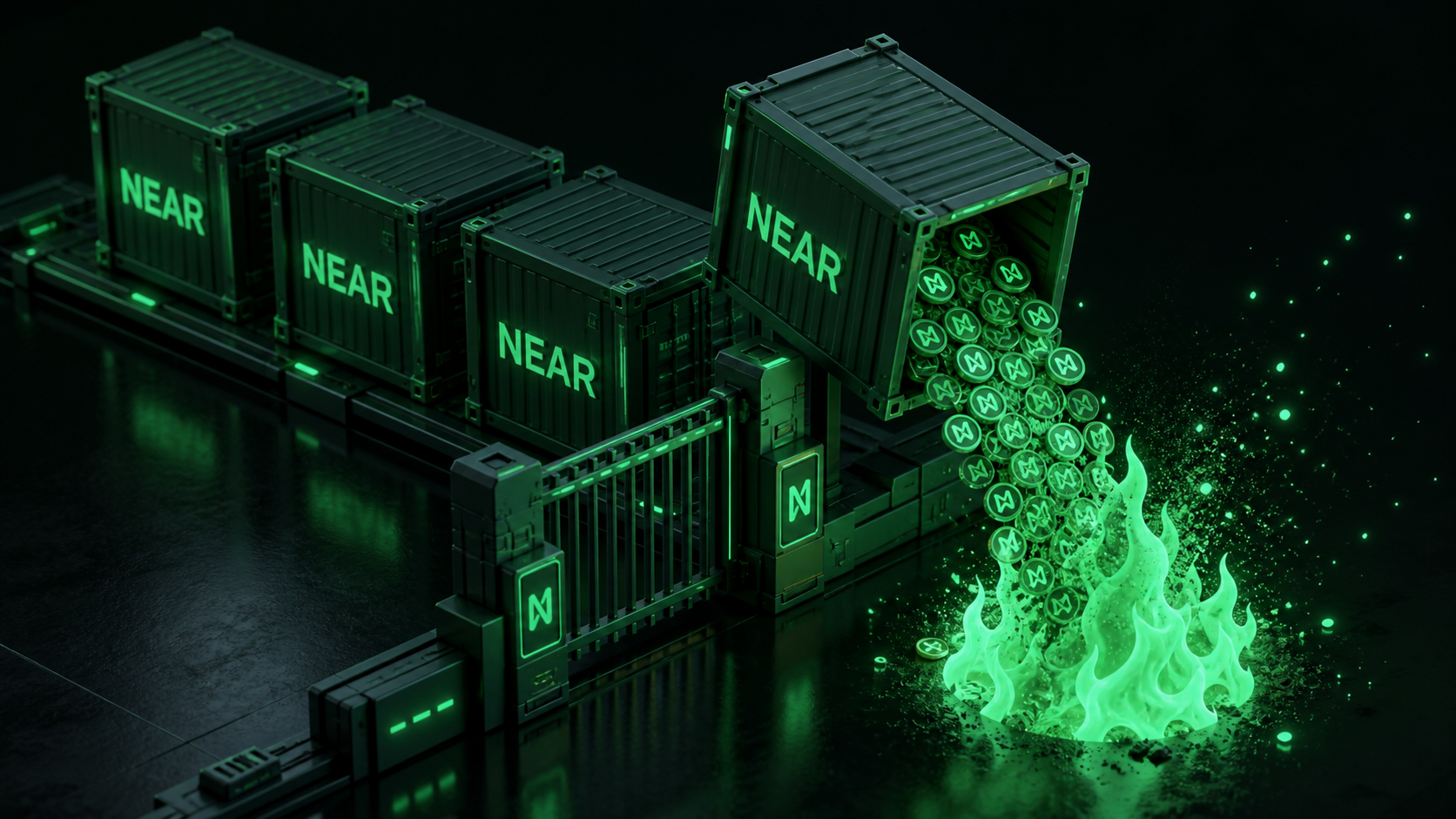
NEAR has no maximum supply. It issues 2.5% of total supply each year to validators and the treasury, burns 70% of every base gas fee, and uses swap revenue to buy tokens on the open market. Circulating supply sat near 1.3 billion in August 2026, and whether that number grows or shrinks from here is a question of network usage rather than a schedule anyone can read in advance.
That makes NEAR's supply curve unusual among large layer 1s. There is no cliff to fear and no halving to wait for, so the entire argument reduces to arithmetic between issuance and burn.
The Cut That Halved Issuance
NEAR launched in April 2020 with 1 billion tokens and a 5% annual inflation rate, split 90% to validators and 10% to the protocol treasury. The rate was fixed in the original economics paper and stayed untouched for five years.
On 30 October 2025, a governance vote permanently reduced it to 2.5%. The reasoning was that staking participation and validator economics no longer required a 5% subsidy, and that persistent sell pressure from issuance was doing more damage to the token than the marginal security bought with it. The change halved annual dilution overnight without altering the 90/10 destination split.
The practical effect: roughly 32.5 million new NEAR enter circulation each year at current supply, against roughly 65 million under the old rate. At an August 2026 price near $1.90, as listed on CoinGecko, that is about $62 million of annual issuance the market has to absorb instead of $124 million.
Every Flow That Moves NEAR Supply
Five mechanisms touch supply or demand, and they pull in different directions.
| Flow | Rate | Effect |
|---|---|---|
| Protocol issuance | 2.5% of total supply per year | Adds roughly 32.5 million NEAR annually |
| Validator and delegator rewards | 90% of issuance | Distributed to stakers each epoch |
| Protocol treasury | 10% of issuance | Funds development and ecosystem work |
| Base gas fee burn | 70% of every transaction fee | Removes NEAR permanently |
| Contract developer rebate | 30% of every transaction fee | Paid to the contract that was called |
The developer rebate is the piece with no equivalent on most chains. When a user calls a contract, nearly a third of the fee routes to the account that owns it, as NEAR's gas documentation describes. Gas becomes a revenue line for builders rather than a pure cost of doing business, which is a quiet but real subsidy for applications that get used heavily.
The Second Demand Channel
Fees collected by NEAR Intents, the network's cross-chain settlement system, are used to buy NEAR on the open market rather than being burned or distributed. That routes activity from 34 external chains into token demand without requiring any of those users to hold NEAR.
The channel is starting to matter. NEAR's protocol fee capture rate climbed from an 11.5% lifetime average to 30.5% over the trailing 30 days in Q2 2026, according to Nansen's quarterly review, as the network switched on fee capture across its front ends and partner channels. Cumulative Intents volume passed $24 billion by August 2026, so even a thin take rate on that flow compounds.
What Would Make NEAR Deflationary
Work the arithmetic and the threshold is concrete. Offsetting 32.5 million NEAR of annual issuance requires burning the same amount. Since the burn captures 70% of base gas fees, total base fees would need to run around 46 million NEAR a year, roughly $88 million at August 2026 prices, or about $240,000 in gas per day.
For context, NEAR processed roughly 854,000 transactions a day during Q2 2026 at fees measured in fractions of a cent. Reaching the deflation threshold at those fee levels would require transaction volume orders of magnitude above current activity, or a shift toward transaction types that consume far more gas, which is exactly what AI inference payments and agent-to-agent settlement would look like at scale.
Treat net deflation as a possible outcome of adoption rather than a property of the design. The useful version of this number is directional: the closer daily burn gets to daily issuance, the more the token's supply behaves like a function of real usage.
Frequently Asked Questions
Does NEAR have a maximum supply?
No. NEAR has no hard cap. Supply grows through protocol issuance at 2.5% of total supply per year and shrinks through the gas burn, so the net figure depends entirely on network activity.
Why did NEAR reduce its inflation rate?
NEAR cut issuance from 5% to 2.5% in October 2025 through a governance vote, on the reasoning that validator economics and staking participation were healthy enough to no longer need the larger subsidy. Halving issuance also halved the recurring sell pressure that newly minted tokens create.
How much of a NEAR transaction fee is burned?
Seventy percent of the base gas fee is burned permanently. The remaining 30% is rebated to the smart contract account that the transaction called, which gives application developers a share of the fees their code generates.
Supply Mechanics Worth Watching
NEAR's token economics are simpler than most and harder to forecast, because nothing about them is scheduled. There is no unlock calendar to price in and no emissions cliff, just a fixed issuance rate running against a burn and a buyback that both scale with usage. That structure rewards patience if adoption compounds and punishes it if activity stalls, with none of the cushioning that vesting schedules provide.
Three numbers tell the story from here: the daily burn rate against daily issuance, the fee capture rate, and Intents volume. All three are observable on-chain, and all three moved in the same direction through the first half of 2026.
Take a view on it with NEAR spot on LeveX for a straight holding, or NEAR perpetual futures if you want leverage on either side of the trade. More token breakdowns live in Crypto in a Minute.