
WBTC offers the deepest liquidity, cbBTC offers a simple claim on one large regulated custodian, and tBTC offers the widest split of custody, with 51 of 100 rotating signers required to move funds. tBTC is the product of Threshold Network, and it suits holders who rank custody design above market depth. WBTC and cbBTC remain the practical choice for most large DeFi trades because they are more than 20 times bigger.
All three let Bitcoin holders use BTC on smart-contract chains. They differ in who can lose it, freeze it or refuse to give it back.
| tBTC | WBTC | cbBTC | |
|---|---|---|---|
| Market cap (Nov 2026) | About $317M | About $8.8B | About $7.5B |
| Who holds the BTC | Rotating group of 100 signers | BitGo and BiT Global | One US-listed exchange |
| Approval needed to move BTC | 51 of 100 | 2 of 3 keys | Single custodian |
| Launched | Current v2 design replaced an ETH-collateral v1 | January 2019 | September 12, 2024 |
| Freeze function | Guardians can cancel optimistic mints and pause suspicious redemptions | Custodian-level controls | Yes |
| Mint and redeem fee | 0.2% each way | Varies by merchant | Varies by route |
Market caps come from CoinGecko.
Three Answers to the Same Custody Problem
WBTC and its 2024 custody change
WBTC built the category and still leads it. Custody changed in 2024 when BitGo formed a joint venture with BiT Global, and the transition completed on October 8 of that year. Control is now spread as two of three signatures across the United States, Singapore and Hong Kong. Some DeFi projects reacted by reducing exposure, which opened the door for its rivals.
cbBTC, a single-entity model
cbBTC has one issuer and custodian, and that simplicity is its selling point. Institutions understand the counterparty immediately. In exchange, holders accept a single point of legal and operational control, along with a contract that can freeze balances. Proof of reserves arrived in February 2025, several months after launch.
What makes tBTC different?
tBTC replaces the custodian with cryptography spread across a rotating signer group. Compromising the funds would require reaching a majority of the 100 operators selected for a two-week period. The details still matter, since the signer set is permissioned and a committee can upgrade contracts. Cointelegraph's research desk noted in 2024 that tBTC remained permissioned because of limits in current cryptography, and that description still holds.
Liquidity Is the Price of Decentralization
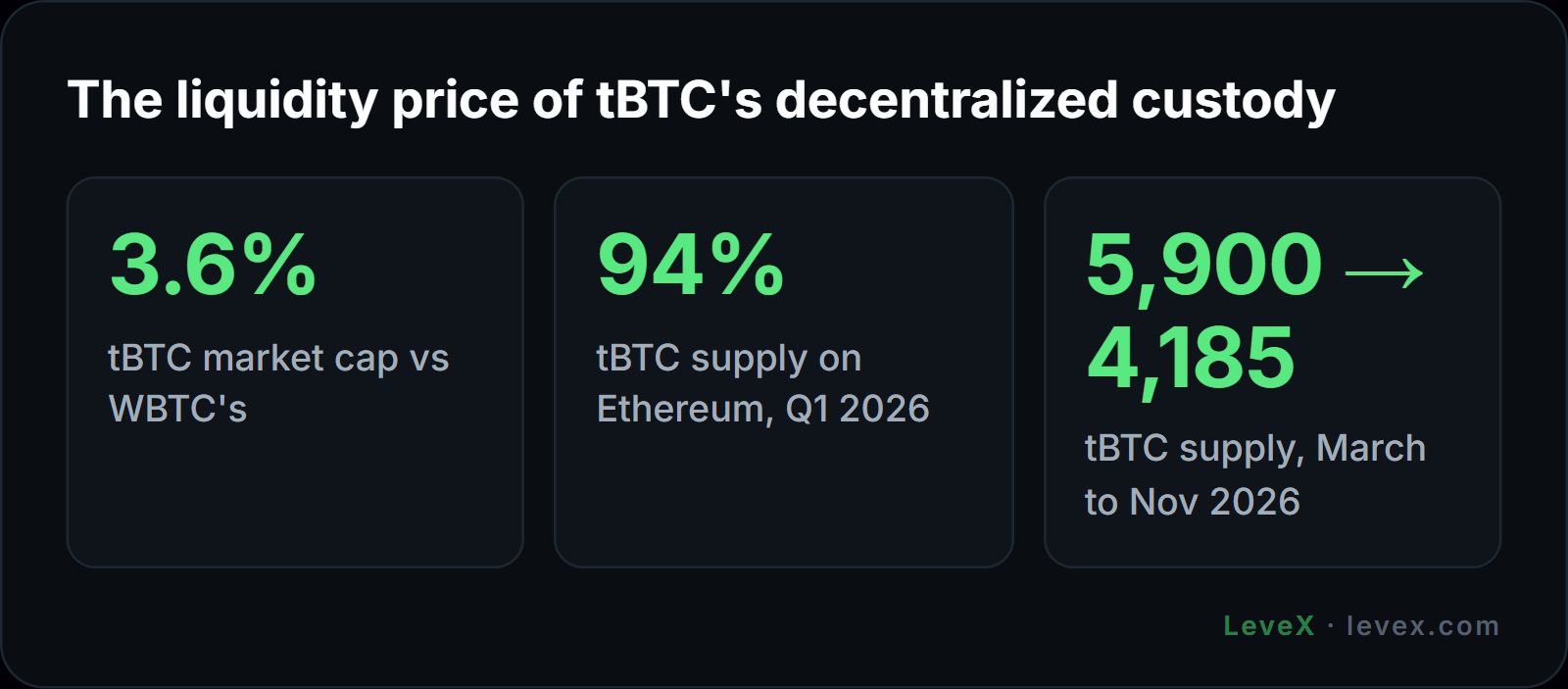
Trust design only pays off if you can use the asset. tBTC's market cap is about 3.6% of WBTC's, so lending markets offer it smaller borrowing caps and large swaps meet thinner pools. About 94% of tBTC supply sat on Ethereum at the end of Q1 2026, even with deployments on 18 chains.
Supply trends tell the same story. tBTC fell from about 5,900 tokens in March 2026 to about 4,185 in November, a slide that weighs on the T price outlook as well.
Fees are another difference. tBTC charges 0.2% on mint and redeem, so a full round trip costs 0.4% plus Bitcoin network fees. Heavy users can reduce that through stake-based tBTC fee waivers. The size of the discount is set out in the T supply and utility rules, which our T tokenomics analysis covers. WBTC and cbBTC users usually buy on a secondary market and pay only trading costs, and that is often cheapest for small amounts.
A Short History Lesson From renBTC
Decentralized-looking designs can still have a hidden single point of failure. renBTC, once a major wrapped Bitcoin option, shut down in 2022 after its node infrastructure proved financially dependent on Alameda Research. The lesson applies to all three products above. Ask who pays the operators and what happens if that funding stops. For tBTC, the answer sits with protocol fees and a treasury that is now operating on a leaner budget.
Which One Should You Use?
- Choose WBTC if you need the deepest DeFi liquidity and are comfortable with a named custodial group.
- Choose cbBTC if a single regulated counterparty is acceptable and you value clear institutional accountability.
- Choose tBTC if avoiding one custodian is your priority and your position fits within its smaller liquidity.
- Hold plain BTC if you have no DeFi use for it, as our guide to wrapped Bitcoin versus native BTC explains. Every wrapper adds risk.
Splitting a large position across two wrappers is a reasonable middle path, since no single failure would then affect all of it.
Frequently Asked Questions
Is tBTC safer than WBTC?
tBTC reduces reliance on one custodian, while WBTC has a longer record and far deeper markets, so neither is safer in every respect. The right choice depends on whether custodial failure or smart-contract and signer-network failure concerns you more.
Can cbBTC or WBTC be frozen?
cbBTC includes a freeze function controlled by its issuer, and WBTC custodians operate under their own compliance controls. tBTC has no single custodian, though its Guardians can stop suspicious optimistic mints and redemptions.
Is tBTC backed 1:1 by Bitcoin?
tBTC is designed to be backed 1:1 by BTC held in wallets controlled by the signer group. Bitcoin balances can be checked on-chain, and DefiLlama showed about $327 million of BTC behind about $317 million of tBTC in November 2026.
Pick the Risk You Understand
No wrapped Bitcoin token is risk-free. WBTC and cbBTC concentrate trust in known institutions, while tBTC spreads it among operators and code, and it pays for that with thinner markets.
If you would rather trade the network's token than bridge through it, T is available on LeveX spot, the TUSDT perpetual offers two-way exposure, and Crypto in a Minute collects our other explainers.