
Threshold Network (T) is the governance and fee-waiver token of Threshold, the network that runs tBTC, a wrapped version of Bitcoin issued by a rotating group of 100 signers. T was created when Keep Network and NuCypher merged at the start of 2022, and its supply is fixed at 11.155 billion tokens. As of November 2026 T trades near $0.0046, roughly 98% below its March 2022 high, while tBTC represents about $317 million of Bitcoin on other chains.
The token is small and the thesis is narrow. Anyone holding T is effectively taking a position on whether Bitcoin holders will pay to use their coins in decentralized finance through a bridge that no single company controls.
What Threshold Does Today
Threshold launched with a broader menu of threshold-cryptography services. It now has one main product. The network's access-control service, TACo, began migrating away in 2025, with the last TACo rewards paid from the Threshold DAO treasury covering August of that year. Threshold's current documentation centers on tBTC and describes T as an ERC-20 token on Ethereum.
Threshold Labs has served as the main operating company since February 2025, after token holders moved to shrink the old system of paid guilds. A further reorganization, TIP-110, passed in July 2026. It cut the budget line for DAO committee roles to zero from the $649,000 approved a year earlier and kept 6-of-9 and 5-of-9 multisig thresholds for protocol upgrades and treasury actions.
That focus makes Threshold easier to analyze than most multi-product networks. When tBTC grows, T has a reason to matter. When tBTC shrinks, there is little else to carry the token.
How Does tBTC Keep Bitcoin Out of One Custodian's Hands?
tBTC turns BTC into a token that can be used on smart-contract chains. Our explainer on how wrapped Bitcoin differs from native BTC covers the general idea. Threshold's version works in four stages:
- Deposit. A user sends BTC to an address controlled by the current signer wallet. The deposit script includes a refund time lock if the deposit is never processed.
- Sweep. Signers consolidate pending deposits into one Bitcoin output, a batching step that typically runs every eight hours.
- Mint. The tBTC contract issues the wrapped token, minus a 0.2% fee reinstated on April 15, 2026. Optimistic minting can release tokens before the sweep, with Guardians able to cancel a suspicious mint during a delay.
- Redeem. A holder burns tBTC, also paying a 0.2% fee, and signers release BTC to the holder's Bitcoin address.
Control of the Bitcoin requires 51 of the 100 signers to cooperate, and the group rotates every two weeks. An attacker would need to compromise a majority of operators during one rotation, which is a very different problem from breaching one company's vault.
The signer set remains permissioned, so tBTC is better described as distributed than as open to anyone. Threshold's team and committee still decide who operates and who can upgrade the contracts.
The Three Jobs T Performs
Voting in the DAO
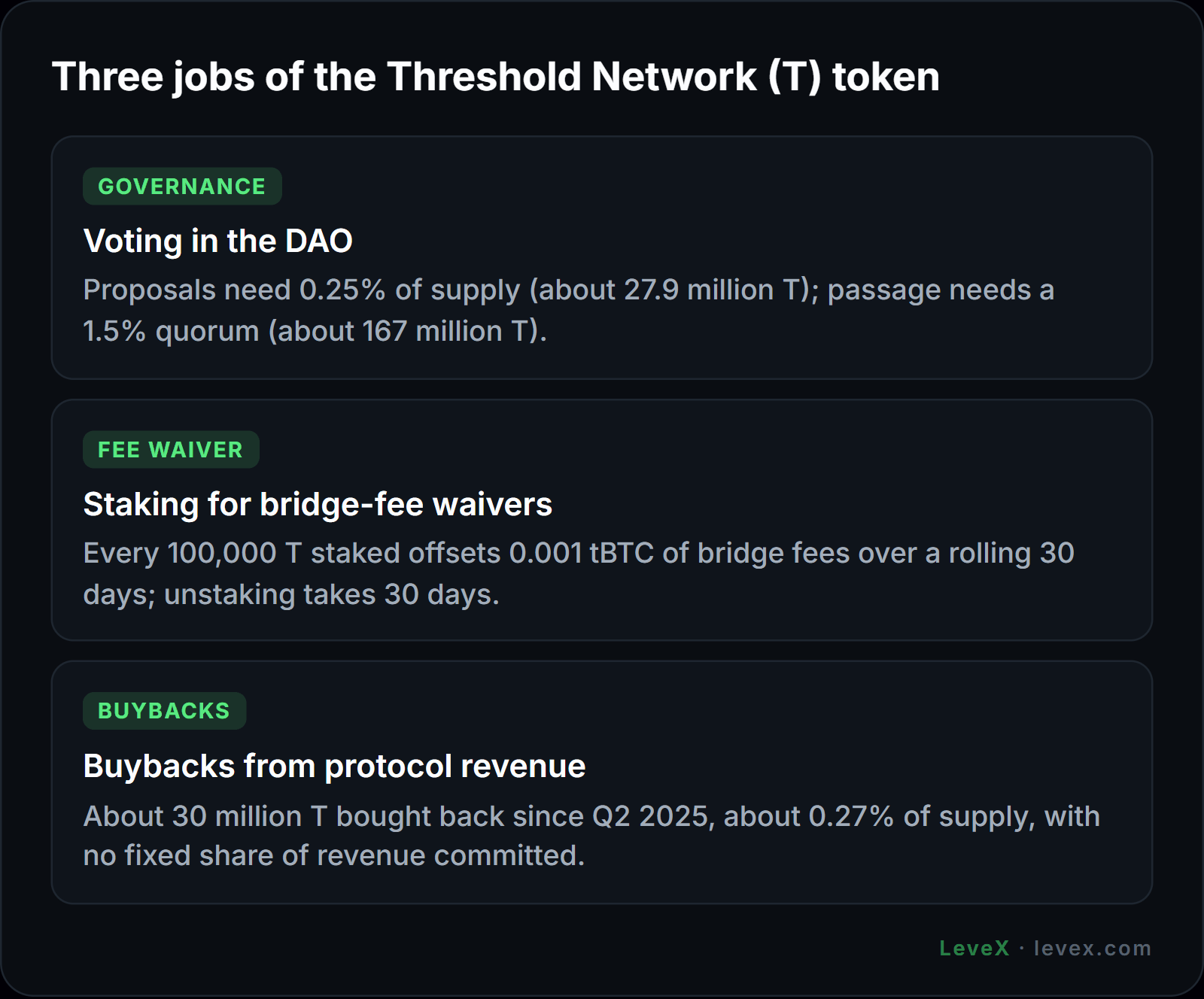
T holders govern the protocol through a Snapshot temperature check and then an on-chain vote. Creating an on-chain proposal takes 0.25% of total supply in voting weight, about 27.9 million T, and passage needs a 1.5% quorum, about 167 million T.
Staking for bridge-fee waivers
Staking emissions ended in 2025. Since January 2026, staking T has instead earned a fee allowance: every 100,000 T staked offsets 0.001 tBTC of bridge fees over a rolling 30 days, and unstaking takes 30 days.
Here is what that means at November 2026 prices. A 100,000 T stake costs around $460 and covers fees on roughly 0.5 tBTC of bridging per month, or about $38,000 of volume. The perk is aimed at frequent bridgers and institutions, so a typical small holder will never use most of it.
Buybacks from protocol revenue
Fees flow to the treasury, and the DAO can use them to buy T on the open market. Alea Research's Q1 2026 report counted about 30 million T bought back since the program was approved in Q2 2025. That equals about 0.27% of supply, and the timing depends on operating costs because no fixed share of revenue is committed.
T by the Numbers
| Metric (November 2026 unless noted) | Figure |
|---|---|
| Price | About $0.0046 |
| Market cap | About $51 million |
| Total and circulating supply | 11.155 billion T |
| All-time high | $0.2269 (March 2022) |
| All-time low | $0.00315 (June 2026) |
| tBTC supply | About 4,185 tBTC |
| tBTC supply at March 31, 2026 | About 5,900 tBTC |
| Annualized protocol fees (March 2026) | $712,000 |
Market figures come from CoinGecko. One ratio stands out: T's market cap equals about 16% of the value of the tBTC it governs. The supply figure matters as well, since every token is already in circulation and unlock schedules no longer weigh on the price.
The less flattering number is the tBTC supply itself, which dropped about 29% between the end of March and early November. A bridge token's fee income depends on that line moving up.
From Two Networks to One
Keep Network built private computation and the first version of tBTC. NuCypher built encryption and access-control tools. In 2021 both communities approved a merger, an unusual move in crypto, where projects tend to compete or fork.
The 10 billion T minted at launch were split as 4.5 billion for NU holders, 4.5 billion for KEEP holders and 1 billion for the DAO treasury. Another 1.155 billion T were issued during an early bootstrapping phase to pay stakers and node operators, which produced today's 11.155 billion total. Holders of legacy tokens can still convert at about 3.26 T per NU and 4.78 T per KEEP, as there is no migration deadline for liquid tokens.
tBTC now lives on 18 chains, including Arbitrum, Base, Optimism, Starknet, Sui and Solana, although about 94% of supply sat on Ethereum at the end of Q1 2026.
Risks Traders Should Price In
- Competition from giants. WBTC and cbBTC each carry market caps above $7 billion, more than 20 times tBTC's size, and DeFi liquidity tends to pool around the largest assets.
- Weak fee capture. Annualized fees of $712,000 against a market cap of about $67 million implied a price-to-fees ratio of 95x in Q1 2026, and fee waivers lower the amount collected.
- Bridge exposure. Bitcoin bridges are a favorite target, as our review of major crypto bridge hacks shows. In May 2026, 103.6 tBTC was drained from the third-party Verus-Ethereum bridge. That flaw sat outside tBTC's own signing system, but it shows how a wrapped asset can be lost through the places it travels.
- Thin trading. Daily volume near $1.8 million means large orders can move the price sharply.
Frequently Asked Questions
Is T the same token as tBTC?
No, T and tBTC are separate assets. T is the governance and fee-waiver token with a floating market price, while tBTC is designed to track the price of Bitcoin and is backed by BTC held by the signer group.
Can I still convert KEEP or NU into T?
Yes, liquid KEEP and NU can still be converted because Threshold's documentation sets no migration deadline. Conversion runs through on-chain vending machine contracts at fixed rates of about 4.78 T per KEEP and 3.26 T per NU.
Does staking T pay rewards?
Staking T no longer pays inflationary token rewards. Since January 2026 it provides an allowance that reduces or waives tBTC bridge fees, with 100,000 T offsetting 0.001 tBTC of fees per rolling 30 days.
What blockchain is T on?
T is an ERC-20 token native to Ethereum at contract address 0xCdF7028ceAB81fA0C6971208e83fa7872994beE5. CoinGecko also lists versions on Base, Optimism and Solana, so confirm the network before sending tokens.
Is T a good investment?
T is a high-risk, small-cap position whose value depends on tBTC adoption and on whether the DAO directs meaningful revenue to buybacks. It has lost about 98% from its peak, every token is already circulating, and no forecast can guarantee a recovery.
A Small Token Tied to One Big Question
Threshold has spent the past two years cutting costs, dropping side projects and tying T directly to tBTC usage. That leaves a clean test of demand for Bitcoin liquidity that does not rely on a single custodian, and the tBTC supply figure is the number to watch.
You can buy T on the LeveX spot market or take a long or short view through TUSDT perpetual futures, and Crypto in a Minute has more guides to tokens like this one.