
Every T token that will ever exist is already in circulation. Threshold Network (T) has a final supply of 11.155 billion tokens, no remaining unlock schedule, and three sources of utility: governance votes, staking for tBTC bridge-fee waivers, and discretionary buybacks funded by protocol revenue.
That removes the dilution worry that hangs over most small-cap tokens. It also shifts the whole debate to demand, which is where T's economics are weakest. Readers who want the price implications can jump to our T price prediction scenarios.
How Did T End Up With 11.155 Billion Tokens?
T came from a merger, so its opening allocation had no venture round or public sale. Threshold's token documentation lays out the origin of every token.
| Source | Tokens | Share of final supply |
|---|---|---|
| Allocated to NuCypher (NU) holders | 4.5 billion | 40.3% |
| Allocated to Keep Network (KEEP) holders | 4.5 billion | 40.3% |
| Threshold DAO treasury | 1 billion | 9.0% |
| Inflationary bootstrapping for stakers and operators | 1.155 billion | 10.4% |
The first three rows are the 10 billion T minted at launch. The final row came later, as incentive issuance during the network's early years.
Legacy holders convert through on-chain vending machine contracts at fixed ratios of about 3.26 T per NU and 4.78 T per KEEP. Those ratios were set by each token's total supply, so neither community got a better deal because of a market price on a given day.
Supply Stopped Growing in 2025
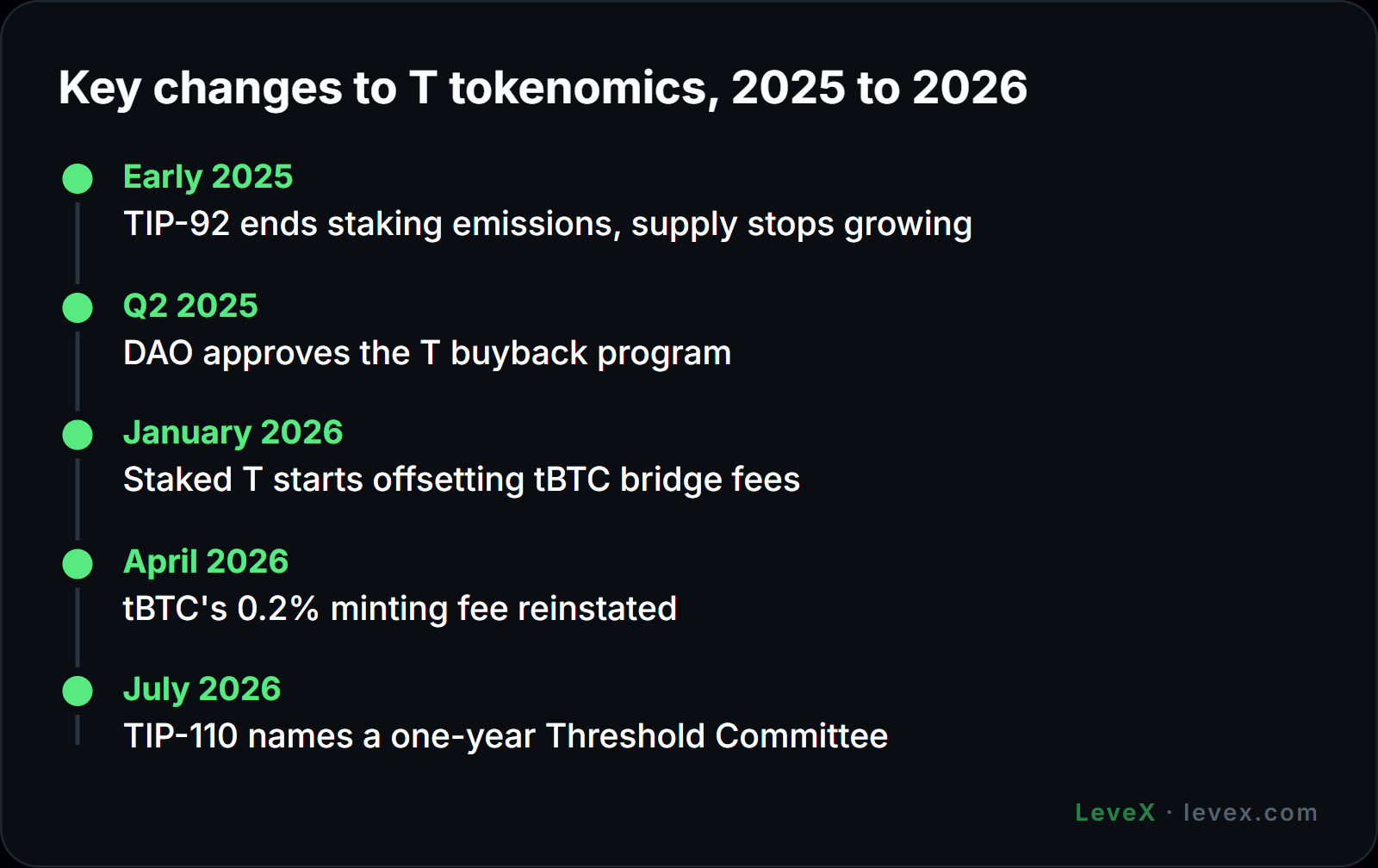
Staking emissions were scheduled to end under TIP-92 in early 2025, and Threshold's documentation now describes T as fully diluted. A separate plan from TIP-98 to mint about 1.12 billion more T was withdrawn by TIP-100, and the total has stayed at 11.155 billion.
Fixed supply is an improvement, but it needs context. Stakers lost their yield when emissions stopped, so the incentive to lock tokens is now limited to the fee waiver.
Where Demand for T Comes From
Bridge-fee waivers. Since January 2026, each 100,000 T staked offsets 0.001 tBTC of fees per rolling 30 days. This creates demand from frequent bridgers, and every waived fee also means less revenue collected.
Governance. On-chain proposals need 0.25% of total supply in voting weight, about 27.9 million T. Votes run for 10 days after a two-day delay and require a 1.5% quorum, about 167 million T. The Governor Bravo structure follows Compound's token-voting model.
Buybacks. The DAO has purchased about 30 million T since approving the program in Q2 2025, according to Alea Research. TIP-54 allows net profits to fund buying and burning, though the sources we reviewed report no executed burn amount.
Running the Buyback Math
A rough calculation shows how much value can realistically reach the token:
- Start with annualized fees of $712,000, the March 2026 run rate.
- Subtract operating costs. How often the DAO buys back tokens depends on these, and no fixed share of revenue is committed.
- Compare what is left with a market cap of about $51 million. Spending all of the fees would equal only about 1.4% of market cap per year.
- Compare with history. The 30 million T repurchased so far is about 0.27% of total supply.
The takeaway is that buybacks are a useful signal of intent. They would need several times today's fee base to set the price floor by themselves. tBTC's 0.2% fees on mints and redemptions, reinstated for minting in April 2026, are the lever that matters, and that lever depends on bridge volume.
Who Controls the Treasury and Upgrades?
Token holders vote, but operational power sits with a smaller group. TIP-110, passed in July 2026, named members to a one-year Threshold Committee term. Protocol upgrades need 6 of 9 signatures, and treasury actions need 5 of 9.
The same proposal cut the DAO committee's budget line to zero from the $649,000 approved in TIP-103, which reduces a direct drain on the treasury. The Elected Committee can also veto proposals, a safety valve that token holders should weigh against the ideal of pure on-chain control.
Frequently Asked Questions
Does T have a maximum supply?
T's effective maximum supply is 11.155 billion tokens, and the full amount is already circulating. Further issuance would require a governance decision, and a past proposal to mint about 1.12 billion more was withdrawn.
Is T deflationary?
T is deflationary only if bought tokens are actually burned, and TIP-54 permits burning without requiring it. About 30 million T have been bought back since 2025, a small amount relative to total supply.
How much T does it take to create a governance proposal?
An on-chain Threshold proposal requires voting weight equal to 0.25% of total supply, or about 27.9 million T. Forum discussion and Snapshot temperature checks have no minimum, so smaller holders can still raise ideas first.
Clean Supply, Unproven Demand
T's token structure has become simpler than many of its peers: no unlock cliffs, a fixed total and a clear link between tBTC fees and buybacks. The open question is whether enough Bitcoin moves through the bridge to make that link matter.
Follow the numbers and decide how you want exposure. Trade T on the spot order book, hedge or speculate with the TUSDT perpetual contract, and explore other token explainers in Crypto in a Minute.