
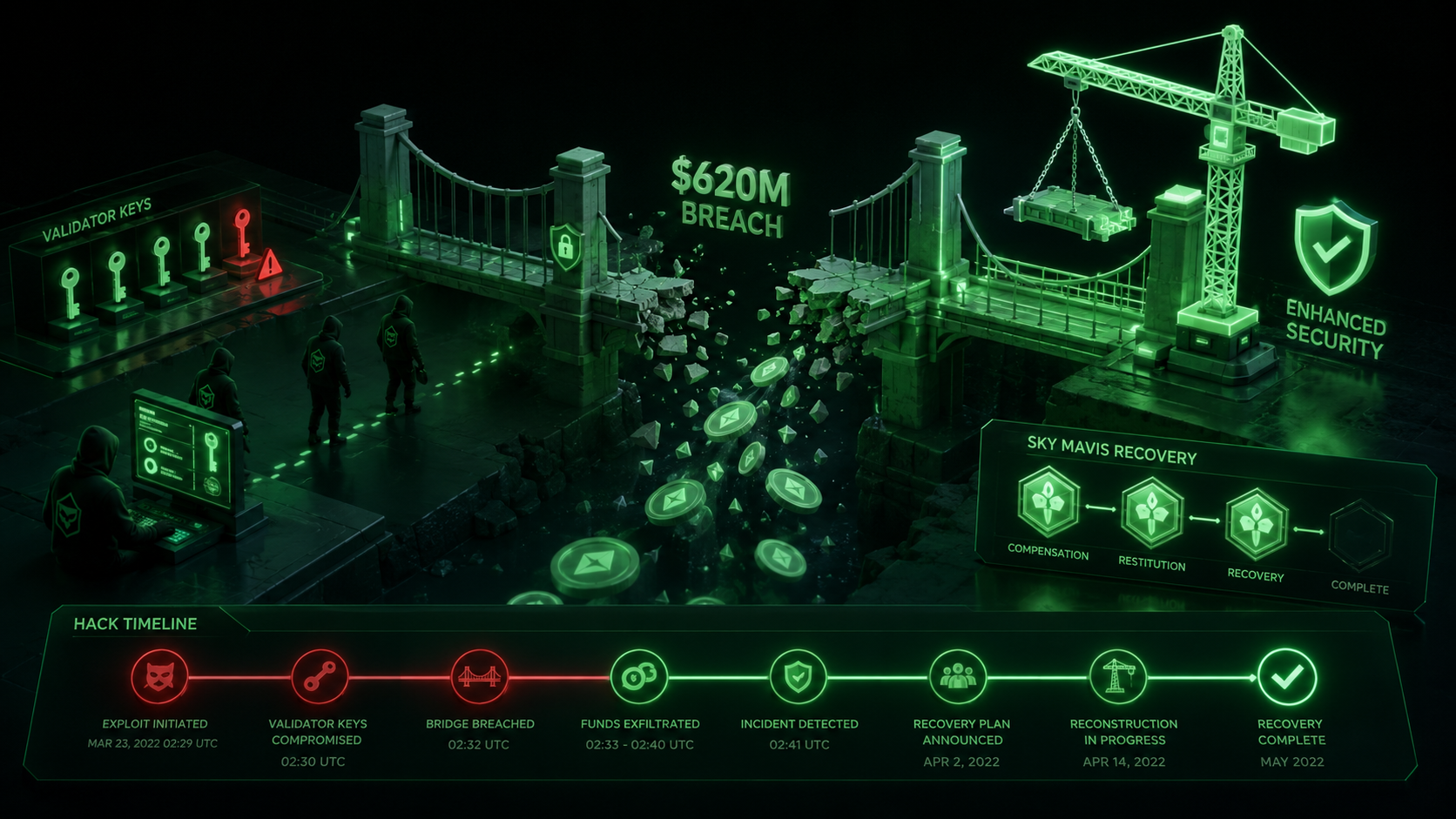
On March 23, 2022, North Korean state-sponsored hackers executed the largest cryptocurrency theft in history, draining $620 million from the Axie Infinity ecosystem. The attack targeted the Ronin Bridge, the critical infrastructure connecting the gaming blockchain to Ethereum mainnet. Six days passed before anyone noticed the funds were gone.
The Ronin hack represents both a cautionary tale about blockchain security and a remarkable story of recovery. Sky Mavis fully reimbursed affected users within months, international law enforcement traced and seized portions of the stolen funds, and the incident prompted comprehensive security overhauls that strengthened the entire ecosystem.
How the Attack Happened
The Ronin Bridge required five of nine validator nodes to approve any withdrawal. Attackers compromised exactly five, gaining the minimum threshold needed to drain the bridge entirely.
Four validators belonged directly to Sky Mavis. The fifth came through an obscure backdoor: in November 2021, during a period of extreme network congestion, Sky Mavis had requested temporary access to sign transactions on behalf of the Axie DAO validator. The arrangement ended in December 2021, but the access permissions were never revoked.
According to FBI attribution, attackers exploited a gas-free RPC node to obtain the Axie DAO validator signature, combining it with the four compromised Sky Mavis keys. Within two transactions, they extracted 173,600 ETH and 25.5 million USDC.
The attack timeline reveals how sophisticated state actors operate:
| Date | Event |
|---|---|
| November 2021 | Sky Mavis gains temporary Axie DAO signing access |
| December 2021 | Arrangement officially discontinued |
| March 23, 2022 | Attackers execute two withdrawal transactions |
| March 29, 2022 | User reports withdrawal failure, hack discovered |
| April 14, 2022 | U.S. Treasury attributes attack to Lazarus Group |
The six-day detection gap proved particularly damaging. By the time Sky Mavis identified the breach, attackers had already begun laundering funds through decentralized exchanges.
The Lazarus Group Connection
Within weeks, the FBI formally attributed the attack to North Korea's Lazarus Group and APT38, state-sponsored hacking units responsible for billions in cryptocurrency theft globally. The U.S. Treasury added the attacker's Ethereum address to its sanctions list, prohibiting American entities from any transactions with the wallet.
Lazarus Group operates as North Korea's primary cyber-theft apparatus, with stolen cryptocurrency funding the regime's nuclear and ballistic missile programs. According to Elliptic's analysis, the Ronin attack wasn't an isolated incident but part of a sustained campaign, with DPRK-linked actors stealing an estimated $1.7 billion in crypto during 2022 alone.
The attack methodology matched Lazarus signatures: social engineering to gain initial access, months of preparation and reconnaissance, sophisticated understanding of blockchain mechanics, and systematic laundering through DEXs to avoid centralized exchange controls.
Immediate Response and User Reimbursement
Sky Mavis moved quickly to contain damage and restore user confidence. The company halted bridge operations immediately upon discovery and launched a comprehensive investigation with blockchain analytics firm Chainalysis.
Most critically, Sky Mavis committed to fully reimbursing all affected users. The company raised $150 million in April 2022 specifically for victim compensation, led by Binance with participation from other investors. By June 2022, all users had been made whole despite the stolen funds remaining largely unrecovered.
This response distinguished the Ronin incident from many crypto hacks where users simply lose their funds. For those holding AXS through the crisis, the reimbursement demonstrated Sky Mavis's commitment to their community. Understanding AXS price dynamics during this period shows how market confidence eventually stabilized following the recovery efforts.
Fund Recovery Efforts
International law enforcement achieved partial success tracing and seizing stolen assets. In September 2022, the FBI recovered approximately $30 million worth of cryptocurrency. Norwegian authorities followed in February 2023, seizing an additional $5.8 million in what became Norway's largest cryptocurrency recovery.
Recovered funds were returned to Sky Mavis for victim reimbursement. However, the majority of stolen assets remained with the attackers, who employed sophisticated laundering techniques including mixing services, chain-hopping between blockchains, and conversion through decentralized exchanges.
The partial recoveries demonstrated both the possibilities and limitations of blockchain forensics. While transactions remain permanently visible on public ledgers, determined state actors with sufficient resources can still obscure fund flows effectively.
Security Overhauls
The breach prompted fundamental changes to Ronin Network's security architecture. Sky Mavis implemented multiple layers of protection:
Expanded Validator Set: The number of validators increased significantly, raising the threshold needed for malicious withdrawals. More validators from independent organizations reduced concentration risk.
Enhanced Verification: Multi-layer verification processes now govern bridge operations, with additional checks preventing single points of failure.
Third-Party Audits: External security firms conducted comprehensive audits of bridge infrastructure and validator operations.
Chainlink CCIP Integration: The bridge migrated to Chainlink's Cross-Chain Interoperability Protocol, leveraging battle-tested infrastructure rather than custom solutions.
Circuit Breakers: Automated systems now monitor for unusual withdrawal patterns and can pause operations before catastrophic losses occur.
These improvements addressed the specific vulnerabilities exploited in 2022 while strengthening overall resilience. The Ronin ecosystem's continued development since the hack demonstrates that recovery from even catastrophic security incidents remains possible.
Lessons for Crypto Security
The Ronin hack illuminated several critical principles for blockchain security that extend beyond any single project.
Validator Concentration: Having four of nine validators controlled by a single entity created unacceptable concentration risk. Decentralized validation matters for bridge security specifically because bridges hold concentrated assets.
Access Management: The lingering Axie DAO permissions represented a classic access control failure. Temporary privileges require automatic expiration rather than manual revocation.
Detection Capabilities: Six days without noticing $620 million missing indicated insufficient monitoring. Real-time anomaly detection should flag any unusual bridge activity immediately.
Social Engineering: Despite sophisticated blockchain architecture, human factors enabled the initial compromise. Technical security means little if attackers can manipulate individuals into granting access.
For users evaluating wallet security, the Ronin incident reinforces the importance of understanding where assets actually reside. Funds on a sidechain depend on bridge security, not just personal key management.
Impact on the Axie Ecosystem
The hack accelerated existing challenges facing Axie Infinity. Player counts had already begun declining from 2021 peaks, and the security incident amplified concerns about the platform's viability.
However, the long-term impact proved more nuanced than initial doom predictions suggested. Sky Mavis's rapid reimbursement preserved user trust among those who remained engaged. The company continued development on new games and features rather than abandoning the ecosystem.
The incident also prompted beneficial infrastructure investments that strengthened Ronin for future growth. The upcoming Layer 2 migration inherits Ethereum's security rather than relying on an independent validator set, directly addressing the architectural weakness exploited in 2022.
Trading Considerations
For traders evaluating AXS positions, the Ronin hack provides important context about project risk and resilience. The incident demonstrated both vulnerability to sophisticated attacks and capacity for recovery when management responds appropriately.
Key factors worth monitoring include ongoing security audit results and validator decentralization metrics, bridge transaction volumes as indicators of user confidence, and development progress on security-enhancing upgrades like the L2 transition.
The hack also established a price floor of sorts by proving Sky Mavis would prioritize user protection over short-term financial considerations. This commitment reduces tail risk for long-term holders.
Security Lessons That Shaped an Industry
The Ronin Bridge hack fundamentally changed how the cryptocurrency industry approaches bridge security. Protocols across the ecosystem implemented enhanced monitoring, expanded validator sets, and adopted more conservative security assumptions. The incident proved that even well-funded, technically competent teams could fall victim to state-level attackers without appropriate safeguards.
Sky Mavis's response set a standard for crisis management in crypto. Full user reimbursement, transparent communication, and systematic security improvements demonstrated that projects can recover from catastrophic incidents while maintaining community trust. The ongoing development of Atia's Legacy and the Layer 2 transition show an ecosystem that learned from disaster rather than collapsing under its weight.
Trade AXS on LeveX spot markets or access futures contracts for leveraged exposure to ecosystem developments. Explore our Crypto in a Minute guides for deeper understanding of blockchain security and gaming tokens.