
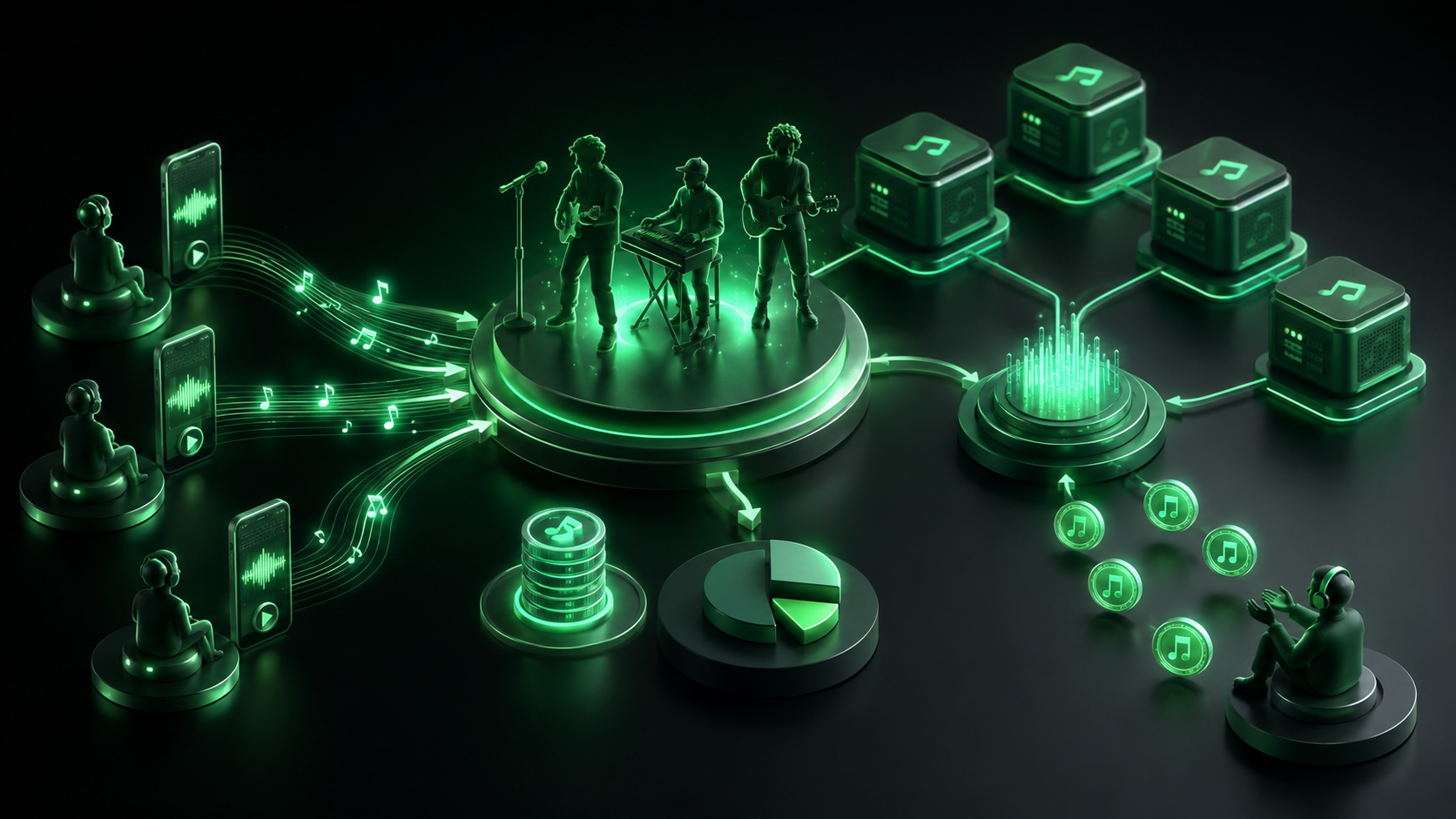
Traditional streaming platforms pay artists fractions of pennies per play while retaining control over distribution, pricing, and revenue splits. Gala Games built Gala Music as a direct challenge to this model, creating a decentralized streaming platform where artists maintain ownership, fans earn rewards for listening, and community-operated nodes replace centralized servers.
The platform has attracted notable artists including Snoop Dogg, Jordin Sparks, and Earl Sweatshirt, signaling that established musicians see potential in blockchain-based alternatives to Spotify and Apple Music.
How Gala Music Works
Gala Music operates on GalaChain, using a three-party system that distributes value among artists, listeners, and infrastructure operators.
Artists mint their music as NFTs using the ERC-1155 standard, maintaining full ownership of their intellectual property. Unlike traditional streaming deals where labels control distribution terms, artists on Gala Music set their own pricing and determine how their content gets monetized. When fans purchase track NFTs, artists receive payment immediately rather than waiting for quarterly royalty statements filtered through multiple intermediaries.
Listeners access music through a free, ad-free streaming experience. Registered users earn MUSIC tokens by streaming songs, which can be redeemed for merchandise, exclusive content, or traded on supported exchanges. A subset of listeners become Track Owners by purchasing song NFTs, gaining rights to host their music on nodes and earn revenue based on play counts.
Jukebox Node Operators provide the decentralized infrastructure that hosts and streams music. Rather than relying on Spotify's centralized data centers, Gala Music distributes hosting across a community-operated network of over 20,000 Jukebox Nodes. Operators earn MUSIC tokens for maintaining uptime and serving tracks to listeners.
The Jukebox Node System
Jukebox Nodes represent Gala Music's implementation of DePIN (Decentralized Physical Infrastructure Network). As detailed in Gala's official documentation, anyone with appropriate hardware and a license can operate a node from their home computer, contributing to the network's capacity while earning rewards.
The pairing mechanism works like this: track owners choose to host their NFT songs on specific Jukebox Nodes or allow automatic pairing. Once paired, the track becomes available for streaming, and both the track owner and node operator receive MUSIC token distributions based on play counts.
| Role | Function | Reward |
|---|---|---|
| Track Owner | Owns song NFT, decides hosting | MUSIC per stream |
| Node Operator | Hosts and serves tracks | MUSIC for uptime + streams |
| Listener | Streams music | MUSIC for engagement |
Node operators must maintain minimum 20-hour daily uptime to ensure hosted music remains consistently available. This requirement prevents the reliability issues that would plague a network where nodes frequently go offline.
The system creates aligned incentives. Popular tracks attract more streams, benefiting both their owners and the nodes hosting them. Node operators naturally want to host in-demand music, while track owners seek reliable nodes with good uptime records.
The MUSIC Token Economy
MUSIC serves as Gala Music's native reward and utility token, separate from the main GALA token used across the broader Gala ecosystem's tokenomics.
Primary functions include streaming rewards distributed to listeners, track owners, and node operators based on platform activity. The token also enables node operators to expand their hosting capacity, with MUSIC required to increase the number of songs a Jukebox can host.
Recent developments expanded MUSIC utility through artist tokens. The December 2025 launch of GalaPump introduced artist-specific tokens like FIMCOIN, tied to Louis King's "Famous in the Metaverse" album featuring collaborations with Snoop Dogg, Wiz Khalifa, and DMX. This system allows artists to create their own fungible tokens that fans can purchase, trade, and use for exclusive access.
Artist Partnerships and Adoption
Snoop Dogg's February 2022 partnership marked Gala Music's most significant artist onboarding. His album "B.O.D.R. (Bacc on Death Row)" launched as blockchain-exclusive NFTs, with Stash Boxes selling for $5,000 worth of GALA. Collectors who acquired all 17 track NFTs unlocked real-world rewards including parties at Snoop's mansion and commemorative merchandise.
Notable artists on the platform:
| Artist | Contribution |
|---|---|
| Snoop Dogg | B.O.D.R. album, exclusive NFT drops |
| Jordin Sparks | Music NFTs, fan engagement |
| Earl Sweatshirt | Platform early adopter |
| City of Sound | Community features, creative process sharing |
Leila Steinberg leads Gala Music as CEO. According to CoinGecko's platform analysis, her background includes marketing roles at Atlantic Records, Sony, Def Jam, and Interscope, plus recognition as the artistic mentor who helped launch Tupac Shakur's career.
Comparing Gala Music to Traditional Streaming
The fundamental difference lies in revenue distribution and ownership rights.
On Spotify, artists reportedly earn $0.003-0.005 per stream, with payments flowing through labels and distributors before reaching creators. The platform retains control over algorithms, playlists, and discoverability. Artists cannot remove their music without label approval in most cases.
Gala Music inverts this model. Artists receive payment directly when fans purchase track NFTs, maintaining full control over pricing and availability. The platform claims to pay artists first rather than treating them as suppliers to be squeezed for margins.
For fans, traditional streaming offers unlimited access for monthly fees but no ownership or earning potential. Gala Music provides free ad-free streaming while rewarding engagement with MUSIC tokens. Track ownership creates investment-like dynamics where fans benefit financially from supporting music they believe in.
The trade-off involves catalog size and mainstream accessibility. Spotify offers 100+ million tracks from virtually every major artist. Gala Music's library remains comparatively limited, focused on artists willing to experiment with blockchain distribution. Mainstream adoption depends on convincing more musicians that decentralized alternatives serve their interests better than established platforms.
Challenges and Considerations
Several obstacles stand between Gala Music and mainstream adoption:
- Network effects: Spotify's 600 million users create gravitational pull that emerging platforms struggle to overcome. Listeners go where music exists, artists go where listeners exist.
- Catalog limitations: While 20,000+ Jukebox Nodes represent substantial infrastructure, Gala Music's artist roster remains a fraction of traditional platforms.
- Token volatility: MUSIC value depends on platform activity. Price declines reduce earning potential, potentially triggering negative feedback loops.
- Onboarding friction: Wallets, tokens, and blockchain concepts present barriers that traditional apps have spent years eliminating.
The broader question of whether Gala's entertainment platforms can sustain growth applies equally to Gala Music. Comparing the model to other blockchain gaming and entertainment tokens reveals common challenges around sustainable tokenomics during market downturns.
Streaming Reimagined Through Ownership
Gala Music's core value proposition transforms passive consumption into active participation. The platform's success directly impacts GALA's price trajectory, as music represents a key pillar of the broader entertainment ecosystem.
Whether listen-to-earn can scale beyond crypto-native early adopters to mainstream consumers remains the central question for Gala Music's long-term viability. The platform offers a compelling alternative for artists frustrated by traditional streaming economics, but converting that frustration into mass adoption requires overcoming significant technical and cultural barriers.
Trade GALA on LeveX spot markets for exposure to the broader Gala ecosystem including Gala Music's growth, or use futures contracts to express views on blockchain entertainment adoption. Explore our Crypto in a Minute guides for coverage of other Web3 entertainment platforms.