
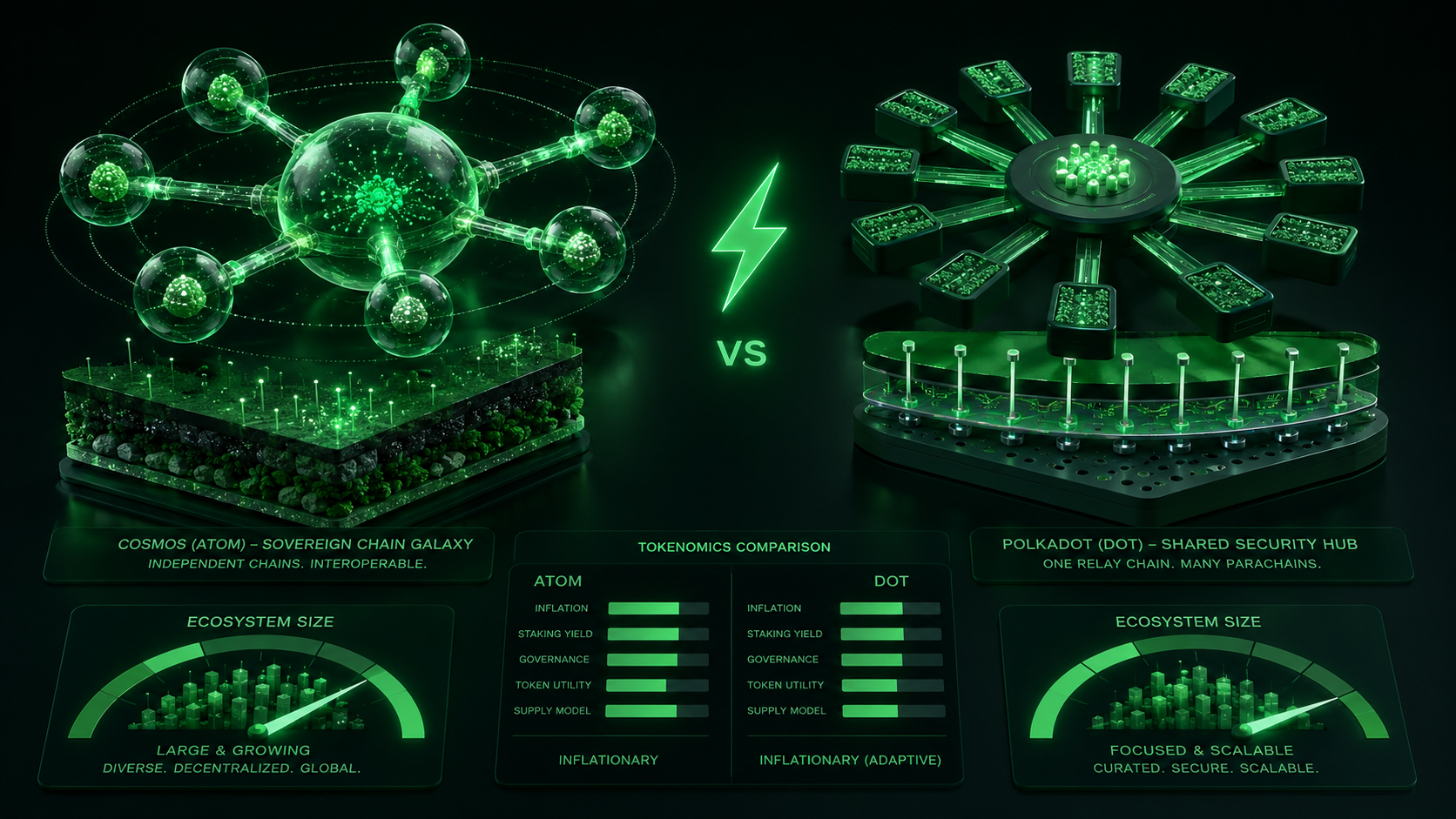
Cosmos and Polkadot launched with the same core goal: connect independent blockchains into a unified network. Both projects have delivered working products, active ecosystems, and meaningful developer adoption. Yet their architectural choices diverge in ways that matter for traders and builders deciding where to allocate attention. This comparison breaks down the differences that actually affect usability, security, and token economics.
Architecture: Sovereignty vs Shared Security
The most fundamental difference between Cosmos and Polkadot is how connected chains relate to their parent network.
Cosmos zones are fully sovereign blockchains. Each zone runs its own validators, sets its own fee structures, and governs itself independently. The Cosmos Hub connects zones through IBC (Inter-Blockchain Communication) but doesn't control them. A zone can disconnect from IBC at any time without affecting its own operation. This makes the Cosmos model highly flexible: projects like dYdX built a dedicated chain with complete control over block times and transaction ordering, something that wouldn't be possible in a shared-security model.
Polkadot parachains, by contrast, share security through the Relay Chain. Parachain blocks are validated by Polkadot's validator set, which means individual parachains don't need to recruit and incentivize their own validators. The trade-off is reduced sovereignty. Parachains must win auction slots to connect, they inherit Polkadot's consensus rules, and their throughput is partially constrained by the Relay Chain's capacity.
For developers, the choice often comes down to control versus convenience. Cosmos gives you everything but asks you to handle security yourself (unless you opt into Interchain Security). Polkadot handles security for you but limits your architectural freedom.
Interoperability Protocols: IBC vs XCM
Both networks have purpose-built cross-chain messaging protocols, but they work differently.
IBC is an open, permissionless protocol. Any blockchain with a compatible light client can implement IBC and begin exchanging tokens and data with the Cosmos network. The protocol uses cryptographic verification, meaning receiving chains can independently verify the validity of incoming packets without trusting intermediaries. IBC now connects hundreds of chains and has processed billions in cross-chain volume since launch.
Polkadot's XCM (Cross-Consensus Messaging) facilitates communication between parachains sharing the Relay Chain's security umbrella. XCM messages are faster within the Polkadot ecosystem because parachains already share a trust layer. For cross-ecosystem communication (connecting to Ethereum or other networks), Polkadot relies on bridge parachains rather than a universal protocol.
| Feature | IBC (Cosmos) | XCM (Polkadot) |
|---|---|---|
| Permissionless | Yes | Within parachain ecosystem |
| External chains | Any IBC-compatible chain | Via bridge parachains |
| Verification | Cryptographic light clients | Shared validator security |
| Active connections | Hundreds of chains | ~50 parachains |
| Cross-ecosystem | Native | Requires bridges |
The practical implication: Cosmos has broader reach across independent chains, while Polkadot offers tighter, faster integration within its own ecosystem.
Token Economics: ATOM vs DOT
ATOM and DOT serve different economic roles within their respective networks, which matters for evaluating their long-term price trajectories.
DOT's primary utility is parachain slot auctions. Projects lock DOT for extended periods (originally 96 weeks) to secure a parachain slot, creating significant demand-side pressure. The recent shift to Polkadot 2.0's "coretime" model changes this dynamic, allowing projects to purchase block space more flexibly instead of committing to long auctions. This may reduce the amount of DOT locked in auctions while making the network more accessible.
ATOM's utility centers on staking and governance. With 61% of the supply staked, ATOM secures the Cosmos Hub and earns inflationary rewards. Interchain Security adds a new utility layer: ATOM stakers also validate consumer chains and earn fees from those networks. The proposed tokenomics overhaul could further transform ATOM's economic profile by replacing inflation with fee-based revenue.
Both tokens face value accrual questions. Polkadot must demonstrate that coretime purchases generate sufficient demand to replace the lock-up pressure from auctions. Cosmos must show that ICS and fee revenue justify ATOM's role as the ecosystem's economic anchor.
Ecosystem Development
Cosmos and Polkadot have attracted different types of projects, reflecting their architectural differences.
The Cosmos ecosystem includes some of the largest standalone crypto applications: dYdX (perpetual futures), Osmosis (DEX), Celestia (data availability), and Injective (DeFi trading). These projects chose Cosmos specifically because they needed full sovereignty over their chain's design. The Cosmos SDK has become one of the most popular blockchain development frameworks, with over 250 projects built on it.
Polkadot's ecosystem leans toward infrastructure and DeFi primitives within the parachain framework: Acala (DeFi hub), Moonbeam (EVM compatibility), Astar (multi-chain smart contracts), and Phala (privacy computing). The shared security model attracts projects that want built-in security without the overhead of recruiting validators.
The developer experience also differs. Cosmos SDK uses Go and offers modular components that developers assemble into custom chains. Polkadot's Substrate framework uses Rust and provides a more opinionated development path optimized for parachain deployment.
Which Network Fits Your Focus?
Cosmos and Polkadot solve the same problem through different philosophies. Cosmos maximizes sovereignty and flexibility at the cost of requiring each chain to arrange its own security (or opt into ICS). Polkadot maximizes shared security and tight integration at the cost of reduced independence and slot competition.
For traders, the choice between ATOM and DOT comes down to which vision you believe will capture more adoption. Cosmos has the larger ecosystem by project count and cross-chain volume. Polkadot has stronger built-in security guarantees and is evolving its economic model with the coretime system. Both remain actively developed with clear roadmaps through 2026 and beyond. For a deeper look at how to manage ATOM holdings, the best Cosmos wallets guide covers self-custody options across the ecosystem.
Trade ATOM and DOT on LeveX through spot or futures markets, with fees from 0.1% and access to multi-trade mode for managing positions in both tokens simultaneously. Explore more comparisons and token guides in the Crypto in a Minute library.