
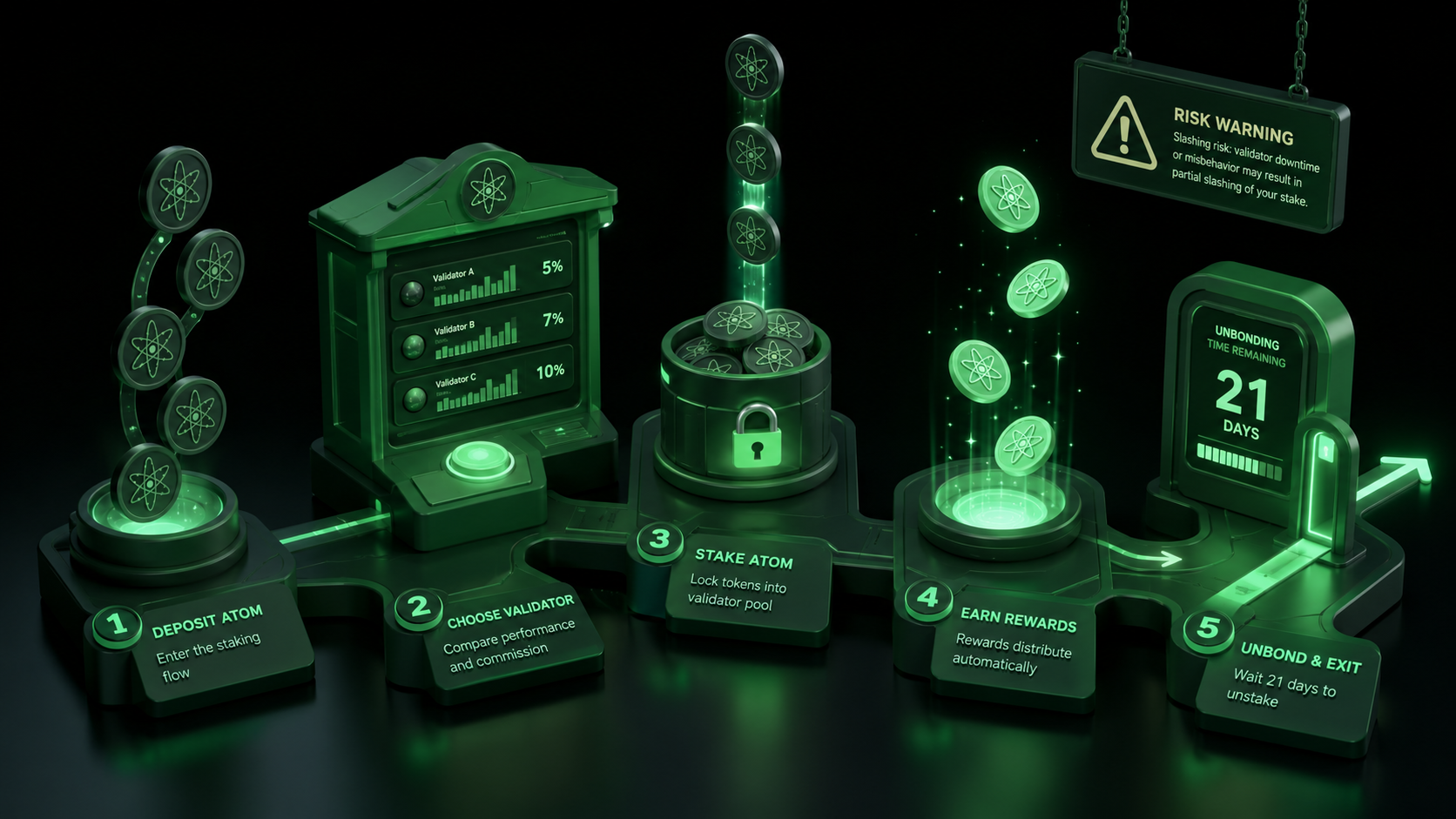
Over 61% of all ATOM in circulation is currently staked, locking roughly 300 million tokens with validators securing the Cosmos Hub. That participation rate makes Cosmos one of the most actively staked networks in crypto, and the annual yields of 10–15% explain much of the appeal. Here's how the staking system works and what to consider before committing tokens.
How Cosmos Staking Works
Cosmos uses a delegated proof-of-stake (DPoS) consensus mechanism called CometBFT (formerly Tendermint). Token holders don't need to run validator infrastructure themselves. Instead, they delegate ATOM to validators who process transactions and produce blocks on the network.
When you delegate ATOM, your tokens remain in your wallet, but they're bonded to the validator you've chosen. The validator uses the combined stake from all delegators to participate in consensus. In return, staking rewards are distributed proportionally. If a validator holds 2% of the total stake and you contributed 10% of that validator's delegation, you earn 10% of the rewards that validator receives.
Rewards come from two sources: new ATOM issuance (inflationary rewards) and transaction fees paid on the Cosmos Hub. The split heavily favors issuance at present, though the proposed tokenomics overhaul could shift this balance toward fee-based revenue over time. These structural changes are among the key factors shaping ATOM's price outlook for the years ahead.
Choosing a Validator
Cosmos Hub has over 180 active validators, and picking the right one matters more than most guides acknowledge. Three factors deserve close attention:
Commission rate is the percentage of your staking rewards the validator keeps. Rates range from 0% to 20%. A 5% commission means the validator takes 5% of the rewards generated by your delegation. Lower commission means more rewards for you, but validators with sustainable commission rates (5–10%) tend to be more reliable operators than those running at 0% to attract short-term delegation.
Uptime and performance directly affect your returns. Validators that go offline miss block proposals and earn no rewards during downtime. Worse, validators that double-sign (attempt to validate conflicting blocks) face slashing penalties that reduce the staked balance of all their delegators. Check a validator's historical performance on explorers like Mintscan before delegating.
Voting participation reflects how engaged a validator is in governance. Cosmos governance allows ATOM stakers to vote on protocol upgrades, parameter changes, and spending proposals. If you don't vote directly, your validator votes on your behalf. Delegating to a validator who actively participates in governance means your stake has representation even when you're not paying attention to proposals.
The Unbonding Period
Cosmos enforces a 21-day unbonding period when you decide to unstake ATOM. During this window, your tokens earn no rewards and cannot be transferred or traded. The design is intentional: it prevents validators and delegators from rapidly withdrawing stake in response to short-term price movements, which could compromise network security.
This lock-up period is a meaningful trade-off. If ATOM's price drops sharply, staked tokens can't be sold for 21 days after initiating the unbonding process. Liquid staking protocols like Stride have emerged to address this friction, issuing derivative tokens (stATOM) that represent staked ATOM but can be traded or used in DeFi while the underlying tokens continue earning rewards.
Staking Risks to Understand
Slashing is the primary risk. If your chosen validator misbehaves (double-signing or extended downtime), a portion of all delegated tokens gets burned. Double-sign slashing is severe, typically 5% of the staked amount. Downtime slashing is lighter, around 0.01%, but compounds if the validator is frequently offline.
Inflation dilution affects non-stakers disproportionately. With ATOM's inflation ranging from 7% to 20%, holders who don't stake see their purchasing power erode relative to stakers who receive new issuance. Staking essentially offsets this dilution, making it closer to a defensive necessity than a pure income strategy.
Opportunity cost is the 21-day unbonding window plus the fact that staked ATOM can't be deployed in DeFi protocols or traded. On Ethereum, liquid staking derivatives solved this problem at scale. The Cosmos ecosystem is developing similar solutions, but adoption remains smaller.
ATOM Staking by the Numbers
| Metric | Current Value |
|---|---|
| Total ATOM Staked | ~303 million |
| Staking Ratio | 61.4% |
| Annual Yield (approximate) | 10–15% |
| Unbonding Period | 21 days |
| Active Validators | 180+ |
| Slashing (double-sign) | ~5% |
| Slashing (downtime) | ~0.01% |
Making the Staking Decision
ATOM staking offers solid yields by crypto standards, and the 61% participation rate suggests the majority of holders view it as worthwhile. The key considerations are validator selection (commission, uptime, governance participation), comfort with the 21-day unbonding period, and awareness that staking rewards currently come primarily from inflation rather than organic network fees.
For traders who want ATOM exposure without the unbonding constraint, Celestia and other Cosmos ecosystem tokens offer alternative positions within the same technological thesis. And staking doesn't prevent you from maintaining a separate trading allocation.
Trade ATOM on LeveX through spot or futures markets with fees starting at 0.1%. Explore more Cosmos ecosystem guides in the Crypto in a Minute library.