
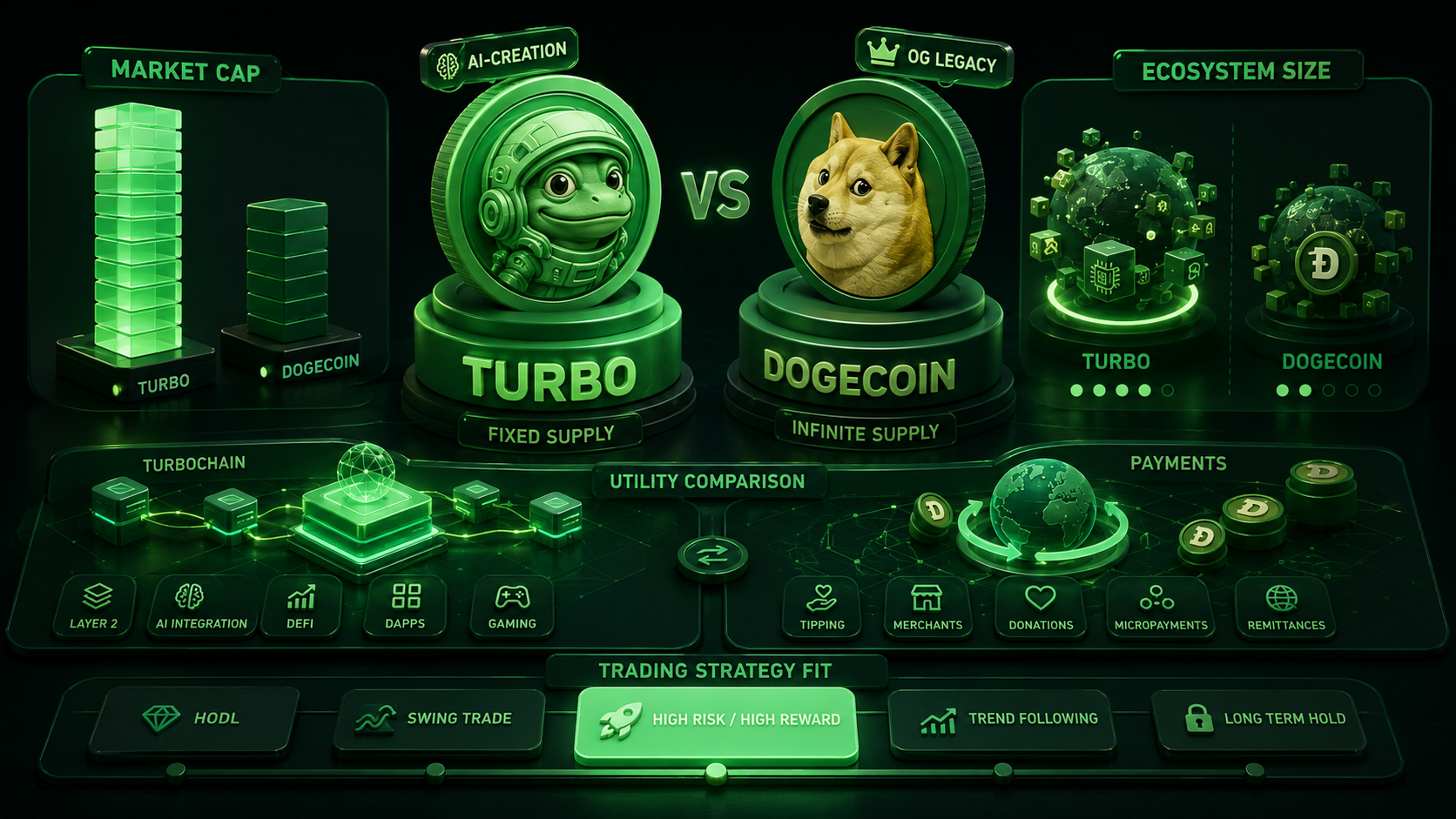
Turbo (TURBO) and Dogecoin represent two different eras of meme coin culture. DOGE launched in 2013 as a lighthearted joke between software engineers. TURBO launched a decade later as the output of a GPT-4 experiment with a $69 budget. Both rely on community enthusiasm for their value, but the mechanics underneath are fundamentally different.
Origin and Philosophy
Dogecoin was created by Billy Markus and Jackson Palmer as a parody of the crypto speculation craze, built on Litecoin's codebase with intentionally absurd inflation. The Shiba Inu mascot came from a popular internet meme, and the project was never designed to be taken seriously as an investment.
TURBO's origin flipped the script. Rhett Mankind asked GPT-4 to design the "next great meme coin," and the AI determined everything from the name and toad mascot to the 69 billion token supply. Where Dogecoin was humans making fun of crypto, TURBO was AI participating in crypto creation for the first time. That distinction matters for narrative, which is the primary currency meme coins trade on.
The philosophical difference extends to governance. Dogecoin still has identifiable core developers who maintain the codebase and can propose changes. TURBO's contract is renounced, making it truly immutable. Neither approach is inherently better, but they produce different risk profiles.
Tokenomics Side by Side
The supply economics of these two tokens couldn't be more different, and this shapes how each one trades.
| Feature | TURBO | Dogecoin (DOGE) |
|---|---|---|
| Total Supply | 69 billion (fixed) | ~148 billion (inflationary) |
| Annual Inflation | 0% | ~3.5% (~5B new DOGE/year) |
| Transaction Tax | 0% | 0% |
| Contract Status | Renounced (immutable) | Active development |
| Consensus | Ethereum PoS (ERC-20) | Proof of Work (Scrypt) |
| Market Cap | ~$78M | ~$25B |
| Launch Year | 2023 | 2013 |
Dogecoin mints approximately 5 billion new tokens every year with no cap. This perpetual inflation means DOGE needs constant buying pressure to maintain its price. TURBO's fixed supply eliminates dilution risk entirely, though the 9 billion founder allocation represents a concentration factor that DOGE doesn't have.
Market Position and Liquidity
Dogecoin holds a roughly 320x market cap advantage over TURBO according to CoinMarketCap rankings, reflecting a decade of brand recognition, celebrity endorsements (most notably Elon Musk), and infrastructure integration. DOGE is accepted as payment by several major companies and has active development around tipping and microtransactions.
TURBO's market position is smaller but growing. The token trades on approximately 40 centralized exchanges with daily volumes between $8M and $150M depending on market conditions. For traders, TURBO's smaller market cap means higher percentage moves in both directions. A $5M inflow that barely moves DOGE's price can push TURBO up 10–15%.
This liquidity gap also affects TURBO's price dynamics. DOGE's order book depth across major exchanges provides relatively stable fills even on large orders. TURBO can experience more slippage during volatile periods, making limit orders and careful position sizing more important.
Ecosystem and Utility
Dogecoin has spent years building payment integrations and maintaining a functional proof-of-work blockchain. The Dogecoin Foundation, with advisors including Vitalik Buterin, has published development roadmaps focused on payment rail efficiency.
TURBO took a different path to utility through the December 2024 TurboChain launch. By partnering with Aurora Labs and NEAR Protocol to create a dedicated blockchain, TURBO gained a DeFi ecosystem layer with TurboSwap for cross-chain trading. TURBO serves as TurboChain's gas token, creating structural demand tied to network usage rather than speculation alone.
Both tokens have utility beyond holding, but the nature of that utility differs: Dogecoin focuses on payments and tipping, while TURBO focuses on DeFi and cross-chain activity through its own chain.
Which One Suits Your Trading Strategy
Choosing between TURBO and DOGE depends on what kind of exposure you want. DOGE offers higher liquidity, lower volatility relative to its meme coin peers, and the most recognized meme coin brand in crypto. It trades like a large-cap asset with meme coin characteristics.
TURBO offers higher volatility, a fixed-supply structure, and the AI-origin narrative that resonates during periods of AI market enthusiasm. Traders looking for percentage gains during meme coin rallies may find TURBO's smaller market cap more responsive. Explore the best wallets for securing TURBO if you're considering longer-term exposure.
Both tokens carry the inherent risks of meme coins: dependence on sentiment, susceptibility to whale movements, and limited fundamental valuation frameworks. Position sizing and risk management matter more than conviction with assets in this category.
Trade TURBO on spot markets or explore TURBO perpetual futures on LeveX. Find more token comparisons in Crypto in a Minute.