
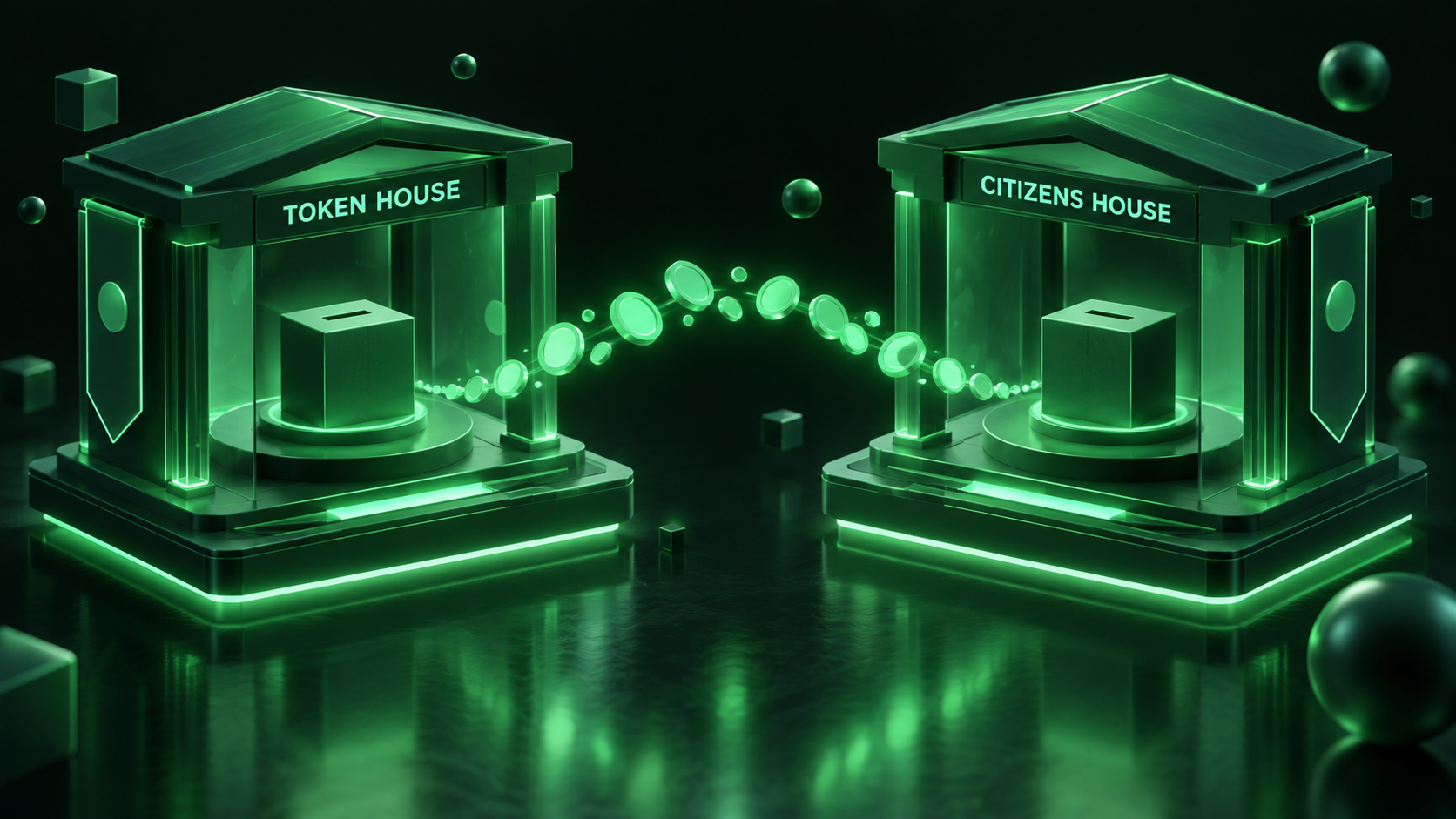
The Optimism Collective governs through two chambers: the Token House, where OP holders and their delegates vote on treasury spending and protocol parameters, and the Citizens' House, where holders of non-transferable identity NFTs allocate retroactive public goods rewards. Splitting money-weighted decisions from person-weighted ones is the design's central idea, and it is the only meaningful thing an OP token actually does, since Optimism has no staking, no fee burn and no direct revenue claim attached to the asset.
That makes governance the entire OP investment case. Understanding who decides what is not optional background for a holder.
Two Houses, One Collective
The Token House
The Token House is the money-weighted chamber. Voting power comes from OP held or delegated, and its remit covers governance fund grants, protocol upgrades, sequencer parameters, inflation adjustments and admissions to the Superchain under the Law of Chains.
Most circulating OP participates through delegation rather than direct voting. A holder assigns voting power to a delegate without transferring custody, and can revoke it at any time. Delegates publish platforms and voting records, and a relatively small group of them carries a large share of active voting power, which is the standard concentration problem in delegated token governance.
The Citizens' House
The Citizens' House is the person-weighted chamber. Membership is conferred by a "soulbound" NFT that cannot be bought or sold, which deliberately breaks the link between capital and influence. Its job is allocating retroactive public goods funding out of the 850 million OP reserved for that purpose.
Citizens do not vote on treasury policy or upgrades. Their authority is narrow and deep: deciding which contributions to the ecosystem deserve payment after the fact. How that allocation runs in practice is covered in our Optimism Retro Funding guide.
Who Decides What
| Decision | Chamber | Example |
|---|---|---|
| Governance fund grants | Token House | Incentive programmes for DeFi protocols on OP Mainnet |
| Protocol upgrades | Token House | Approving Superchain Upgrade 16.0 in July 2026 |
| Superchain admissions | Token House | Ratifying a new chain under the Law of Chains |
| Revenue policy | Token House | The January 2026 vote to fund OP buybacks |
| Retroactive rewards | Citizens' House | Allocating a Retro Funding round budget |
| Badgeholder selection | Citizens' House | Deciding who votes in future rounds |
The Optimism Foundation sits alongside both, operating programmes, publishing budgets and holding emergency powers through the Security Council. Governance is progressive rather than complete: the Foundation still executes a great deal, and the stated direction is to devolve more of it each season.
The Vote That Changed the Token
In January 2026 the Token House approved directing 50% of net Superchain sequencer revenue into monthly OP buybacks for a twelve-month pilot. The proposal passed with 84.4% support and executed its first purchases in February.
It was the first time governance converted network activity into token demand, and it briefly gave OP something closer to an equity claim. Five weeks later Base announced it was leaving the Superchain, taking 96.5% of the Collective's gas fee revenue with it. Buyback funding fell from 6.95 million OP on March revenue to 926,000 OP on April revenue.
The episode is the clearest illustration of what Token House votes are worth. Governance can decide how revenue is used. It cannot decide that revenue exists. The dependency runs through Superchain membership, which our OP Stack and Superchain explainer sets out, and it feeds directly into the supply and demand picture in our OP tokenomics breakdown.
Season 8 and the Enterprise Turn
Optimism organises governance into seasons, each with a defined scope, budget and set of process changes. Season 8 marked a shift toward tighter budgets and a more institutional focus, with overall OP spending down 35% in Year 4 and user airdrops halted.
The practical effect for delegates is fewer large discretionary grant decisions and more scrutiny of what the Collective spends against what it earns. For holders, it means the governance rights attached to OP now control a smaller pool of money and a more consequential set of strategic choices, chiefly about how to attract paying chains back into the federation. The competitive backdrop to those choices is set out in our Optimism and Arbitrum comparison, and the market's read on whether it works is covered in our OP price prediction.
Frequently Asked Questions
What does the OP token let you vote on?
OP grants voting power in the Token House, covering governance fund grants, protocol upgrades, sequencer parameters, inflation settings, Superchain admissions and revenue policy such as the 2026 buyback programme. It does not grant a vote in the Citizens' House, which allocates retroactive public goods funding and is governed by non-transferable identity NFTs instead.
How do you delegate OP voting power?
Delegation is done through Optimism's governance interface by assigning voting power to a delegate address, and the tokens never leave the holder's wallet. Delegation can be changed or revoked at any time and earns no reward, since Optimism has no staking mechanism. Most active voting power in the Token House is exercised by delegates rather than by holders voting directly.
Who are Optimism citizens?
Citizens are holders of a soulbound, non-transferable NFT that grants voting rights in the Citizens' House. Citizenship cannot be purchased, which is the point: it separates influence over public goods funding from token wealth. Badgeholder selection has moved progressively from Foundation control toward the Citizens' House itself.
Does Optimism governance control the Superchain?
Token House votes ratify which chains join the Superchain and approve the shared upgrades those chains adopt, so governance controls the federation's membership and rules. It has no authority over chains that run the OP Stack outside the Superchain, since the code is MIT-licensed and free to fork. Base's 2026 departure demonstrated that limit directly.
Governance as the Token's Only Job
OP is a pure governance asset, and 2026 stress-tested what that is worth. The Token House made a real value-accretive decision in January, linking network revenue to token demand for the first time, and watched most of that revenue walk out the door six weeks later through a channel governance had no power over.
The takeaway for anyone holding OP is that the token's value tracks the size of what governance controls, and that pool is currently shrinking. The counter-case rests on the Collective using its remaining treasury and its upgrade authority to make Superchain membership worth paying for again, which is a decision the Token House can actually make. That is the vote worth watching.
Hold OP with direct ownership through spot trading, or trade governance-driven volatility with OP perpetual futures on LeveX. More token and protocol breakdowns sit in Crypto in a Minute.