
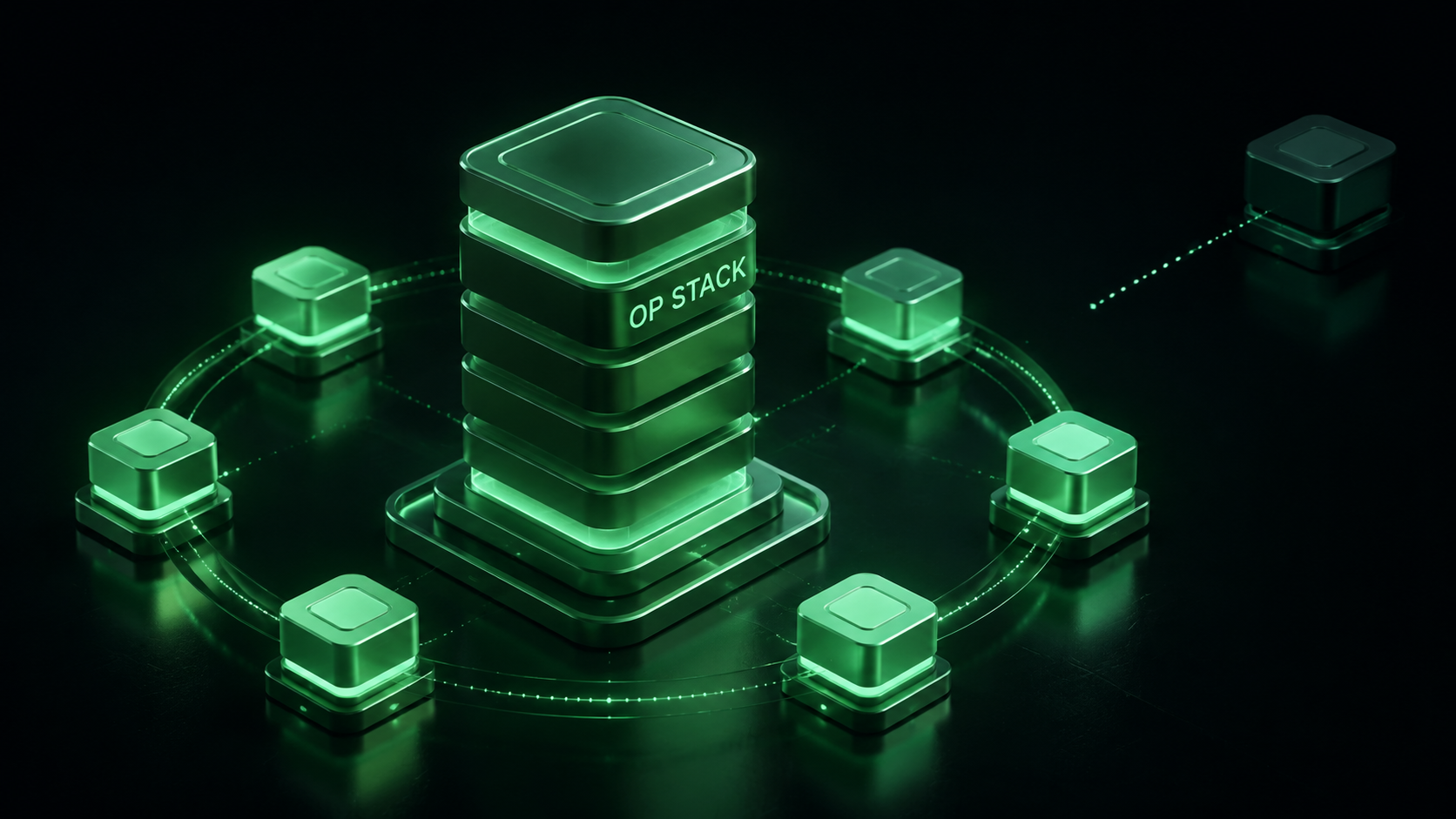
The OP Stack is an open-source, modular codebase for building Ethereum layer-2 rollups, published under an MIT licence by the team behind Optimism. More than thirty production chains run on it. The Superchain is a much smaller thing: the subset of those chains that also opt into shared governance, a common fault-proof system and a revenue agreement with the Optimism Collective.
Conflating the two is the most common error in coverage of Optimism, and February 2026 made the difference concrete when Base kept the code and left the federation.
The Modules That Make Up the Stack
The OP Stack decomposes a rollup into swappable layers. A team launching a chain picks an implementation for each one rather than writing a rollup from scratch.
- Data availability layer. Where transaction data is published so anyone can reconstruct state. Most chains use Ethereum blobs; alternative DA providers such as Celestia can be substituted.
- Sequencing layer. Who orders transactions and issues soft confirmations. Currently a single operator on nearly every OP Stack chain, with shared sequencing on the roadmap.
- Derivation layer. The rules that turn raw posted data into a canonical chain of blocks.
- Execution layer. The EVM implementation that processes those blocks. Since the Bedrock upgrade this is a lightly modified Ethereum client, which is why OP Stack chains inherit Ethereum tooling almost for free.
- Settlement layer. Where state roots are posted and disputes are resolved, typically Ethereum, using the Cannon fault-proof system across a seven-day challenge window.
- Governance layer. Who can upgrade the contracts. This is the layer that separates a Superchain member from a plain fork.
Bedrock, shipped in June 2023, is what made this modularity practical. By reusing Ethereum's execution client with minimal changes, it cut the maintenance burden of running a fork to near zero and turned launching an L2 into a configuration exercise. The broader family of Ethereum scaling designs includes zero-knowledge alternatives with different trade-offs, but none has matched the OP Stack's deployment count.
What Joining the Superchain Actually Costs
Running the OP Stack is free. Joining the Superchain is not.
Members sign up to the Law of Chains, a set of commitments covering upgrade authority, censorship resistance and user protections. In exchange for shared security infrastructure and a seat in the federation, a member pays the Optimism Collective either 2.5% of chain revenue or 15% of on-chain profit after costs, whichever is higher.
That payment is the entire commercial basis of the OP token. The buyback programme approved in January 2026 routes 50% of net Superchain sequencer revenue into monthly OP repurchases, so Law of Chains payments flow, indirectly, into token demand. Everything about OP's valuation runs through this pipe, which is why supply and demand dynamics are inseparable from federation membership in our OP price prediction.
Members also cede upgrade authority to the Collective's Security Council and governance process. For a chain with its own ambitions, that is the real cost. It was the sticking point for Base, which forked the stack and kept full control of its own roadmap.
Which Chains Run the Stack, and Which Pay for It
As of April 2026 the Superchain spanned roughly a dozen production chains, including OP Mainnet, World Chain, Zora, Mode and Unichain. The wider OP Stack population is far larger and includes Ink, Soneium, Fraxtal and Base's post-fork network, none of which route revenue to the Collective.
The imbalance is stark. Before its departure, Base alone accounted for 96.5% of the Collective's gas fee revenue. Its exit did not reduce the number of chains running Optimism's code by one meaningful unit; it removed almost the entire paying customer base. Buyback volumes tell the story: 6.95 million OP funded by March revenue, then 926,000 OP funded by April revenue, an 87% collapse. The full arithmetic sits in our OP tokenomics breakdown.
Open-sourcing the stack won Optimism the standard. It also removed the leverage needed to charge for it.
Interop: The Argument for Staying
Native interoperability is Optimism's answer. The design lets Superchain members pass messages and move assets atomically, within a single block, without routing through an external bridge and its associated trust assumptions.
If it works as specified, a chain inside the federation gets something a fork cannot replicate alone: instant, trust-minimised composability with every other member. That is a network effect a chain has to buy into rather than copy. Interop reached devnet in April 2026, and Superchain Upgrade 16.0 in July 2026 shipped the contract changes plus a gas limit increase to 500 million units per block, per the Optimism upgrade notices. Mainnet deployment is targeted for the Pectra-aligned window later in 2026.
The commercial question is whether atomic composability is worth 2.5% of revenue to a chain that could otherwise fork for free. No large chain has answered yes since February.
Frequently Asked Questions
Is the OP Stack free to use?
The OP Stack is released under an MIT licence, so any team can fork it, modify it and launch a chain without paying Optimism anything. Fees only apply to chains that choose to join the Superchain, which requires paying the Optimism Collective 2.5% of chain revenue or 15% of on-chain profit, whichever is larger. Base demonstrated the distinction by continuing to run OP Stack code after leaving the federation.
What is the difference between the OP Stack and the Superchain?
The OP Stack is software; the Superchain is a governance and revenue federation built on top of it. Over thirty chains run OP Stack code, while roughly a dozen are Superchain members sharing a governance contract, a fault-proof system and revenue obligations to the Optimism Collective. Membership is opt-in and can be exited.
Which chains are part of the Superchain?
As of 2026 the Superchain includes OP Mainnet, World Chain, Zora, Mode and Unichain among about a dozen production networks. Base was the largest member until it exited in February 2026. Chains such as Ink, Soneium and Fraxtal run the OP Stack without being Superchain members.
Does the OP Stack use Ethereum for security?
OP Stack chains post transaction data and state roots to Ethereum and rely on Ethereum for final settlement, with the Cannon fault-proof system allowing anyone to challenge an invalid state root during a seven-day window. Chains can substitute an alternative data availability layer, which reduces costs and also reduces the security inherited from Ethereum.
The Standard Won, the Business Model Is Being Rewritten
The OP Stack achieved what it set out to achieve. Launching a rollup went from a multi-year engineering programme to a configuration file, and the resulting chains speak the same dialect, which is why so much Ethereum tooling works across all of them without modification.
Monetising a standard you gave away is a harder problem, and Optimism is solving it in public with interop as the lever. Whether atomic cross-chain composability is a strong enough product to justify the Law of Chains fee is the single question that determines what OP is worth over the next two years. It is an unusually clean thesis to trade against, in either direction.
Buy OP directly on the LeveX spot market, or position around Superchain announcements using OP perpetual futures. Other infrastructure explainers are collected in Crypto in a Minute.