
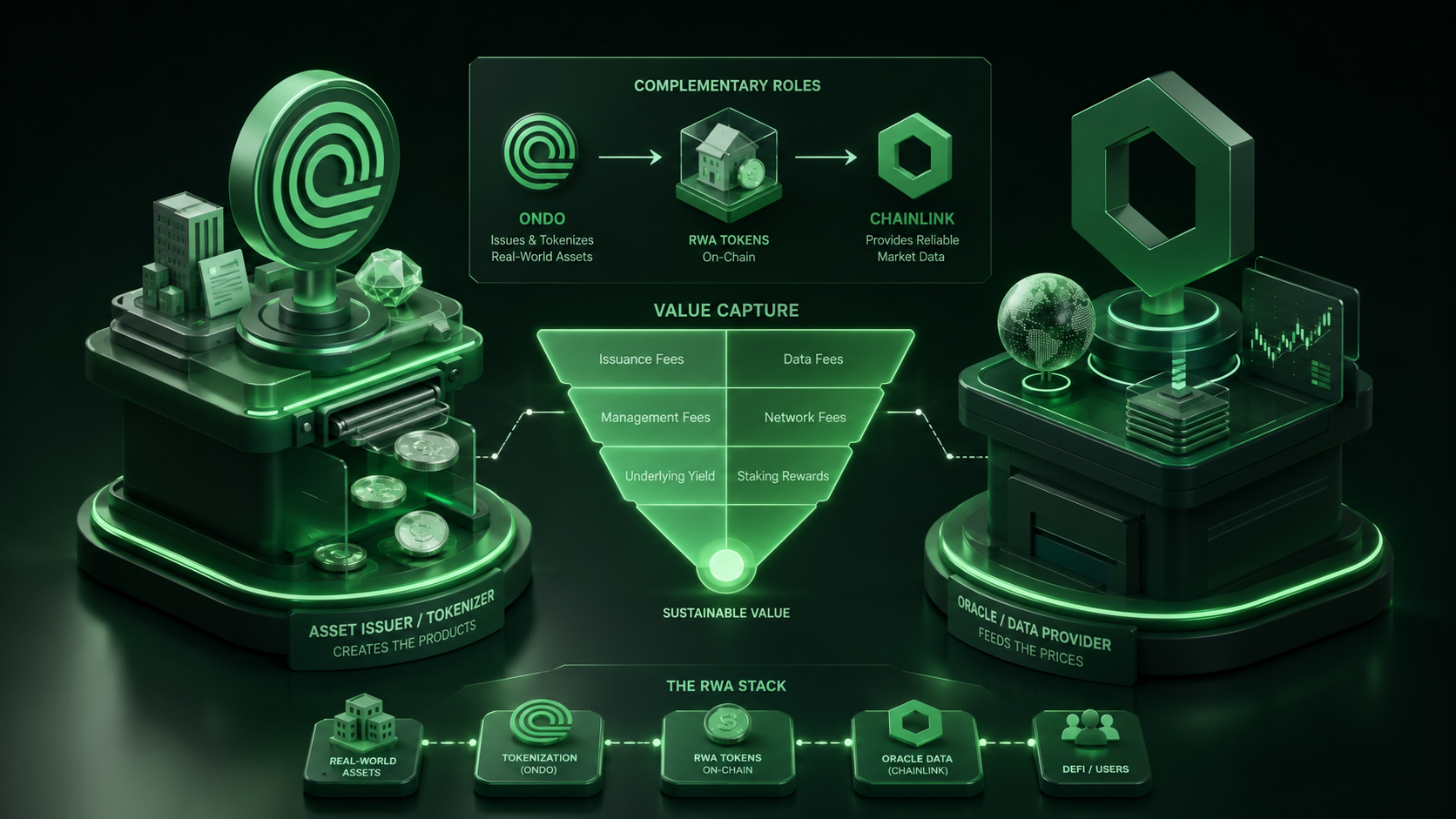
Ondo Finance and Chainlink show up in every conversation about real-world asset tokenization, often framed as competitors. The framing misses the point. These projects occupy fundamentally different layers of the RWA infrastructure stack, and their May 2025 collaboration with J.P. Morgan's Kinexys unit on a cross-chain settlement of tokenized Treasuries demonstrated exactly how they connect.
Understanding where each project creates value helps traders evaluate which token captures what type of RWA growth, and why holding both might make more sense than choosing between them.
Different Problems, Different Layers
The simplest way to frame the distinction: Ondo creates the tokenized assets. Chainlink makes sure those assets work correctly across blockchains.
Ondo operates as an asset issuer and platform builder. Its products include OUSG and USDY (tokenized Treasuries and yield-bearing stablecoins), Ondo Global Markets (200+ tokenized stocks and ETFs), and Ondo Chain, a purpose-built L1 for institutional finance. With over $600 million in TVL and roughly 60% market share in tokenized securities, Ondo is the largest issuer in this category.
Chainlink operates as infrastructure. Its oracle network provides the price feeds, proof-of-reserve verification, cross-chain messaging (CCIP), and compliance tooling that tokenized asset platforms depend on. According to INX research, Chainlink holds 67% of the oracle market and supports approximately 80% of all RWA protocols. The network has processed over $27.6 trillion in transaction value across its verified oracle services.
| Dimension | Ondo Finance | Chainlink |
|---|---|---|
| Role | Asset issuer and platform | Infrastructure and middleware |
| Core products | OUSG, USDY, Global Markets, Ondo Chain | Price feeds, CCIP, Proof of Reserve, NAVLink, ACE |
| Revenue model | Management fees on tokenized assets | Service fees paid in LINK by protocols |
| RWA focus | Creates and distributes tokenized securities | Verifies, prices, and moves tokenized securities |
| Market cap (Feb 2026) | ~$800M | ~$6B |
| Token price (Feb 2026) | ~$0.25 | ~$8.50 |
The J.P. Morgan Transaction: A Case Study
The most concrete evidence that these projects are complementary came in May 2025, when Chainlink, Ondo, and J.P. Morgan's Kinexys blockchain unit completed a cross-chain Delivery versus Payment (DvP) test transaction. According to J.P. Morgan's announcement, this was the first cross-chain atomic settlement between a permissioned banking network and a public blockchain.
The transaction worked across three systems simultaneously. Ondo provided the asset: OUSG, its tokenized U.S. Treasuries fund with over $692 million in TVL. Ondo Chain's testnet served as the settlement layer for the asset leg. Kinexys Digital Payments handled the fiat payment leg on J.P. Morgan's permissioned network. Chainlink's Runtime Environment (CRE) orchestrated the entire workflow, monitoring escrow events on Ondo Chain, translating them into instructions for Kinexys, and confirming payment completion before releasing the asset.
The transaction structure reveals why "Ondo vs Chainlink" misses the point. Ondo needed Chainlink's cross-chain orchestration to connect with J.P. Morgan's payment rails. Chainlink needed Ondo's tokenized assets and dedicated chain to have something worth settling. Neither could have completed the transaction alone.
J.P. Morgan's Kinexys platform has processed over $1.5 trillion in total transaction volume since launch, with daily volumes exceeding $2 billion. The fact that this infrastructure chose Chainlink as the bridge to public blockchain markets, and Ondo as the first asset issuer to connect through it, validates both projects' positioning.
How Each Token Captures RWA Value
ONDO and LINK accrue value through different mechanisms, which means they respond to different catalysts.
ONDO Token Dynamics
ONDO's value thesis ties directly to platform adoption. As Ondo Global Markets adds tokenized stocks and ETFs, as OUSG and USDY TVL grows, and as Ondo Chain launches its mainnet, the token benefits through staking demand, gas fees, and governance utility. The January 2026 unlock of 1.94 billion tokens created near-term supply pressure, contributing to the decline from December 2024 highs. For current technical levels and analyst forecasts, see the ONDO price prediction analysis.
ONDO performs best when Ondo announces new products, partnerships, or TVL milestones. The token is a direct bet on one company's ability to dominate tokenized securities issuance.
How LINK Accrues Value Differently
LINK captures value more broadly across the entire tokenization ecosystem. Every RWA protocol that uses Chainlink's oracles, CCIP, or compliance tools generates demand for LINK. The Chainlink staking mechanism locks tokens as collateral for node operators, reducing circulating supply. The Strategic LINK Reserve converts protocol revenue into LINK purchases, adding accumulation pressure. As of January 2026, Chainlink ETFs (Grayscale's GLNK and Bitwise's CLNK) hold $92 million in assets, and CME launched LINK futures on February 9, 2026.
LINK performs best when the entire RWA sector grows, regardless of which specific issuer leads. The token is a bet on tokenization as an infrastructure category, with exposure to DeFi ecosystem growth beyond just RWAs.
Risks Specific to Each
Ondo's concentration risk is significant. The platform depends heavily on U.S. Treasury yields remaining attractive enough to drive TVL growth, and on regulatory clarity around tokenized securities. A single adverse SEC ruling on tokenized stocks could impact Ondo Global Markets directly. The project also faces competition from BlackRock's BUIDL fund ($2B+ AUM), Securitize, and other institutional issuers entering the space.
Chainlink's value capture problem persists. Despite powering 80% of RWA protocols and processing trillions in transaction value, LINK has traded down 84% from its May 2021 all-time high of $52.99. Critics argue that oracle services face commoditization pressure and that LINK's price doesn't adequately reflect the network's usage. The Chainlink price prediction outlook explores whether institutional products like ETFs and CME futures can change that dynamic.
Shared regulatory risk affects both. RWA tokenization operates in regulatory gray zones across most jurisdictions. Favorable regulation (like the CFTC's expanding jurisdiction over digital assets) benefits both tokens. Restrictive regulation around tokenized securities or oracle liability would pressure both, though through different channels.
Complementary Bets on Tokenized Finance
Ondo and Chainlink represent two distinct investment theses within the same macro trend. Ondo offers concentrated exposure to the leading tokenized securities issuer, with upside tied to product launches, TVL growth, and Ondo Chain's mainnet debut. Chainlink provides diversified exposure to RWA infrastructure, benefiting from sector-wide adoption regardless of which issuers win market share.
The RWA market grew from $8.6 billion to over $23 billion in the first half of 2025 alone, according to CoinTelegraph. Industry projections from Bitwise and Security Token Market estimate the sector could reach $600 billion by 2030. Both projects are positioned to capture meaningful portions of that growth, at different layers and with different risk profiles.
Trade ONDO on LeveX spot markets or through ONDO perpetual futures to position around platform catalysts. For broader RWA infrastructure exposure, access LINK spot and LINK futures trading on LeveX. Explore our Crypto in a Minute series for deeper coverage of both projects and the tokenization ecosystem.