
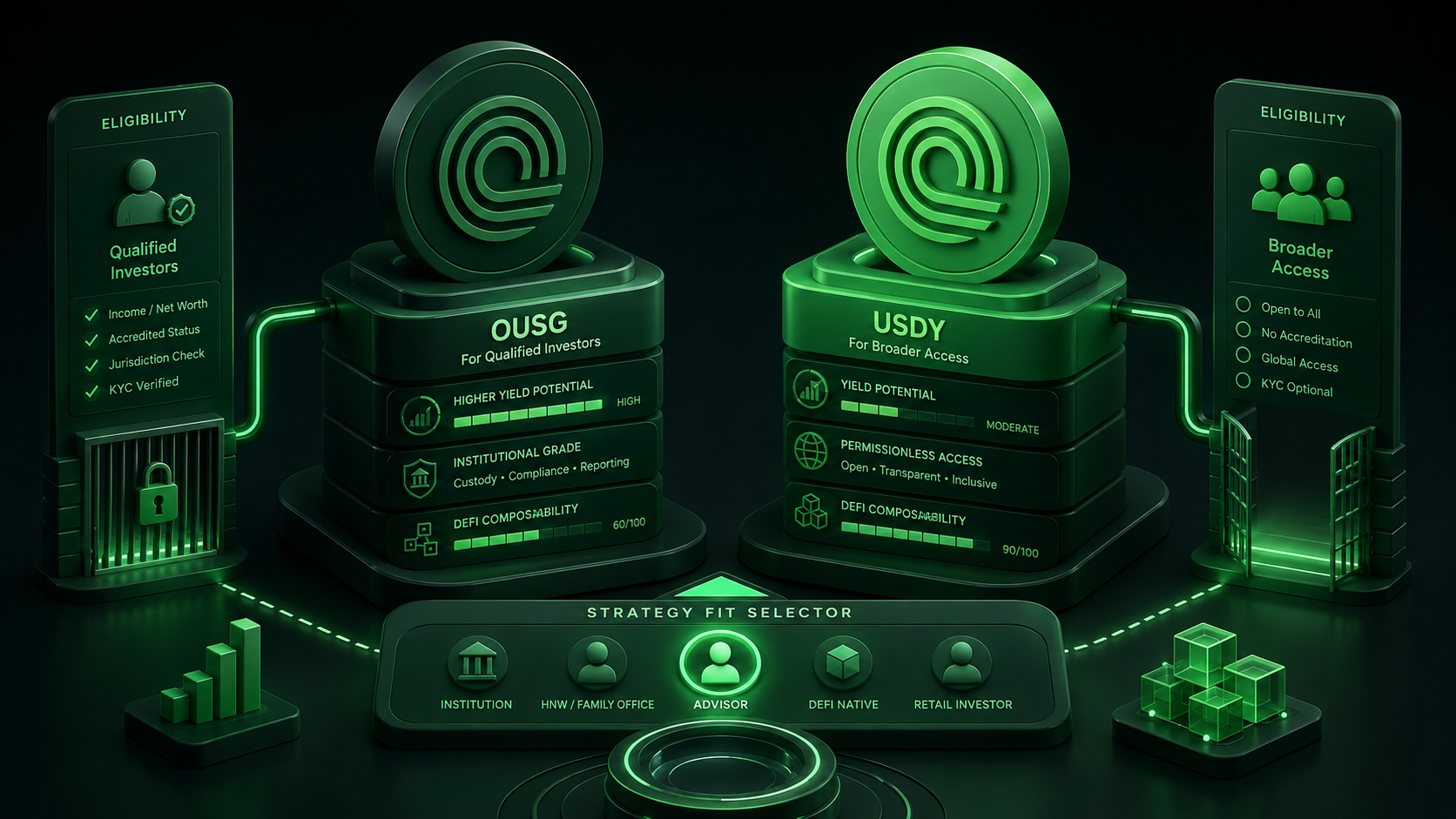
Ondo Finance manages over $2.5 billion in tokenized assets across two flagship products that serve fundamentally different audiences. OUSG targets U.S. institutional investors seeking on-chain Treasury exposure, while USDY functions as a yield-bearing stablecoin alternative for non-U.S. participants across more than ten blockchain networks. Choosing between them depends on where you're located, how you plan to use the tokens, and whether DeFi composability matters to your strategy.
What Each Product Actually Does
OUSG: Tokenized Treasury Fund
OUSG (Ondo Short-Term US Government Treasuries) provides direct exposure to short-term U.S. Treasury securities through a tokenized fund structure. The portfolio invests primarily in BlackRock's BUIDL fund, with additional allocations to Franklin Templeton, WisdomTree, Fidelity, and Wellington Management vehicles. According to Ondo's official documentation, the product supports 24/7 instant minting and redemption with a $5,000 minimum for instant transactions.
Eligibility is restricted to U.S. Qualified Purchasers who complete KYC verification. Every transfer of OUSG tokens requires both parties to be verified, meaning the token cannot circulate freely on secondary markets. This restriction reflects its regulatory classification as a securities product under SEC Regulation D.
USDY: Yield-Bearing Dollar Token
USDY takes a different approach entirely. Backed by short-term U.S. Treasuries and bank demand deposits, it functions as a yield-generating alternative to traditional stablecoins like USDC and USDT. The key distinction: after an initial restricted period following purchase, USDY can trade freely among anyone in eligible geographies without requiring recipient KYC.
As of December 2025, USDY was folded into the Ondo Global Markets umbrella. The token has been deployed across Ethereum, Solana, Base, Arbitrum, Mantle, Sei, Stellar, Celo, and XRP Ledger, with TVL exceeding $1 billion. Non-U.S. individual and institutional investors can access it, but U.S. persons are explicitly excluded.
Head-to-Head Comparison
| Feature | OUSG | USDY |
|---|---|---|
| Target Audience | U.S. Qualified Purchasers | Non-U.S. individuals and institutions |
| Approximate APY | ~3.75% | ~3.75–4% |
| Minimum Investment | $5,000 (instant) | Lower threshold, varies by channel |
| Backing | BlackRock BUIDL + multi-manager Treasury portfolio | Short-term Treasuries + bank demand deposits |
| Transfer Restrictions | KYC required for all transfers | Freely tradeable after restricted period |
| Chains Supported | Ethereum, XRP Ledger | 10+ chains including Ethereum, Solana, Base, Arbitrum |
| Management Fee | 0.15% | Embedded in yield spread |
| DeFi Composability | Limited (Flux Finance, permissioned protocols) | Broad (lending, swaps, collateral across DeFi) |
| Rebasing Version | rOUSG | rUSDY |
| Regulatory Framework | SEC Regulation D | Non-U.S. securities exemptions |
Both products deliver similar yields because they draw from the same underlying asset class. The spread between them reflects fee structures and slight differences in portfolio composition rather than meaningful risk divergence.
Yield Mechanics and DeFi Integration
Both OUSG and USDY come in two flavors: accumulating and rebasing. The accumulating versions (OUSG and USDY) increase in price as yield accrues, meaning a token purchased at $100 might be worth $103.75 after a year. The rebasing versions (rOUSG and rUSDY) maintain a stable $1.00 price while distributing yield as additional tokens to your wallet daily. Users can convert between accumulating and rebasing versions instantly on Ondo's platform.
Where OUSG Shines
OUSG's strength lies in institutional treasury management. The product integrates with Flux Finance, Ondo's lending protocol, where OUSG holders can use their tokens as collateral to borrow stablecoins without selling their Treasury position. JPMorgan executed its first public settlement of OUSG tokenized Treasuries using Chainlink for cross-chain delivery. Mastercard's Multi-Token Network integration also positions OUSG as a potential cash management tool for banking partners.
The tradeoff is limited composability. Because every OUSG transfer requires KYC verification, the token can only move within Ondo's permissioned ecosystem. DeFi protocols that want to integrate OUSG must implement compliance layers that most permissionless platforms don't support.
Where USDY Wins
USDY's permissionless secondary market makes it far more versatile across DeFi. On Solana, USDY has been integrated into lending protocols like Kamino Finance for collateralization. On Sei, it went live across multiple DeFi verticals within hours of deployment, including swaps, lending markets, and cross-chain bridging through LayerZero. According to TheNewsCrypto's analysis, USDY delivers approximately 4% APY across ten chains with $1.5 billion in TVL.
This broader composability makes USDY attractive for users who want yield on idle capital while retaining the ability to deploy those tokens across DeFi strategies. The rebasing version (rUSDY) particularly suits protocols that need stable unit pricing for accounting purposes.
Which Product Fits Your Situation
Geography determines your starting point. U.S.-based investors can access OUSG but cannot hold USDY. Non-U.S. investors have access to USDY and, in some cases, may also qualify for OUSG depending on their accreditation status and jurisdiction.
Beyond eligibility, three factors shape the decision:
Capital deployment goals. If you're managing institutional or corporate treasury funds and want clean regulatory documentation with blue-chip custodian backing, OUSG provides that framework. The BlackRock BUIDL allocation and multi-manager portfolio structure appeal to compliance teams that need identifiable counterparties.
DeFi strategy requirements. If you plan to use tokenized Treasuries as collateral, provide liquidity, or integrate yield into DeFi positions across multiple chains, USDY's permissionless transferability gives you flexibility that OUSG cannot match. The ten-chain deployment means you can access USDY wherever your DeFi activity concentrates.
Yield optimization approach. Both products deliver comparable returns in the 3.75–4% range. The difference emerges in what you can do around that yield. USDY holders can layer additional returns by supplying to stablecoin vaults or lending protocols. OUSG holders are limited to Flux Finance and other permissioned venues, though these integrations continue expanding.
For traders monitoring how Ondo's product adoption affects the ONDO token itself, our ONDO price prediction analysis examines the disconnect between platform TVL growth and token price performance.
Choosing Based on What You Need
OUSG and USDY represent two philosophies for bringing Treasury yields on-chain. OUSG prioritizes regulatory clarity and institutional credibility through its permissioned structure and BlackRock-backed portfolio. USDY prioritizes accessibility and DeFi composability through permissionless transfers across a growing multi-chain footprint. The yield difference between them is negligible because both draw from the same asset class.
Ondo's broader ecosystem continues expanding around both products. Ondo Global Markets now offers tokenized equities and ETFs, while the planned Ondo Chain L1 aims to provide purpose-built infrastructure for regulated RWA trading. How these developments affect each product's utility and the ONDO governance token's value will shape the investment thesis through 2026 and beyond.
Trade ONDO on LeveX spot markets or access leveraged positions through ONDO perpetual futures. Explore our Crypto in a Minute series for guides on other tokenized asset projects and DeFi infrastructure.