
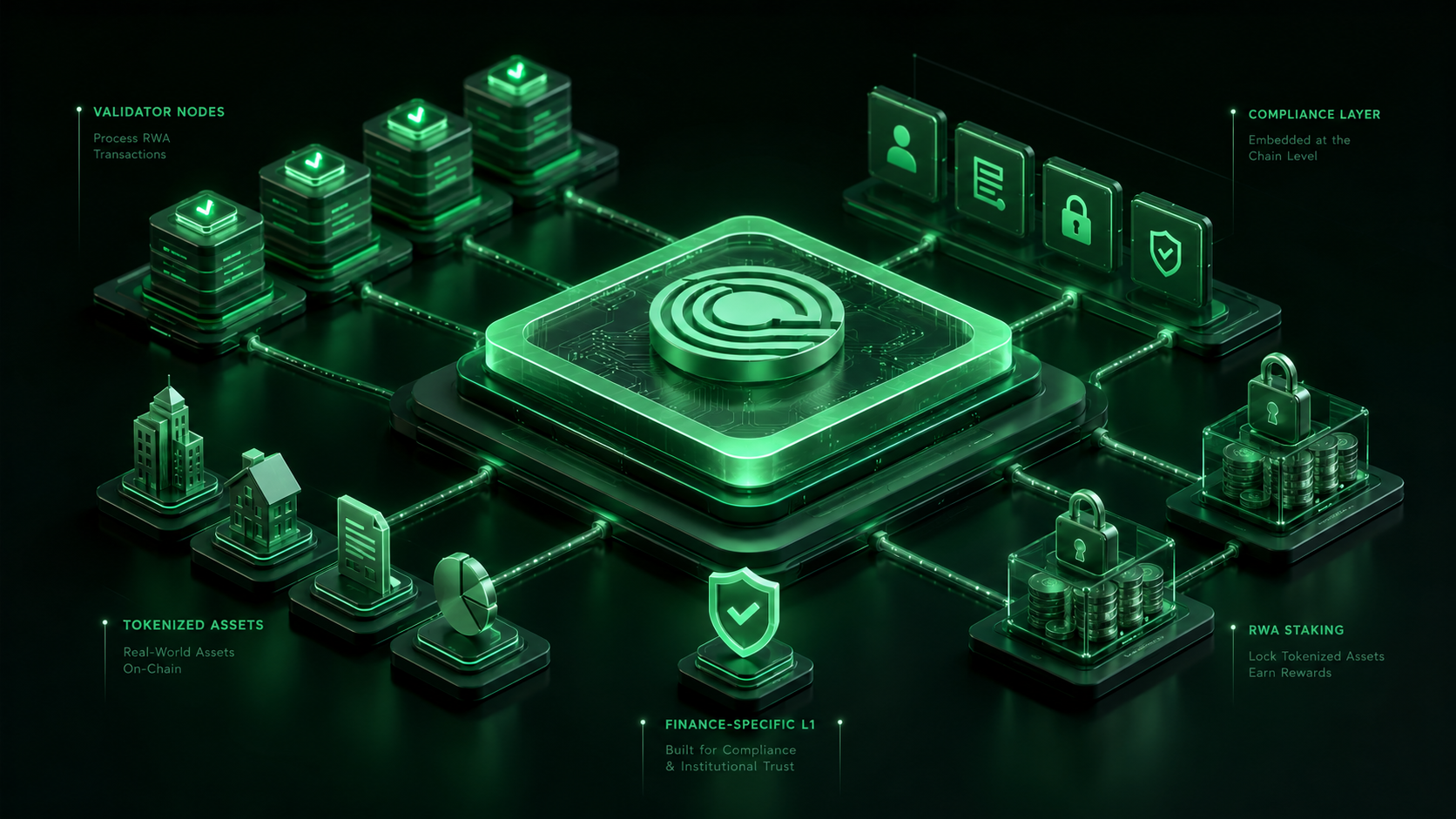
Ondo Finance already operates the largest tokenized securities platform by TVL, with over $600 million in tokenized stocks and ETFs distributed across Ethereum, Solana, and BNB Chain. Ondo Chain is the next piece: a purpose-built Layer 1 blockchain designed specifically for institutional-grade financial markets. Announced at the inaugural Ondo Summit in February 2025, the network combines permissioned validation by regulated financial institutions with open access for developers and users.
Franklin Templeton, Wellington Management, WisdomTree, Google Cloud, ABN Amro, Aon, and McKinsey all signed on as design advisors, according to The Block's coverage of the announcement. That roster signals where Ondo Chain sits on the spectrum between crypto-native infrastructure and traditional financial plumbing.
Why Build a Dedicated Chain?
Ondo's existing products, including OUSG and USDY, already function across multiple public blockchains. Building a separate L1 might seem redundant until you look at the five problems Ondo identified with deploying tokenized securities on general-purpose chains.
Corporate actions compatibility creates friction that general-purpose blockchains weren't designed to handle. Stock splits, dividend reinvestments, and merger-related adjustments require coordinated token supply changes that most DeFi protocols can't process natively. On Ondo Chain, these mechanics are built directly into the infrastructure layer, eliminating the application-level workarounds that general-purpose chains require.
Liquidity fragmentation worsens each time a tokenized asset deploys on another chain. Assets split across Ethereum, Solana, and BNB Chain create isolated pools that reduce depth for traders on each network. Ondo Chain's native omnichain bridging, powered by its own decentralized verifier network (DVN), centralizes settlement while maintaining distribution across chains.
Gas fee volatility on public chains makes institutional cost planning unpredictable. When Ethereum gas spikes during a memecoin frenzy, an institution trying to settle a large tokenized equity trade gets caught in the same congestion. A dedicated chain with controlled throughput eliminates that variable.
Network security concerns keep regulated entities off public chains entirely. Banks and broker-dealers face compliance restrictions around holding crypto assets, running nodes on permissionless networks, and exposing transactions to MEV extraction. Ondo Chain addresses this through its permissioned validator set.
Regulatory barriers prevent many institutions from interacting with fully public blockchains where anonymous participants validate transactions. Ondo Chain's model, where known financial institutions operate validator nodes, provides the accountability chain that compliance departments require.
Architecture: Four Core Components
Ondo Chain is built on the Cosmos SDK with EVM compatibility, according to CoinMarketCap's technical documentation. The architecture breaks into four pillars that differentiate it from both public L1s and private enterprise chains.
Permissioned Validators with Open Access
The validator set consists of institutional asset managers, broker-dealers, and regulated financial entities. These validators verify transactions, enforce best execution standards, and are monitored to prevent front-running and MEV extraction. The comparison Ondo draws is to the National Securities Clearing Corporation (NSCC), which requires broker-dealers to post high-quality collateral when participating in settlement.
The permissioning applies only to the validator layer. Anyone can issue tokens, deploy smart contracts, build applications, or transact on Ondo Chain. This creates what Ondo calls a "public permissioned" model: institutional-grade validation with permissionless usage.
RWA-Backed Staking
Traditional proof-of-stake networks secure themselves with volatile native tokens. When token prices drop 80%, the economic security of the network drops proportionally. Ondo Chain allows validators to stake tokenized real-world assets, including Ondo Global Markets tokens and other high-quality liquid securities, as primary collateral securing the network.
This approach reduces volatility risk in the security model while letting staked assets continue generating yield. A validator staking tokenized Treasury bonds earns the underlying bond yield while simultaneously contributing to network security.
Enshrined Oracles and Proof of Reserves
Most blockchains rely on third-party oracle networks to bring off-chain data on-chain. Ondo Chain embeds oracle functionality directly into the consensus layer. Validators automatically verify asset prices through integrated price feeds and confirm proof of reserves through custodian and broker-dealer attestations.
Chainlink already serves as Ondo's oracle provider across its existing multi-chain deployments. On Ondo Chain, the enshrined oracle system adds a consensus-level verification layer on top of external feeds, creating redundancy that reduces the risk of price manipulation or stale data affecting tokenized securities.
Native Omnichain Bridging
External bridging protocols have been responsible for billions in crypto losses. Ondo Chain integrates cross-chain messaging and asset transfers directly into the network, bypassing that vulnerability entirely. The Ondo DVN and multi-attestation protocols handle transfers between both EVM and non-EVM networks.
For higher-value transfers, additional third-party DVNs can be layered on top, balancing speed against security. The system also connects to private, permissioned chains, meaning an institutional partner running its own internal ledger can interface with Ondo Chain's public infrastructure.
What Ondo Chain Enables
The chain's design enables use cases that existing deployments on Ethereum and Solana cannot fully support.
| Use Case | How It Works |
|---|---|
| On-chain prime brokerage | Cross-collateralization across RWAs and crypto with margin from both on-chain and off-chain sources |
| Automated wealth management | 24/7 portfolio rebalancing across equities, ETFs, fixed income, and crypto |
| Cross-chain token issuance | Issue tokens that automatically function across multiple chains with configurable bridging conditions |
| Stablecoin distribution | Distribute stablecoins backed by tokenized securities across supported blockchains |
| RWA restaking | Stake Ondo Chain assets to secure emerging protocols during bootstrapping phases |
The on-chain prime brokerage vision ties directly into the recently announced Ondo Perps platform, which enables perpetual futures trading on tokenized equities with up to 20x leverage. Traders can use tokenized securities as collateral, and Ondo Chain provides the settlement infrastructure where these products converge.
Launch Timeline and Current Status
Ondo Chain's testnet development was reported as nearly complete in the official documentation, with the team focused on onboarding institutional partners including broker-dealers and distributors before mainnet goes live. Multiple sources indicate a targeted mainnet launch in early-to-mid 2026, though Ondo has not committed to a specific date publicly.
The phased approach reflects a deliberate strategy: building a meaningful institutional ecosystem before opening the network so that mainnet launches with actual participants and liquidity. Given that Ondo Global Markets already has over $9 billion in cumulative trading volume and tens of thousands of asset holders, the chain won't be starting from zero.
Risks Worth Weighing
Centralization trade-offs are inherent in the permissioned validator model. While institutional validators provide compliance benefits, they also concentrate control among a relatively small group of entities. The chain's governance model will need to evolve credibly toward broader participation to attract crypto-native developers and users who prioritize decentralization.
Execution risk around mainnet launch looms large. Ondo Chain is competing for developer attention against established L1s and L2s with years of production experience. The Cosmos SDK provides a proven foundation, but building institutional-grade financial infrastructure on top of it introduces complexity that general-purpose chains don't face.
Token utility questions persist. ONDO trades around $0.25 as of early February 2026, down significantly from its December 2024 highs despite accelerating platform adoption. The January 2026 unlock of 1.94 billion tokens added supply pressure. Whether Ondo Chain's launch creates meaningful new demand for ONDO through staking, gas fees, and governance depends on how quickly the network attracts institutional usage. For deeper analysis, see the ONDO price prediction coverage.
Ondo's Infrastructure Bet
Ondo Chain represents a bet that tokenized finance needs purpose-built infrastructure designed from the ground up for regulated securities. The four-pillar architecture, combining permissioned validators, RWA-backed staking, enshrined oracles, and native omnichain bridging, addresses specific pain points that have limited institutional adoption of public chains. The design advisory roster from Franklin Templeton to Google Cloud suggests the target market takes the project seriously.
The open question is timing. Ondo Global Markets proved product-market fit for tokenized equities across existing chains. Ondo Chain's value proposition depends on demonstrating that a dedicated L1 can deliver meaningfully better outcomes for institutional participants, from lower costs and faster settlement to compliance guarantees that Ethereum and Solana cannot match natively.
Trade ONDO on LeveX spot markets to accumulate ahead of the chain launch, or use ONDO perpetual futures to position around development milestones. Explore our Crypto in a Minute series for coverage of other Layer 1 networks and RWA infrastructure projects.