
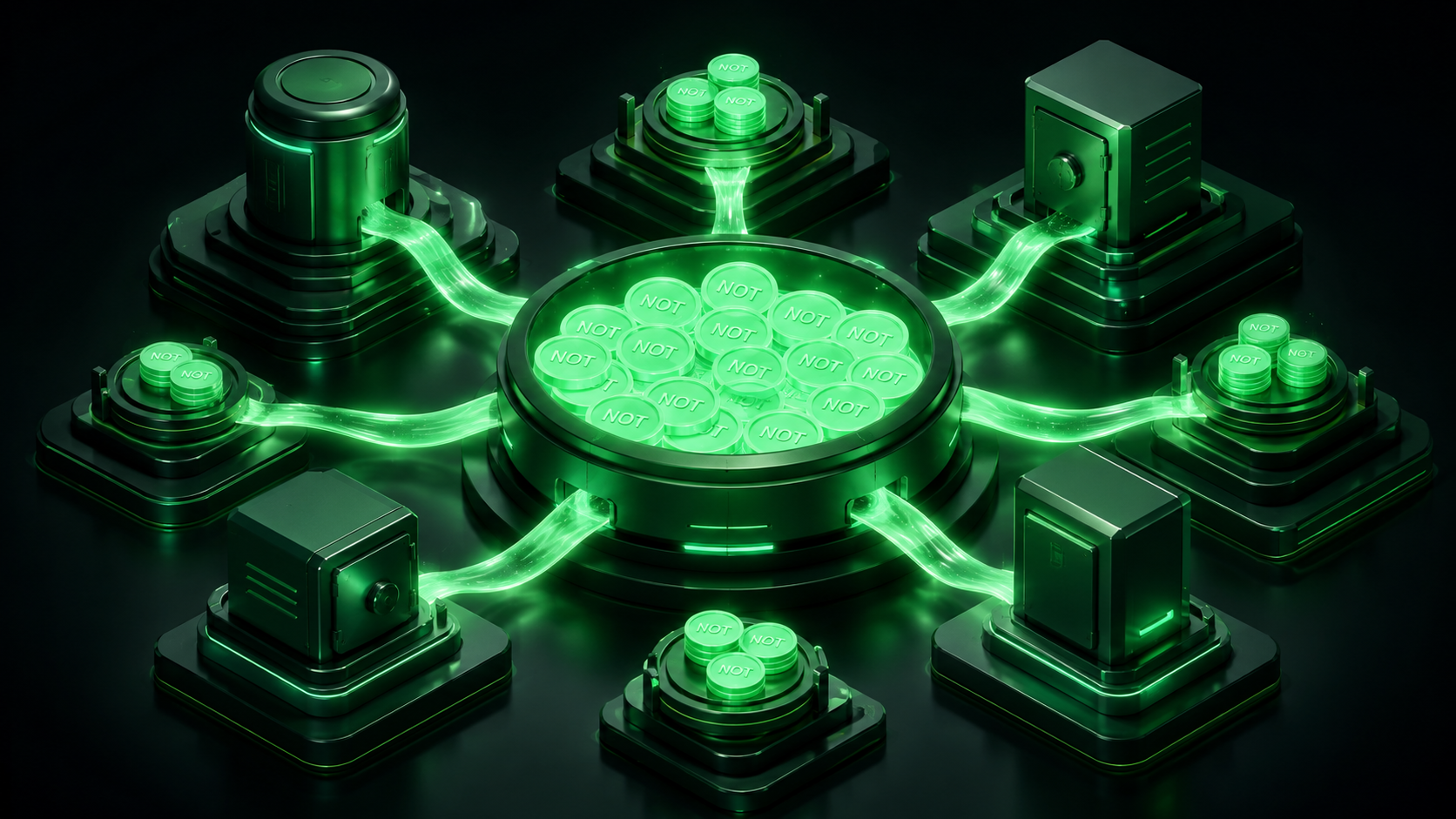
Notcoin Explore pays users in NOT for completing promotional tasks that crypto projects fund. A project deposits a pool of Notcoin tokens, sets a campaign of actions such as joining a channel or opening a mini app, and users who complete those actions split the pool according to their staking tier. More than 200 projects have run campaigns this way, drawing around 22.5 million participants.
That makes Explore the closest thing NOT has to a business. The tapping game ended in April 2024, and what replaced it is an advertising exchange where the audience gets paid directly instead of a platform pocketing the spend.
How a Campaign Actually Works
The flow is the same whether the advertiser is a TON game or a DeFi protocol on another chain.
- A project funds a pool. It buys NOT on the open market and deposits it as the campaign budget.
- The campaign defines tasks. Typical actions are following a social account, joining a Telegram channel, opening a partner mini app, or holding a specific token for a period.
- Users complete the tasks inside the Notcoin app. Verification happens automatically for on-chain and Telegram actions.
- Rewards accrue rather than paying out instantly. Decrypt described these earning missions as passive when they launched, because a user who completes a campaign keeps drawing from the pool over its duration.
- Your share depends on your tier. Two users completing identical tasks receive different amounts based on how much NOT each has staked.
Step five is the design decision that gives the token a job. Without it, Explore would be a task board that pays in a currency nobody has any reason to hold.
The Tier System That Decides Your Share
Levels run from entry tiers up to Platinum, and the sole input is the amount of NOT staked in the app. The team said Platinum multiplies base earning rates dramatically and quoted annualized returns above 300% at launch, though those figures reflected an early period with four active pools and heavy promotion behind them.
Two details matter more than the headline rate. First, the balance is assessed at the end of each month, so depositing NOT the day before a claim achieves nothing. The design deliberately rewards holding across a full cycle. Second, this is staking in the loyalty-program sense. NOT validates no blocks and secures no network, so the yield is funded by advertiser budgets rather than by protocol inflation.
The consequence for supply is direct: every tier upgrade locks tokens that would otherwise sit on an exchange. Given that 97% of the NOT supply already circulates, as covered in the Notcoin tokenomics breakdown, staked balances are the only meaningful mechanism removing float from the market.
Who Actually Pays for the Rewards
Advertisers do, and understanding why they bother is the key to judging whether Explore lasts.
A TON project launching a mini app faces the same acquisition problem every consumer app faces, with the added handicap that most paid channels restrict crypto advertising. The pool of potential advertisers grew in 2025, when TON became the exclusive blockchain for Telegram mini apps and every competing project on the platform had to migrate across. Notcoin offers a Telegram-native audience that has already installed a wallet and already claimed a token, which removes the two hardest steps in crypto onboarding. Paying that audience in NOT to try a product costs less than most alternatives and converts better, because the users are pre-qualified.
The obvious objection is that reward-motivated users churn. They do. But the advertiser is often buying a measurable on-chain action rather than a loyal customer, which makes the spend rational even at high churn. That is a more durable arrangement than asking the same players to keep grinding a game, which is the retention strategy that failed for other tap-to-earn projects, as the Notcoin and Hamster Kombat comparison shows.
Exchanges run structurally similar programs. LeveX's own Quests system pays traders for completing platform milestones, on the same logic that a reward tied to a specific action beats an untargeted marketing budget.
What Explore Means for the NOT Token
Campaign funding is the transmission belt between Notcoin's product and NOT's price. Each new pool requires an advertiser to acquire tokens, and each tier upgrade requires a user to hold them. Neither is large in absolute terms against the $50 million market capitalization CoinGecko records for NOT in September 2026, and both are real.
This also makes NOT unusually easy to model in one respect. The token has no burn, no fee switch and no governance rights, so its demand curve is essentially the sum of campaign budgets on TON plus whatever speculative flow the ticker attracts. Any serious NOT price forecast is a forecast of TON marketing spend wearing a chart pattern as a disguise.
The risk sits in the same place. Campaign volume tracks how much funding TON projects have raised, and that funding tracks the broader altcoin cycle with a lag. A quiet year for TON fundraising means fewer pools, smaller pools, thinner yields, and less reason to stake.
The Limits of Earning This Way
Explore is a reasonable way to accumulate small amounts of NOT and a poor way to build a position. The arithmetic is unsentimental: reaching a tier that meaningfully raises your share requires staking a quantity of NOT worth considerably more than the rewards a casual participant will earn from it.
The people for whom the system works are those who already hold NOT and want it to do something while they wait. For everyone else, buying the token outright costs less time than farming it. That is a feature rather than a flaw, since the design exists to give holders a reason to hold rather than to pay strangers.
Task-completion rewards also carry the usual hygiene warnings. Campaigns route users to third-party apps, and the presence of a project inside Explore is a paid placement rather than an endorsement. Connecting a wallet to an unfamiliar mini app for a few dollars of NOT is a bad trade at any tier.
Frequently Asked Questions
How much can you earn from Notcoin Explore?
Earnings depend on your staking tier and the size of active campaign pools, and for most participants amount to small sums rather than meaningful income. Higher tiers multiply the base rate substantially, but reaching them requires staking a NOT balance worth far more than typical rewards.
Do you need to stake NOT to use Explore?
You can complete campaigns without staking, but your share of each reward pool will be at the lowest tier. Staking NOT raises your level, and the balance held at the end of each month determines whether you move up or down the ladder.
Is Notcoin Explore free to use?
Yes for users. Projects pay to run campaigns by funding the reward pool in NOT, so the cost sits with the advertiser. Users only need a Telegram account and a connected TON wallet to claim.
Why the Advertising Model Outlasted the Game
Notcoin's second act is more conventional than its first. Tens of millions of taps built an audience, and that audience is now inventory sold to projects that want Telegram users. The novelty is that the audience gets paid directly, which is what makes the token necessary at all.
Whether the arrangement holds depends on something outside Notcoin's control, namely how much money TON projects have to spend on acquiring users. Explore gives NOT a functioning reason to exist while that question resolves, which is more than most tokens from the 2024 airdrop cohort can claim.
Ready to hold NOT rather than farm it? Buy NOT on the spot market or trade the moves with NOT perpetual futures on LeveX. More TON ecosystem coverage sits in Crypto in a Minute.