
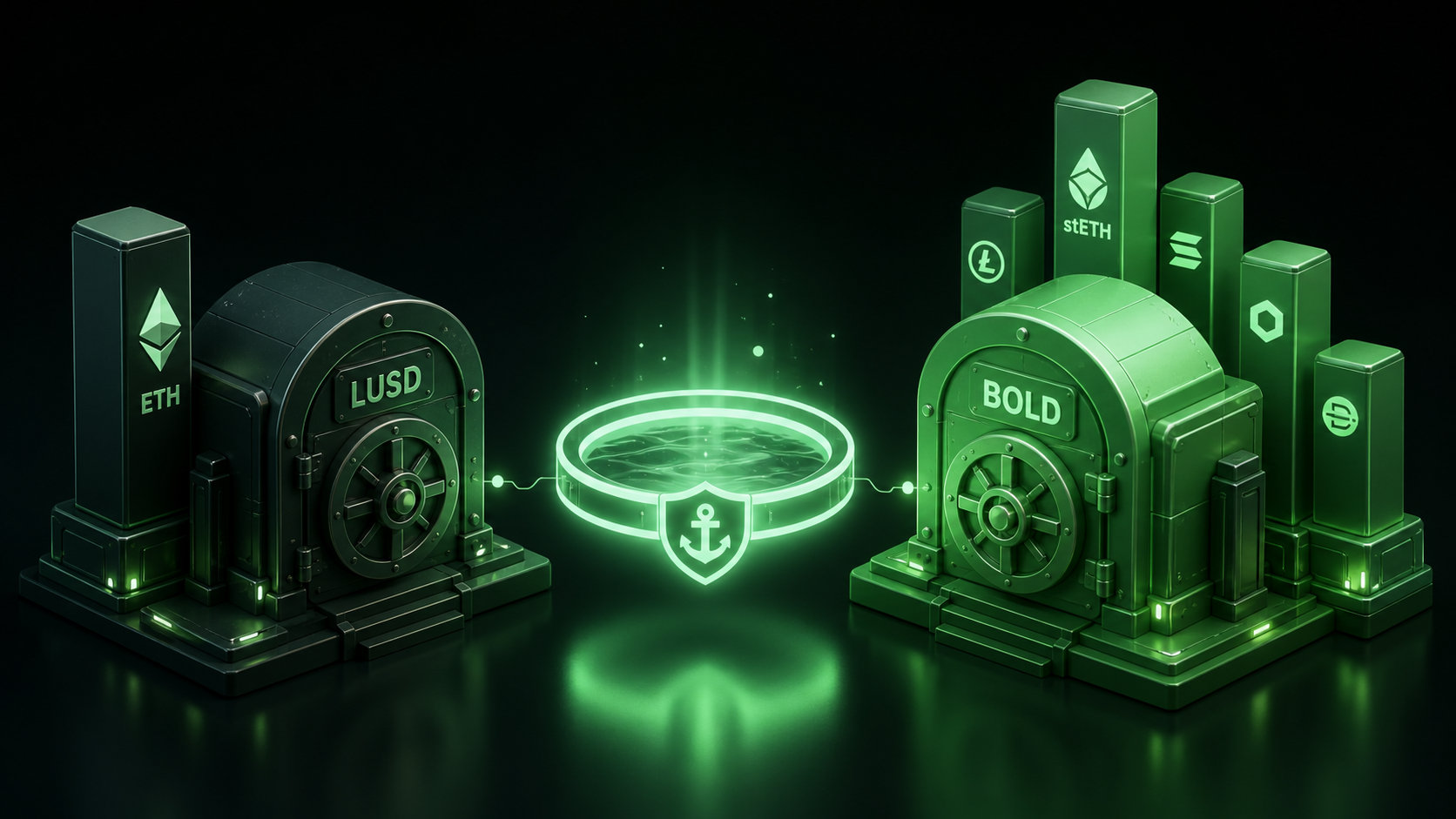
The strangest fact about Liquity is that its older protocol is still the bigger one. As of August 2026, Liquity V1 holds roughly $142 million in collateral against V2's $72 million, more than five years after V1 launched and over a year after V2's relaunch. Both run on Ethereum, both are immutable, and both feed the same LQTY token. They are otherwise different products aimed at different borrowers.
V1 issues LUSD at 0% recurring interest against ETH. V2 issues BOLD at whatever rate the borrower chooses, against ETH and two liquid staking tokens. That single distinction cascades into almost everything else.
The Core Differences at a Glance
| Liquity V1 | Liquity V2 | |
|---|---|---|
| Stablecoin | LUSD | BOLD |
| Launched | April 2021 | January 2025, redeployed May 2025 |
| Collateral | ETH only | WETH, wstETH, rETH |
| Borrowing cost | One-off fee, 0% ongoing | Continuous rate set by the borrower |
| Max LTV | 90.91% | 90.91% ETH, 83.33% for the staking tokens |
| Minimum debt | 2,000 LUSD | 2,000 BOLD |
| Holder yield | None on LUSD directly | 75% of borrower interest to Stability Pool depositors |
| Stress mechanism | Recovery Mode, system-wide | Safety Mode and Shutdown Mode, per collateral branch |
| Redemption fee | Paid to LQTY stakers | Stays with the redeemed borrower |
| TVL (Aug 2026) | ~$142M | ~$72M |
Figures from DefiLlama, August 2026.
Why V1 Still Holds More Collateral
A 0% loan with no maturity is difficult to beat. A V1 borrower who opened a Trove in 2022 has paid nothing since the day they drew it, and their debt is exactly the number it was on day one. Moving that position to V2 means starting to pay interest every second, forever, in exchange for slightly better collateral flexibility and access to a stablecoin with yield attached.
For borrowers who intend to hold the loan indefinitely and never touch it, that trade is unattractive on its face. V1's design also has no Stability Pool yield to lose, since the original protocol pays LQTY emissions rather than real revenue to its depositors, and those emissions have long since wound down.
The catch is that V1 is frozen in time. It supports one collateral asset, it retains Recovery Mode, and no future feature will ever reach it. Its TVL is a legacy book rather than a growing one, and the fee revenue it produces for LQTY stakers arrives only when someone opens a new loan or triggers a redemption.
What V2 Changed, and Why
Multiple Collateral Branches
V2 runs three separate borrow markets, each with its own Stability Pool, rate curve, and shutdown threshold. A failure in one branch does not directly liquidate borrowers in another, though BOLD holders are exposed to all three because the stablecoin's backing pools them. V1 accepted ETH alone, which was cleaner but excluded the enormous pool of staked ETH that borrowers actually hold.
Interest That Someone Actually Chooses
V1's 0% headline hid a real cost: the one-off borrowing fee floated with redemption pressure and could reach 5%. V2 replaces it with a continuous rate the borrower sets, which does two things at once. It creates a live price for credit that adjusts without governance, and it funds BOLD's native yield so Stability Pool depositors earn revenue rather than token emissions.
Recovery Mode Replaced
V1's Recovery Mode kicks in when the whole system's collateral ratio drops below 150%, and it can put otherwise healthy Troves at risk of liquidation. V2 removed it. Safety Mode restricts actions that would worsen a branch's collateralization without threatening any individual position, and it lifts automatically once the ratio recovers. A branch that deteriorates far enough enters a permanent Shutdown Mode instead, which winds it down through fee-free redemptions with a 2% collateral bonus rather than by liquidating users.
What This Means for LQTY Holders
LQTY stakers earn from both protocols simultaneously, which is unusual and easy to misread. V1 pays them directly in LUSD and ETH from borrowing and redemption fees. V2 gives them no direct cut of interest at all. Instead it routes 25% of interest revenue to a weekly incentive budget that stakers vote to allocate, while 75% goes to Stability Pool depositors.
So the migration from V1 to V2 converts a direct fee claim into governance influence over a growing pool. Whether that is an upgrade depends entirely on how large the V2 debt book becomes, and LQTY's fixed supply and fee structure mean there is no other lever available to improve the outcome. Every dollar that migrates from V1 to V2 turns a one-off fee into a recurring one, which is the trade LQTY holders are implicitly rooting for.
Liquity's redeployment history matters here too. V2's original January 2025 deployment was retired after a Stability Pool flaw surfaced in February, and the protocol relaunched in May 2025 following an audit competition with more than 800 researchers. That four-month gap cost V2 the momentum it needed to overtake V1, and the gap in TVL has never closed.
Frequently Asked Questions
Should I use Liquity V1 or V2?
Use V1 if you want a long-term ETH-backed loan with no recurring interest and you are comfortable with a protocol that will never be updated. Use V2 if you hold wstETH or rETH, want to control your own borrowing rate, or want to earn yield on the stablecoin you mint. Short-term borrowers are generally better served by V2, since a low self-set rate can undercut V1's upfront fee.
Is LUSD being deprecated?
No. Liquity V1 is immutable and will keep running as long as Ethereum does, with no ability for anyone to shut it down or migrate users. LUSD remains fully redeemable for ETH at face value. The protocol simply receives no new features, and its collateral base has been slowly shrinking as borrowers close positions.
Can you convert LUSD to BOLD directly?
There is no protocol-level conversion between the two stablecoins. Moving between them means repaying a V1 Trove to release the ETH, then opening a V2 Trove to mint BOLD, or swapping LUSD for BOLD on the open market. The two systems share a token in LQTY but have no shared contracts.
Two Protocols, One Token
Liquity now operates as two independent systems that happen to pay the same stakers. V1 is a finished product with a loyal book of interest-free loans and no growth path. V2 is the live protocol, carrying the design ideas that twenty licensed forks are now deploying across other chains, with a smaller book and a real revenue stream.
For traders, the migration rate between them is the metric worth tracking, since it converts static fees into recurring ones and directly shapes LQTY's price outlook. The two TVL lines have been converging slowly, and the pace of that convergence says more about Liquity's future than any announcement will.
Take a view on the protocol with LQTY spot trading or LQTY perpetual futures on LeveX. For more DeFi protocol breakdowns, visit Crypto in a Minute.