
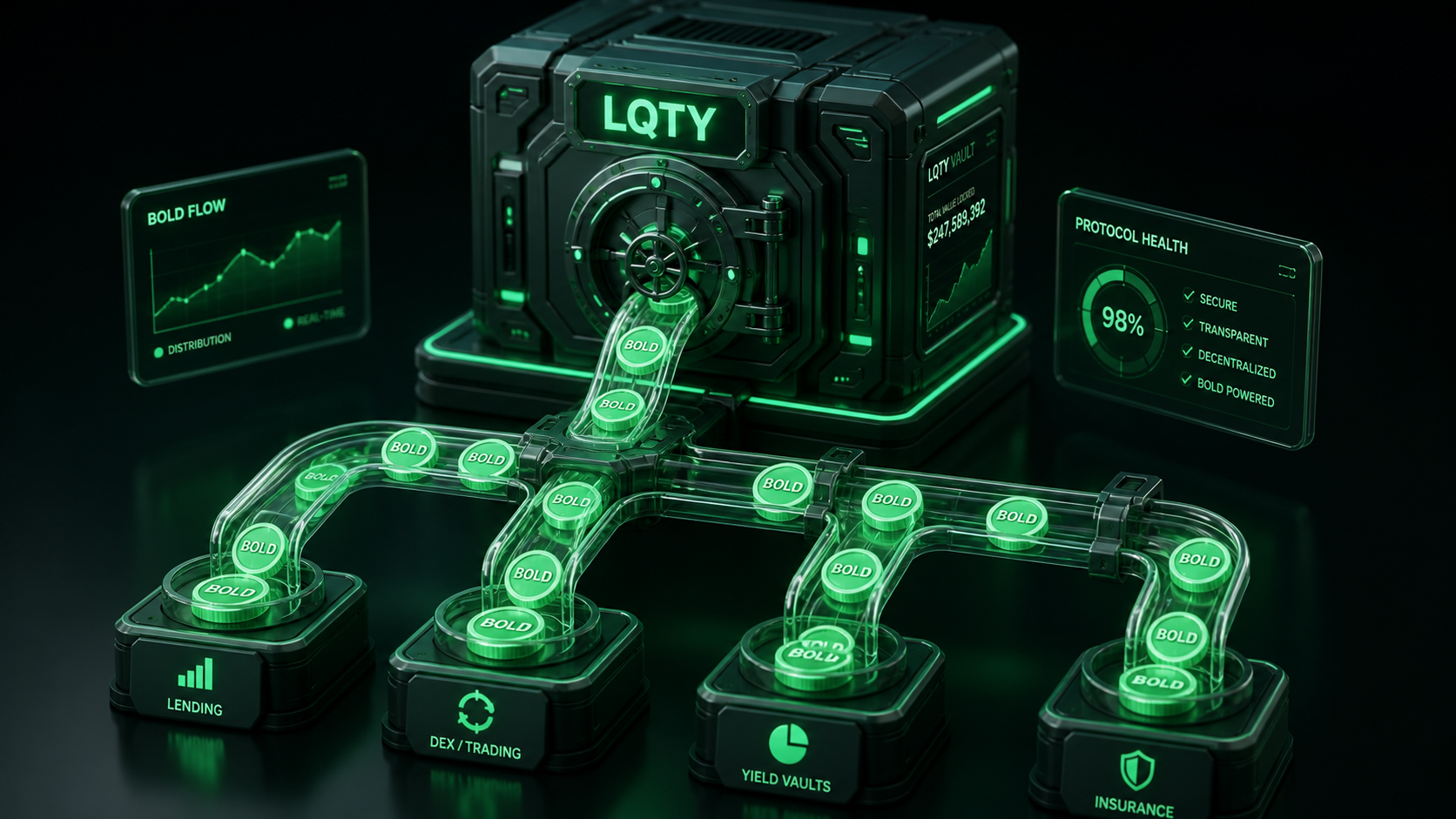
Liquity is a decentralized borrowing protocol on Ethereum that lets anyone mint a stablecoin against ETH or staked ETH collateral, with no governance, no admin keys, and no way for anyone to change the rules after deployment. LQTY is its secondary token, and it captures a slice of what borrowers pay while giving holders control over where the protocol spends its liquidity budget.
That immutability is the whole pitch. Most lending protocols ship with a multisig that can pause markets, adjust collateral factors, or raise rates by vote. Liquity ships without one, which means the parameters a borrower sees on day one are the parameters they will see in five years. The tradeoff is that a mistake cannot be patched, a lesson the team learned publicly in 2025 and one that shapes how the protocol operates today.
An Immutable Protocol With No Admin Keys
Liquity AG, based in Zurich, deployed the first version of the protocol in April 2021. Version 1 issued LUSD against ETH at a minimum collateral ratio of 110% and charged no recurring interest at all, replacing it with a one-off borrowing fee. That design attracted borrowers who wanted a loan they could leave open indefinitely without watching debt compound, and LUSD held a reputation as the most censorship-resistant dollar in Ethereum DeFi because no entity could freeze it.
Version 2 arrived in January 2025 with a new stablecoin, BOLD, and a new economic engine. Weeks later, on 12 February 2025, the team disclosed a flaw in the V2 Stability Pool contracts and told depositors to withdraw. No user funds were lost, but because the contracts could not be upgraded, the only fix was to redeploy the entire protocol. Liquity ran a five-week audit competition with more than 800 researchers, commissioned re-audits from ChainSecurity and Dedaub, and relaunched V2 on Ethereum mainnet on 19 May 2025.
Liquity AG runs no frontend of its own. Users reach the protocol through independent interfaces such as Liquity.App, DeFi Saver, LQTY.IO and Trove Zero, which keeps the access layer censorship-resistant and forces the contracts to stand on their own.
How Borrowing Works in Liquity V2
A loan in Liquity is called a Trove, and each one is an ERC-721 NFT tied to a wallet. One address can hold as many Troves as it wants, across as many collateral types as it wants, each with its own risk profile.
Setting Your Own Interest Rate
The headline feature of V2 is that borrowers choose their own rate. There is no oracle-fed curve and no governance vote setting the price of credit. A borrower picks a number, pays it continuously in BOLD, and can change it whenever they like, subject to a fee if they adjust within seven days of the last change. Opening a Trove also costs an upfront fee equal to seven days of average interest on that collateral branch, which exists to stop people cycling positions to dodge redemptions.
Rates are the mechanism through which redemption risk is priced. Set a low rate and borrowing is cheap, but redeemers reach your position sooner. Set a high rate and you pay more for the privilege of being left alone. The Liquity V2 documentation describes this as a market-driven equilibrium, and in practice it produces a visible histogram of borrower rates that new entrants position themselves against.
Collateral, Limits, and Liquidation
Three collateral assets are accepted: WETH, plus the two largest liquid staking tokens, Lido's wstETH and Rocket Pool's rETH. Each runs as a separate borrow market with its own Stability Pool, its own rate curve, and its own risk parameters.
| Branch | Max LTV | Liquidation trigger | Safety Mode (CCR) | Shutdown (SCR) |
|---|---|---|---|---|
| WETH | 90.91% | LTV above 90.91% | Branch TCR under 150% | Branch TCR under 110% |
| wstETH | 83.33% | LTV above 83.33% | Branch TCR under 160% | Branch TCR under 120% |
| rETH | 83.33% | LTV above 83.33% | Branch TCR under 160% | Branch TCR under 120% |
Minimum debt is 2,000 BOLD, and opening a Trove requires a refundable 0.0375 ETH deposit that funds the gas cost of a future liquidation. When a position crosses its LTV ceiling, the branch Stability Pool absorbs the debt and pays out the collateral, and the liquidated borrower typically loses 5% as a penalty while keeping whatever remains. If a Stability Pool runs dry, liquidators can either buy the collateral directly at 105% of the debt or trigger a redistribution that spreads the position across every other borrower on that branch.
V2 also dropped V1's Recovery Mode, which used to put healthy Troves at risk during system-wide stress. In its place, Safety Mode blocks the actions that would worsen a branch's collateral ratio without threatening anyone's position, and it lifts automatically once the ratio recovers.
Redemptions, the Mechanism That Holds the Peg
Redemptions are what make BOLD worth a dollar without a bank account behind it. Anyone holding BOLD can send it to the protocol and receive ETH and staked ETH at face value, which becomes profitable the moment BOLD trades below $1 minus the redemption fee. That arbitrage pulls the price back up, and the supply shrinks in the process.
The queue runs from the lowest interest rate upward. Redeemers do not choose which collateral they receive either. The protocol routes redemptions toward the branches with the most debt uncovered by their own Stability Pool, so the riskiest market gets drained first and the overall backing of BOLD improves with every redemption. The fee starts at a 0.5% floor, rises with redemption volume, and decays with a six-hour half-life, and unlike in V1, that fee stays with the redeemed borrower rather than being paid out to token holders.
Borrowers who would rather not think about any of this can delegate rate management to a third party. A delegate can change the rate within a preset range and can do nothing else, which caps the damage a bad manager can do to a Trove.
What LQTY Does for Holders
Every second, open Troves accrue interest in BOLD, and that revenue splits on a hard-coded ratio: 75% to Stability Pool depositors, 25% to Protocol Incentivized Liquidity. PIL is the budget LQTY stakers control. Each week, stakers direct that 25% toward on-chain addresses called initiatives, which in practice means liquidity pools, lending integrations, or anything else pitched as useful to BOLD adoption.
Voting power scales with time as well as size, calculated as staked LQTY multiplied by staking age. Fresh deposits start at zero voting power, which blocks flash-loan capture, and unstaking wipes the accumulated age. Epochs run weekly from 00:00 UTC Thursday, an initiative needs 2% of votes to qualify for any payout, and proposing one costs 100 BOLD plus 0.01% of total voting power. Stakers also keep earning LUSD and ETH from Liquity V1 fees, and external projects competing for votes have begun paying bribes on top.
The catch is scale. DefiLlama data puts V2 at roughly $72 million in TVL as of August 2026, generating about $2.02 million in annualized fees and $445,000 in annualized PIL revenue. Split weekly across competing initiatives, that is a real but modest budget, and LQTY's roughly $18 million market cap reflects it. V1 still holds about $142 million in collateral, more than the successor protocol, largely because LUSD borrowers have no interest payments to escape.
The Friendly Fork Ecosystem
Liquity V2's code ships under a business license, and more than 20 teams have signed it to deploy their own stablecoin on their own chain. Eleven were live as of August 2026, including Felix on Hyperliquid, Quill on Scroll, Nerite on Arbitrum, Orki on Swellchain, Aesyx on Avalanche, Soneta on Sonic, and Ēnosys on Flare, which launched the first XRP-backed stablecoin using the codebase.
The licensing terms are the interesting part. Each fork commits roughly 4% of its token supply to BOLD users, with the program's own estimate putting the total between $20 million and $70 million depending on valuations. Holding and using BOLD therefore earns airdrop exposure to a dozen separate ecosystems, a distribution strategy that turns a small protocol into the reference implementation for CDP design across chains. Rival decentralized stablecoins such as crvUSD have taken a different route, expanding through their own governance rather than licensing the design outward.
Frequently Asked Questions
What is Liquity used for?
Liquity is used to borrow a decentralized stablecoin against ETH or staked ETH without giving up ownership of the collateral. Borrowers open a Trove, mint BOLD, set their own interest rate, and repay whenever they choose. The second common use is earning yield by depositing BOLD into a Stability Pool, which collects most of the interest borrowers pay.
What is the difference between LQTY and LUSD?
LQTY is Liquity's secondary token, capped at 100 million units, and it captures protocol fees and directs incentive spending. LUSD is the dollar-pegged stablecoin issued by Liquity V1. BOLD is the equivalent stablecoin for V2. LQTY is the volatile asset traders speculate on, while LUSD and BOLD are designed to sit at $1.
Is Liquity safe to use?
Liquity's contracts are immutable and have no admin keys, so no team or DAO can seize funds or alter terms. The V2 codebase was rebuilt after a Stability Pool flaw was found in February 2025, then re-audited and redeployed in May 2025 following an 800-researcher audit competition. Smart contract risk, collateral risk, and liquidation risk all remain, and BOLD depends on ETH, wstETH, and rETH holding their value.
How many LQTY tokens are there?
LQTY has a hard cap of 100 million tokens, with roughly 98.8 million in circulation as of August 2026. That leaves the circulating supply at about 99% of the maximum, so future emissions have almost no dilutive effect on the price.
Can you earn passive income with LQTY?
Staked LQTY earns LUSD and ETH from Liquity V1 fee revenue and grants weekly voting power over the 25% of V2 interest revenue routed to Protocol Incentivized Liquidity. Voters can also receive payments from projects competing for those incentives. There is no lockup, though unstaking resets the accumulated voting power.
Where Liquity Sits in the Stablecoin Market
Liquity is a small protocol with an outsized influence on how decentralized stablecoins get designed. The user-set interest rate, the redemption queue ordered by rate, and the branch-level Stability Pools are ideas that arrived here first and are now running on a dozen chains through licensed forks. The rating agency Bluechip scores BOLD at A-, above widely held centralized alternatives, which is an unusual result for a stablecoin this small.
For traders, the interesting question is whether that design influence ever translates into fee revenue. LQTY's value accrual is tied to interest paid on a $72 million book, and at a roughly $18 million market cap the token trades close to a bet that borrowing demand for a fully immutable dollar eventually scales. The fork ecosystem is the clearest path to that, since every deployment expands the design's reach even when the fees land elsewhere.
You can trade LQTY on the spot market or take a leveraged view with LQTY perpetual futures on LeveX. For breakdowns of other DeFi tokens, browse Crypto in a Minute.