
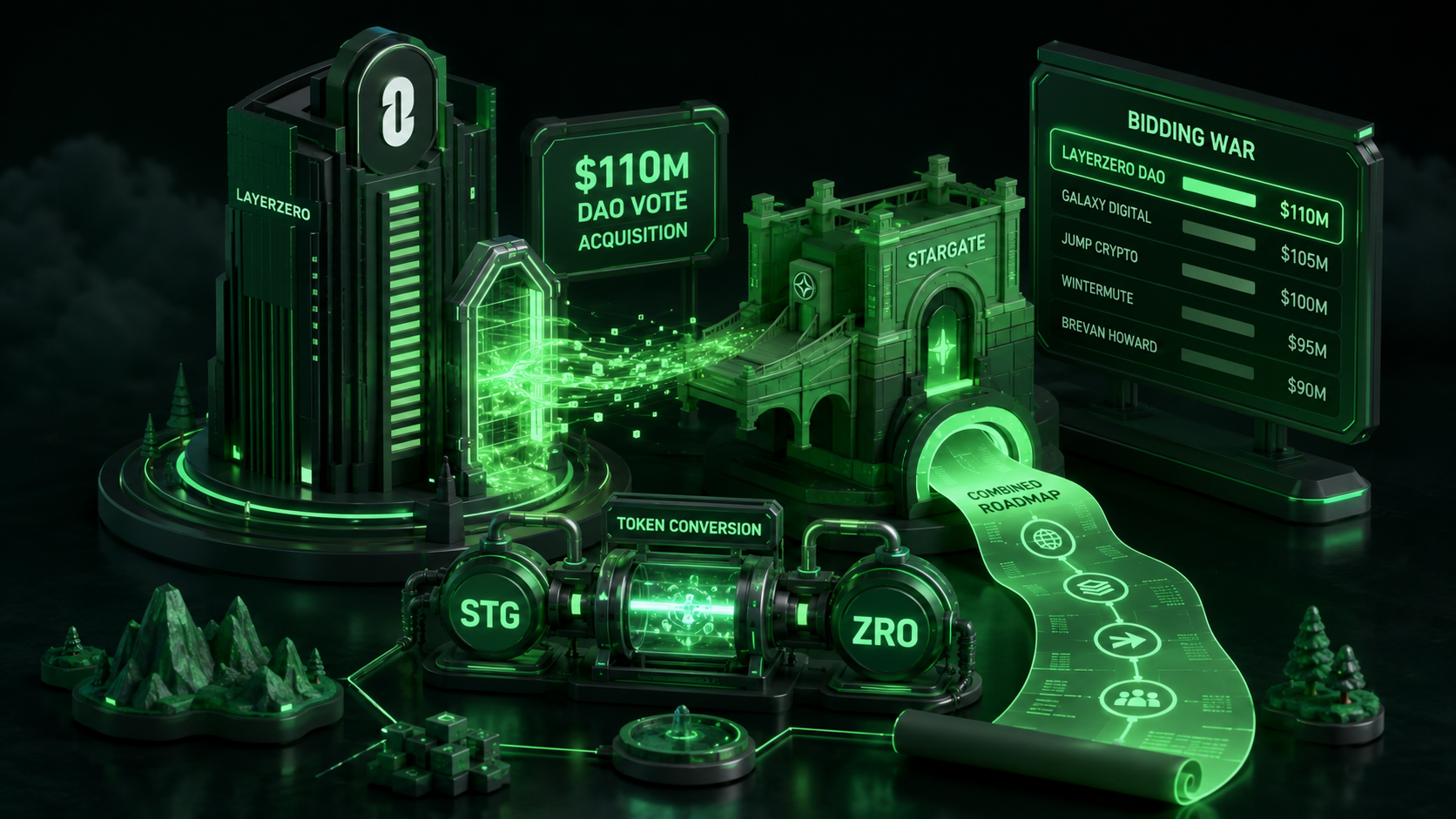
On August 24, 2025, Stargate DAO voted to accept LayerZero Foundation's $110 million acquisition offer, dissolving its own governance structure and folding one of DeFi's most-used bridges back into the protocol that originally built it. The deal drew competing bids from Wormhole, Axelar, and Across Protocol, triggered the highest voter participation in Stargate's history, and set a precedent as the first DAO acquisition exceeding $100 million.
This article breaks down how the deal came together, why Stargate's community chose LayerZero over a higher cash offer, and what the merger means for STG holders and traders going forward.
Why LayerZero Bought Back Its Own Protocol
LayerZero Labs created Stargate in 2022 as a cross-chain liquidity protocol built on LayerZero's messaging infrastructure. The project was spun out as an independent DAO with its own governance token, STG, and its own staking system that paid veSTG holders a share of bridge transaction fees.
By mid-2025, Stargate had processed over $70 billion in cumulative transfer volume and maintained roughly $348 million in TVL across 80+ blockchains. The protocol handled $4 billion in bridge volume during July 2025 alone, a 10x year-over-year increase. Those numbers made Stargate the most active cross-chain bridge by transaction volume, according to The Block's reporting on the acquisition.
LayerZero's rationale for reacquiring Stargate was simple: consolidate the messaging layer and the application layer under a single token and development team. Running two separate governance structures, two tokens, and two treasuries created overhead without clear benefit. LayerZero CEO Bryan Pellegrino framed the deal as a way to accelerate the product roadmap, expanding Stargate beyond bridging into swaps, vaults, and intent-based transaction execution.
The Four-Way Bidding War
The acquisition nearly went differently. LayerZero's original proposal on August 10 drew immediate criticism from parts of the Stargate community. The main complaints centered on the conversion ratio undervaluing STG relative to Stargate's revenue generation ($939,000 in quarterly staker payouts) and the elimination of the veSTG staking program.
As DL News reported, that discontent opened the door for competitors.
Wormhole's $120M cash bid. Bridge rival Wormhole submitted a $120 million all-cash offer on August 21, $10 million more than LayerZero's proposal. Wormhole also promised to triple Stargate's projected revenue within six months and requested a five-day pause to the ongoing vote so the community could evaluate alternatives. The foundation backed its offer with $120 million in USDC moved into a segregated wallet.
Axelar and Across enter the picture. Both protocols expressed formal interest in submitting bids. Across co-founder Hart Lambur wrote on the governance forum that his team would participate if the process was slowed down for proper review. The Axelar Foundation said it had "strong interest in preparing a comprehensive proposal" if a competitive bidding process was established.
Why the DAO chose the lower offer. Despite Wormhole's higher bid, 95% of voters (over 7.5 million veSTG tokens from 15,000+ addresses) approved LayerZero's revised offer. The revised terms added a six-month revenue share where veSTG holders who were locked before the proposal received 50% of Stargate protocol revenue. The other 50% would fund ZRO buybacks. The community's reasoning came down to strategic alignment: LayerZero built Stargate, understood its architecture, and had a concrete roadmap to expand its capabilities. A cash payout from Wormhole, while larger, would have ended Stargate's technical trajectory.
Token Conversion and Deal Mechanics
The merger set a fixed conversion rate of 1 STG = 0.08634 ZRO, based on ZRO's market price of $1.94 at the time of the original proposal. That valued each STG at roughly $0.1675, a modest premium over its trading price when the deal was announced.
Key terms of the agreement:
| Term | Details |
|---|---|
| Conversion Rate | 1 STG = 0.08634 ZRO |
| Conversion Deadline | None (open indefinitely) |
| Total Deal Value | ~$110M in ZRO tokens |
| Revenue Share | 50% to veSTG holders for 6 months |
| Remaining Revenue | 50% to ZRO buybacks |
| DAO Status | Dissolved |
| Governance | Transferred to LayerZero Foundation |
The conversion contract launched on August 25 via Stargate's platform. STG holders can swap their tokens at any time, with no expiration. This open-ended structure means STG continues trading on exchanges alongside ZRO, creating an ongoing arbitrage dynamic where STG's price closely tracks ZRO multiplied by the 0.08634 ratio.
After the six-month revenue share window closed in February 2026, all of Stargate's protocol revenue now flows entirely to ZRO buybacks. STG holders who haven't converted no longer receive any direct yield from the protocol.
What Comes After the Merger
LayerZero's post-acquisition announcement treats Stargate as the consumer-facing application layer for its broader interoperability stack. Several major initiatives are either in progress or recently launched:
Intent-based transaction system. The Stargate DAO approved $20 million in funding for an intent-based execution engine before the merger closed. This system would allow users to set conditional cross-chain transfers, such as executing a swap only when gas fees drop below a specific threshold. Development is targeted for Q1 2026.
Tokenized asset integration. In December 2025, Stargate partnered with Ondo Finance to enable cross-chain transfers of over 100 tokenized assets, including stocks and ETFs. The integration made Stargate's bridge the primary distribution channel for Ondo's tokenized securities across multiple chains.
Expanded Hydra deployments. With LayerZero's 138-chain messaging network backing it, Stargate's Bridging as a Service product continues onboarding new chains. Recent integrations include the IOTA Mainnet, connecting it to Ethereum, Solana, Base, and BNB Chain through Stargate's pools.
Multi-currency liquidity. Plans for 2026 include expanding beyond USD-pegged stablecoins to support EURC and other regional currencies, broadening the bridge's utility for international transfers.
What the Stargate Acquisition Means for Traders
The LayerZero-Stargate merger consolidated two of DeFi's most critical cross-chain infrastructure protocols under a single token. For STG holders, the conversion contract provides a permanent exit into ZRO at a fixed ratio, creating an effective price floor tied to ZRO's market value. For the broader cross-chain ecosystem, the deal signaled that interoperability protocols have reached a maturity level where consolidation adds more value than independence.
The merger also set a precedent that other DeFi protocols are watching closely. A DAO voting to dissolve itself in favor of absorption by its parent protocol, against a higher competing cash offer, is a governance outcome that will inform future decentralized M&A discussions for years.
Trade STG on LeveX through spot markets or perpetual futures, and explore more token deep dives in the Crypto in a Minute series.