
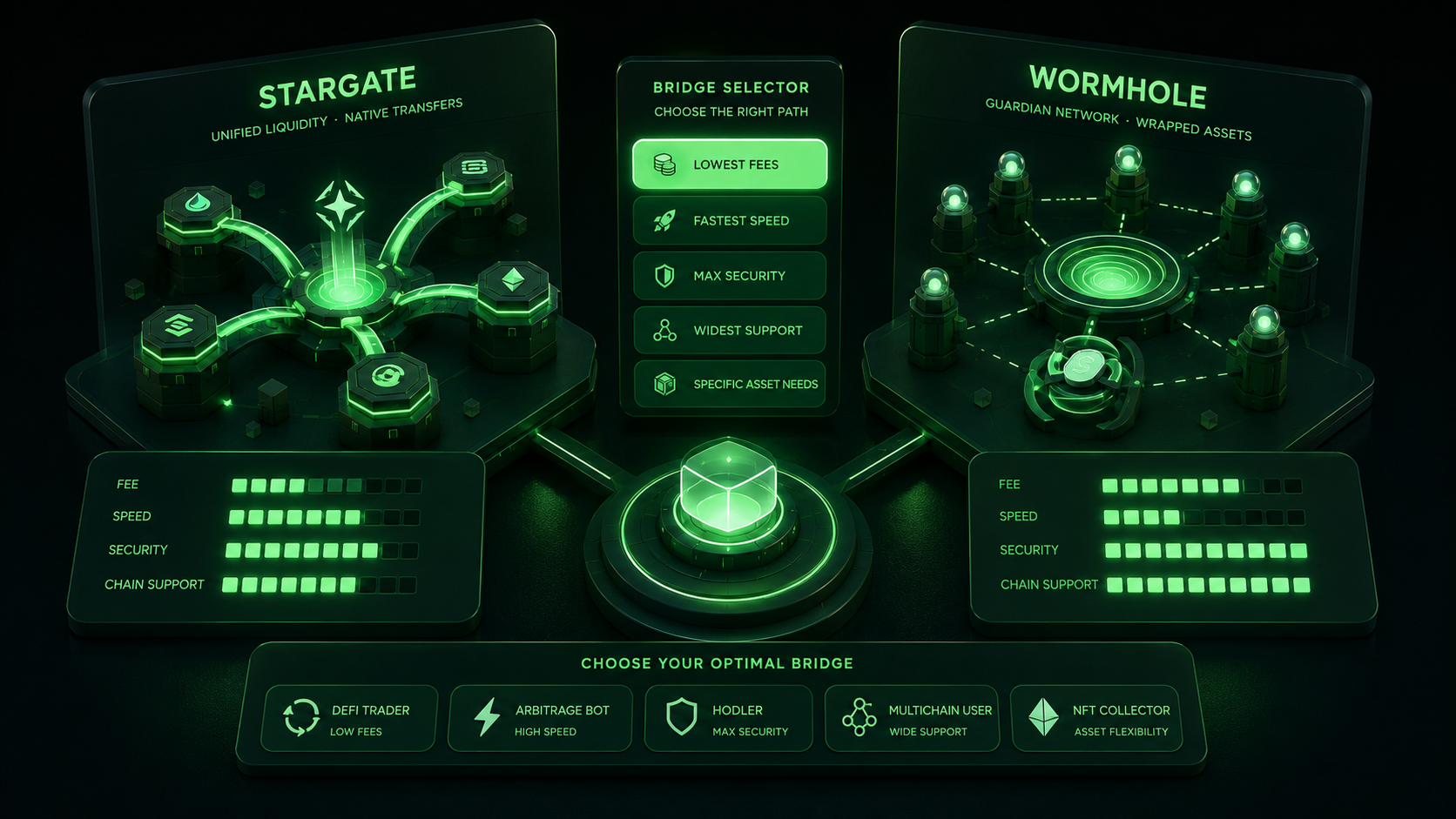
Two bridges dominate cross-chain infrastructure in 2026, and both have processed over $70 billion in lifetime transfer volume. Stargate, now fully owned by LayerZero, specializes in native asset transfers across 80+ EVM-compatible chains. Wormhole connects 40+ blockchains across multiple virtual machine environments, including Solana, Aptos, and Sui alongside EVM networks. Choosing between them comes down to what you're bridging, where you're bridging it, and how much the token format matters to you on arrival.
Architecture: How Each Bridge Moves Assets
Stargate and Wormhole take fundamentally different approaches to the same problem. The architectural choice affects everything from the tokens you receive on the destination chain to how much you pay in fees.
Stargate uses unified liquidity pools shared across all connected chains. When you transfer USDC from Arbitrum to Avalanche through Stargate, your tokens are burned on the source chain and minted natively on the destination. You receive actual USDC, the same token everyone else on Avalanche is using. Stargate's delta algorithm (upgraded in V2 to an AI-driven Planning Module) dynamically rebalances liquidity across pathways to prevent any single route from running dry.
V2 also introduced transaction batching through the "Stargate Bus," which aggregates multiple transfers and splits messaging costs among users. This reduced per-transaction gas costs by over 90% compared to V1. For users who need immediate processing, the "Stargate Taxi" mode offers direct one-to-one transfers at full gas cost but still cheaper than V1 due to optimized contract design.
Wormhole operates as a generic message-passing protocol secured by 19 Guardian validators running a proof-of-authority consensus. Its Portal bridge uses a lock-and-mint model: tokens are locked in a smart contract on the source chain, and wrapped equivalents are minted on the destination. This means you receive Wormhole-wrapped versions of tokens rather than native assets on most routes.
The key advantage of this approach is reach. Wormhole connects EVM chains, Solana, Cosmos-based networks, Sui, Aptos, Near, and other environments that Stargate currently cannot access. Its newer Native Token Transfer (NTT) framework does allow burn-and-mint transfers for certain tokens, closing the gap with Stargate on supported routes.
Fees, Speed, and Supported Chains
| Feature | Stargate | Wormhole |
|---|---|---|
| Supported Chains | 80+ (EVM-focused) | 40+ (multi-VM) |
| Transfer Model | Native assets (burn + mint) | Wrapped tokens (lock + mint), NTT for select assets |
| Base Fee | 0.06% flat | Often under $0.01 |
| Transfer Speed | Instant finality on most routes | 1–5 minutes (Guardian signing + relay) |
| TVL | ~$135 million | ~$2.5 billion |
| Lifetime Volume | $70 billion+ | $70 billion+ |
| Security Model | LayerZero oracle/relayer | 19 Guardian proof-of-authority |
| Token | STG (converting to ZRO) | W |
| Notable Hack | None | $320 million (February 2022, fully reimbursed) |
Stargate's 0.06% flat fee makes costs predictable regardless of transfer size. A $100 transfer costs the same percentage as a $100,000 transfer. Wormhole's fee structure is different: the protocol itself charges minimal fees (often fractions of a cent), but users pay gas on both source and destination chains. For small transfers, Wormhole can be significantly cheaper. For larger transfers, Stargate's flat percentage becomes more competitive because the gas overhead is proportionally smaller.
Speed favors Stargate on EVM-to-EVM routes, where instant finality means your tokens arrive as soon as the source chain confirms the transaction. Wormhole transfers typically require 1–5 minutes because the Guardian network needs to observe, verify, and sign each message before relay.
Security Track Records
Wormhole suffered a $320 million exploit in February 2022 when attackers bypassed signature verification on the Solana side of the bridge. Jump Crypto, Wormhole's primary backer, replaced the stolen funds in full. Since then, Wormhole has expanded its security infrastructure significantly: continuous audits from Trail of Bits and OtterSec, a $5 million bug bounty through Immunefi, and verifiable open-source builds. The Uniswap DAO's Bridge Assessment Committee unconditionally approved Wormhole as the safest multi-chain bridge protocol in 2025.
Stargate has not experienced a comparable exploit. Its security relies on LayerZero's oracle and relayer model, where independent entities must agree on the validity of each cross-chain message. The trade-off is that Stargate's EVM-only focus reduces its attack surface compared to bridges that connect fundamentally different virtual machine architectures. Bridge security across the broader industry remains a serious concern, with over $2.8 billion lost to bridge-related hacks in 2025 alone.
When to Use Each Bridge
The right bridge depends on the specific transfer you need.
Choose Stargate when: you're moving stablecoins or native assets between EVM-compatible chains and want guaranteed native tokens on arrival. Stargate's recent integration with Ondo Finance for cross-chain tokenized stock transfers also makes it the clear choice for RWA bridging. Cost-conscious users moving larger amounts benefit from the predictable 0.06% fee, and the Stargate Bus batching mode offers the cheapest option for users willing to wait slightly longer.
Choose Wormhole when: you need to bridge between fundamentally different blockchain environments, particularly anything involving Solana, Sui, Aptos, or Cosmos ecosystems. Wormhole's multi-VM architecture handles these routes natively where Stargate cannot. Micro-transactions also favor Wormhole, where the per-transfer cost can drop below one cent.
For traders active on both EVM and non-EVM chains, using both bridges as part of a routing toolkit makes practical sense. Many DeFi aggregators already do this behind the scenes.
The Acquisition That Linked Them
The relationship between Stargate and Wormhole took an unexpected turn in August 2025. When LayerZero proposed its $110 million acquisition of Stargate, Wormhole submitted a competing counter-bid, arguing the offer undervalued Stargate's $4 billion monthly bridge volume and $92 million treasury. Despite Wormhole's higher cash offer, 94% of Stargate DAO members voted for LayerZero's proposal, citing long-term alignment over short-term premium. The STG price surged alongside both ZRO and Wormhole's W token during the bidding war. STG holders can now convert to ZRO at a fixed rate of 1 STG = 0.08634 ZRO, effectively tying Stargate's future to LayerZero's broader interoperability roadmap.
Picking the Right Bridge for Your Strategy
Stargate and Wormhole solve overlapping problems from different angles. Stargate delivers native asset transfers with instant finality across the widest EVM chain coverage available, making it the default for traders who operate primarily within Ethereum and its Layer 2 ecosystem. Wormhole's multi-VM reach makes it essential for anyone who regularly moves assets to or from Solana, Sui, and other non-EVM environments.
Both protocols continue to evolve rapidly. Stargate's accelerated roadmap under LayerZero aims to expand beyond bridging into broader value transfer infrastructure, while Wormhole's NTT framework chips away at the wrapped-token disadvantage on more routes. Traders who understand the strengths of each bridge can minimize fees, reduce transfer times, and avoid unnecessary exposure to wrapped token risk.
Trade STG on LeveX through spot markets or perpetual futures, and explore more token deep dives in the Crypto in a Minute series.