
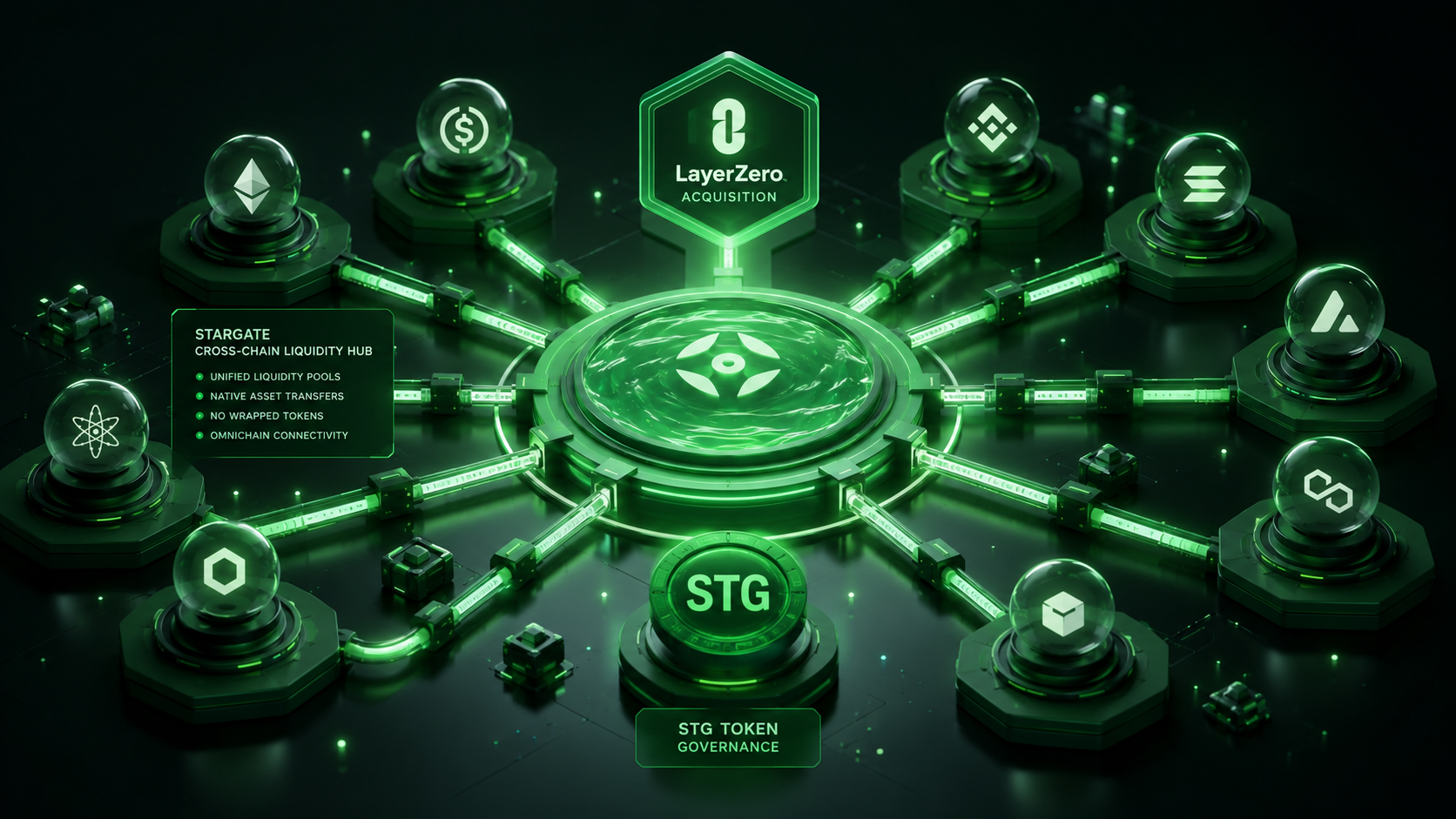
Over $70 billion in cross-chain transfers have passed through Stargate since its March 2022 launch, making it one of the most heavily used bridges in crypto. Built on LayerZero's messaging infrastructure, the protocol connects 80+ blockchains through unified liquidity pools that deliver instant guaranteed finality on every transfer.
In August 2025, LayerZero Foundation acquired Stargate for $110 million, dissolving the Stargate DAO and beginning a transition that merges STG into the ZRO token ecosystem. The acquisition consolidated two of DeFi's most critical interoperability layers under a single governance structure, with plans to expand Stargate beyond bridging into a comprehensive value transfer interface.
What is Stargate Finance?
Stargate Finance is a cross-chain liquidity transport protocol that enables native asset transfers between blockchain networks. LayerZero Labs created Stargate as the flagship application demonstrating its omnichain messaging capabilities, and co-founders Bryan Pellegrino, Ryan Zarick, and Caleb Banister built the protocol to solve what the team calls the "bridging trilemma": the inability of previous bridges to simultaneously guarantee instant finality, support native assets, and maintain unified liquidity across chains.
Traditional cross-chain bridges forced users to accept trade-offs. Some offered speed but required wrapped tokens that introduced smart contract risk. Others supported native assets but fragmented liquidity into isolated pools per chain pair. Stargate's Delta algorithm manages a single shared liquidity pool across all supported networks, dynamically rebalancing allocations to ensure sufficient depth on every chain while keeping transfers instant.
The protocol supports native transfers of USDC, USDT, ETH, and other major assets across networks including Ethereum, Arbitrum, Avalanche, BNB Chain, Optimism, Polygon, Base, and dozens more. Applications like decentralized exchanges and lending protocols integrate Stargate directly, enabling their users to execute cross-chain transactions without manually bridging assets first.
How Stargate V2 Works
Stargate V2, launched in May 2024, introduced three major upgrades that expanded the protocol's reach and slashed transaction costs.
Hydra: Bridging as a Service
Hydra allows new blockchains to plug into Stargate's liquidity on day one. When a user bridges USDC from a core chain like Arbitrum to a Hydra-enabled network, the native USDC locks in Stargate's pool while an equivalent OFT (Omnichain Fungible Token) mints on the destination chain. These Hydra assets move freely between all Hydra-enabled chains and remain redeemable for the underlying native asset on any core Stargate chain at any time. For emerging Layer 2s and Layer 3s competing to attract users, Hydra eliminates the cold-start liquidity problem that typically throttles new network adoption.
Transaction Batching with the Stargate Bus
Every Stargate V1 transfer required its own LayerZero message, and the messaging fee often exceeded the bridge fee itself. V2 introduces a "Bus" mode that batches multiple transactions into a single LayerZero message. Users choosing the Bus trade slightly longer confirmation times for gas savings of up to 91% compared to V1. A "Taxi" mode remains available for users who prefer immediate execution at full cost.
AI Planning Module
V1 managed liquidity rebalancing entirely on-chain, limiting how quickly the protocol could respond to shifting demand patterns. The V2 Planner moves credit allocation off-chain, using an AI-driven module to dynamically adjust fees and incentives across chains without ever controlling user funds. This reduces capital requirements while keeping pools balanced more efficiently than the previous on-chain-only approach.
The LayerZero Acquisition
On August 10, 2025, LayerZero Foundation proposed acquiring Stargate for $110 million in ZRO tokens. The Stargate DAO approved the deal on August 23 with 95% approval, recording the highest voter participation in the protocol's history.
The acquisition set a fixed conversion rate of 1 STG = 0.08634 ZRO, with no deadline for token redemption. The deal dissolved the Stargate DAO and ended STG staking, though veSTG holders who were locked before the proposal received 50% of Stargate protocol revenue for six months post-acquisition. The remaining 50% funded ZRO buybacks.
The process drew controversy. Wormhole submitted a competing $120 million cash bid, and critics argued the rushed voting timeline prevented adequate deliberation. According to The Defiant's reporting, two addresses controlled more than half the votes. Despite these concerns, the DAO elected to proceed with LayerZero's offer, citing long-term strategic alignment over the higher cash alternative.
Post-acquisition, Stargate operates under LayerZero Foundation governance. The roadmap includes expanding beyond bridging into swaps, vaults, and enterprise-grade cross-chain infrastructure, with a $20 million allocation approved for building an intent-based transaction system in Q1 2026.
Understanding STG Tokenomics
STG has a maximum supply of 1 billion tokens. The initial three-year allocation prioritized community distribution over insider holdings.
Token Distribution:
- Community: 65% (including launch allocation, auction, emissions, and DEX liquidity)
- Core Contributors: 17.5%
- Investors: 17.5%
The vote-escrow model allowed holders to lock STG and receive veSTG, which granted governance voting power and a share of protocol transaction fees. Voting weight decayed linearly as lock duration decreased, incentivizing longer commitment periods. One-sixth of non-STG transfer fees (1 basis point) flowed to veSTG holders.
Following the LayerZero acquisition, STG is being phased out as a standalone token. Holders can convert to ZRO at the fixed 1:0.08634 rate through a redemption contract on Stargate's platform, with no expiration deadline. As of early 2026, STG trades around $0.15, down roughly 96% from its April 2022 all-time high of $4.14. The token's circulating supply sits near 600 million, with approximately 340 million actively tradeable on exchanges.
Trading STG on LeveX
LeveX provides access to STG through both spot and futures markets.
Spot Trading suits traders accumulating STG for conversion to ZRO or those speculating on price movements relative to the fixed conversion rate. Since the redemption contract has no deadline, some traders monitor the STG/ZRO ratio for arbitrage opportunities when market prices diverge from the implied conversion value.
Futures Trading enables leveraged exposure to STG price movements in either direction. Given STG's elevated volatility since the acquisition announcement, perpetual contracts allow traders to capitalize on sentiment shifts around LayerZero integration milestones, intent-system development, and broader cross-chain infrastructure narratives. LeveX futures fees start at 0.02% for makers.
The Multi-Trade Mode on LeveX allows simultaneous positions with independent leverage and risk parameters, useful for managing exposure across correlated cross-chain infrastructure tokens.
Risks and Considerations
Token transition uncertainty defines STG's current risk profile. The conversion to ZRO introduces execution risk around timing, and market pricing of STG may deviate significantly from the implied ZRO conversion value based on liquidity conditions and sentiment.
Bridge security remains an industry-wide concern. Cross-chain bridges have historically been prime targets for exploits, with billions lost across various protocols. While Stargate has avoided major security incidents, the complexity of supporting 80+ chains creates a broad attack surface.
Competitive pressure from protocols like Wormhole, Across, and Chainlink's CCIP continues intensifying. LayerZero's acquisition consolidated resources, but rivals have their own integration advantages and institutional backing.
Revenue sustainability warrants monitoring. According to DefiLlama data, Stargate's TVL sits around $135 million with annualized fee generation that remains modest relative to protocol valuation. Post-acquisition revenue flows entirely toward ZRO buybacks after the initial six-month revenue share period, meaning STG holders who don't convert lose access to protocol economics.
Cross-Chain Infrastructure's Flagship Bridge
Stargate proved that cross-chain transfers could work with native assets, unified liquidity, and instant finality at scale. The $70 billion in cumulative transfer volume and integration across 80+ networks established it as the default liquidity layer for the omnichain ecosystem that LayerZero envisions.
The LayerZero acquisition marks a transition point. Stargate's technology and user base now serve a broader mandate that includes swaps, vaults, and intent-based execution, all funneling value through ZRO. Whether this consolidation strengthens the combined protocol or dilutes the focused bridge product that attracted millions of users will become clear as the 2026 roadmap executes.
For traders seeking exposure to cross-chain infrastructure, STG offers a position in one of DeFi's most battle-tested bridge protocols during a pivotal transition. Start with STG spot trading or access leveraged positions through STG futures on LeveX. Explore our Crypto in a Minute guides for deeper coverage of DeFi protocols and blockchain infrastructure.