
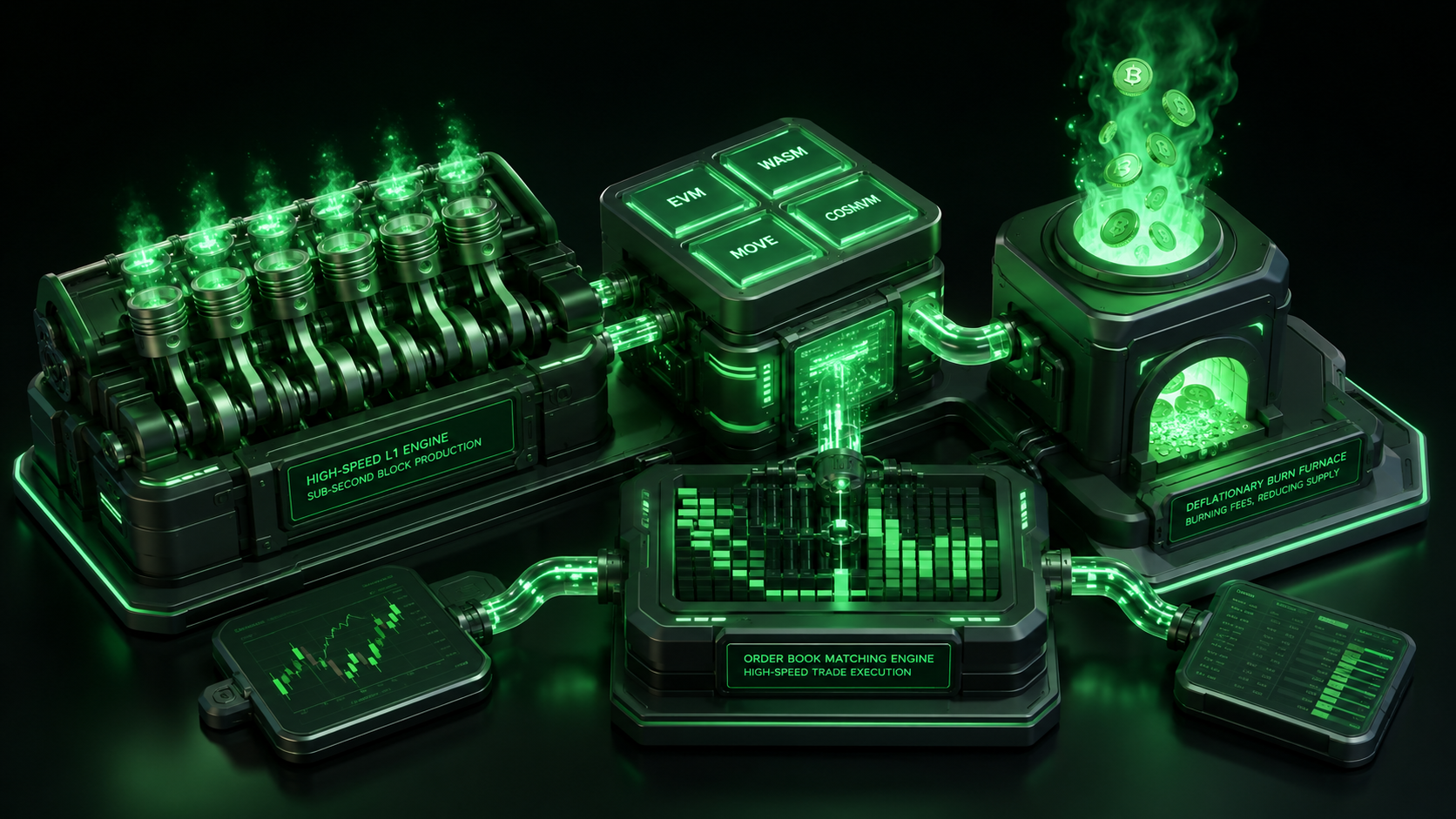
Injective is a sovereign Layer 1 blockchain built specifically for finance, with a fully on-chain orderbook, block times around 0.64 seconds, and fees as low as $0.00008 per transaction. Its native token, INJ, secures the network through proof-of-stake, carries governance rights, and gets permanently burned through one of the most aggressive deflation programs in crypto. Founded in 2018 by Eric Chen and Albert Chon, and backed by Pantera Capital and Mark Cuban in a $10 million raise in April 2021, Injective launched its mainnet in November 2021 and has since grown into a settlement layer for markets most chains cannot host: tokenized stocks, FX, commodities, and pre-IPO exposure to private companies like OpenAI and SpaceX.
That focus is the entire thesis. General-purpose chains treat trading applications as one workload among many. Injective builds exchange infrastructure into the chain itself, and everything distinctive about the project follows from that choice.
How Injective Works
Injective is built with the Cosmos SDK and runs Tendermint proof-of-stake consensus, which gives every transaction deterministic finality in under a second. Validators stake INJ to produce blocks, delegators back them to share in rewards, and anyone acting maliciously risks losing their stake. Because the chain speaks the IBC protocol, assets move natively between Injective and dozens of connected networks without wrapped tokens or custodial bridges.
The design decision that separates Injective from most other chains is its exchange module. A central limit orderbook lives at the protocol level, so every application launching on Injective plugs into the same shared liquidity from day one. Orders are matched through frequent batch auctions, a mechanism that neutralizes front-running by settling all orders in a block at a uniform clearing price. Teams building a derivatives venue or a tokenized asset market use ready-made chain modules for order matching, oracles, and settlement instead of writing that plumbing themselves.
One Chain, Two Virtual Machines
In November 2025, Injective launched its native EVM mainnet, opening the chain to Ethereum developers who can now deploy Solidity contracts without modification. Injective calls this the MultiVM era: the EVM and the existing WASM environment run side by side in one state machine, sharing liquidity and assets rather than splitting them across bridged silos. More than 30 dApps and infrastructure providers went live on day one, according to the Injective blog. A Real-Time EVM upgrade followed in February 2026, and the Vulcan mainnet upgrade landed on June 9, 2026, bringing lower fees, native USDC settlement, new real-world-asset markets, and an advanced oracle engine.
Sub-second blocks and near-zero fees put Injective in the same performance tier as Solana, while the protocol-level orderbook gives financial applications a piece of infrastructure that most chains leave to individual apps to build.
| Injective at a glance | Detail |
|---|---|
| Block time | ~0.64 seconds |
| Transaction fees | As low as ~$0.00008 |
| Consensus | Tendermint proof-of-stake |
| Virtual machines | Native EVM and WASM (MultiVM) |
| Max INJ supply | 100 million |
For traders, the practical upshot is that order placement, cancellation, and settlement all happen on-chain at speeds that feel like a centralized venue, with self-custody intact the whole time.
INJ Tokenomics: Utility, Burns, and Staking
INJ has a hard cap of 100 million tokens, and roughly 99.97 million of them already circulate as of July 2026, according to CoinGecko. The token does three jobs: it secures the chain through staking, it votes on governance proposals, and it captures protocol fee value through burns. Issuance is dynamic, as detailed in Injective's documentation: the inflation rate adjusts automatically based on how much of the supply is staked, tightening when participation is healthy. The INJ 3.0 upgrade (governance proposal IIP-392) narrowed those inflation bands and increased deflationary pressure roughly fourfold.
The burn side is where Injective stands out. For years, a weekly Burn Auction collected fees from ecosystem dApps and auctioned the basket for INJ that was then destroyed, removing more than 6.78 million INJ, about 7% of total supply, worth roughly $32 million at the time. In November 2025, the Community BuyBack replaced the auction: each month, participants commit INJ, receive a pro-rata share of ecosystem revenue, and the committed INJ is permanently burned. The first four rounds burned around 178,338 INJ, lifting all-time burns above 7 million tokens, and the community approved the broader INJ Supply Squeeze framework (IIP-617) with 99.96% support.
Staking runs through the Injective Hub. Rewards accrue every block, delegators can switch validators instantly, and unstaking carries a 21-day unbonding period. Yields vary with the network staking rate and validator commission, roughly mid-single digits to low teens annually as of 2026. If the mechanics of delegation and unbonding are new territory, our primer on how crypto staking works covers the fundamentals.
The Injective Ecosystem
Injective's application layer clusters around trading, and three projects define its current identity.
Helix, the flagship orderbook DEX
Helix is the most visible application on Injective, offering spot and perpetual markets on the chain's shared orderbook, including the pre-IPO and RWA contracts that made headlines. Fully on-chain orderbook trading is the model Hyperliquid built its reputation on, and Helix inherits the same architecture directly from the chain rather than through a custom engineering effort.
iBuild, apps without code
Launched in November 2025, iBuild is an AI-powered platform that turns plain-language descriptions into deployed on-chain applications. Someone with no programming background can describe a token launchpad or a trading tool and ship it to Injective, which widens who gets to build in the ecosystem.
iAgent, AI that trades
iAgent is Injective's SDK for on-chain AI agents. Developers use it to build agents that execute trades, manage funds, and automate strategies directly against the chain's financial modules, a natural pairing with sub-second finality.
Real-World Assets and Pre-IPO Perpetuals
Injective has pushed further into real-world assets than most Layer 1s. Its RWA markets, spanning tokenized equities, commodities, FX, and indices, have processed roughly $6.8 billion in cumulative volume as of May 2026. Where tokenization projects like Ondo focus on bringing yield-bearing instruments on-chain, Injective's angle is making those asset classes tradable as fast, liquid derivatives markets.
The boldest example arrived in October 2025, when Injective launched the world's first on-chain private-equity perpetual futures. Traders gained exposure to pre-IPO giants like OpenAI, SpaceX, Anthropic, and Perplexity, a corner of the market historically reserved for venture funds and accredited insiders. The markets processed $1 billion in volume within their first 30 days, with pricing data supplied by Seda Protocol and Caplight. Vulcan's native USDC settlement and upgraded oracle engine were built partly to deepen exactly this category.
Wall Street Is Paying Attention
Institutional signals around INJ accelerated through late 2025 and 2026. Canary Capital filed for the first US staked INJ ETF under the ticker INJS, slated for Cboe BZX, with its S-1 amended on June 25, 2026, and approval still pending at the SEC as of July 2026. A year earlier, NYSE-listed Pineapple Financial launched a $100 million INJ digital asset treasury in September 2025, the first INJ treasury held by a publicly traded company.
The market context makes those bets notable. INJ trades near $5.27 with a market cap around $517 million as of July 2026, far below its all-time high of $52.75 set in March 2024. Institutions building INJ exposure at these levels are effectively underwriting the thesis that finance-specific infrastructure wins the next cycle.
Injective (INJ) FAQ
What is Injective (INJ) used for?
INJ is the token that secures the Injective blockchain through proof-of-stake staking, grants voting power over governance proposals, and absorbs protocol fee value through recurring burns. It also serves as collateral and settlement currency across the chain's trading applications.
How many INJ tokens are there?
INJ has a maximum supply of 100 million tokens, with roughly 99.97 million circulating as of July 2026. Ongoing burns through the monthly Community BuyBack permanently remove tokens, so effective supply trends downward over time. All-time burns exceed 7 million INJ.
Does Injective support Ethereum smart contracts?
Yes. Injective launched a native EVM mainnet in November 2025, so Solidity contracts deploy directly on the chain without bridges or modifications. The EVM shares state, liquidity, and assets with Injective's WASM environment under the MultiVM architecture.
Is INJ a good investment?
INJ carries the same volatility and drawdown risk as any crypto asset, and nothing about its design guarantees returns. The bull case rests on deflationary tokenomics, growing RWA and pre-IPO volumes, and a pending US ETF. On the other side, the token sits more than 90% below its March 2024 all-time high as of July 2026. Size any position to survive being wrong.
How do I stake INJ?
You stake INJ through the Injective Hub by delegating tokens to a validator of your choice. Rewards accrue every block and redelegating to a different validator is instant, but fully unstaking triggers a 21-day unbonding period during which tokens earn nothing and cannot be moved.
Where Injective Goes From Here
Injective made an early bet that a blockchain purpose-built for markets would age better than a general-purpose chain retrofitted for them. With the MultiVM era live, burns compounding, RWA volume approaching $7 billion, and an ETF filing in the queue, that bet now has measurable traction behind it. For traders, INJ offers direct exposure to the thesis, and its perpetual markets reward preparation: understand crypto leverage trading mechanics before sizing a position, because speed cuts both ways.
When you are ready to act on it, buy INJ directly on the INJ/USDT spot market, take a leveraged view with INJ perpetual futures, or keep sharpening your edge with more guides in Crypto in a Minute.