

"I am excited to be an investor in trade(xyz) as they partner with ICE to bring 24/7 perpetual futures on Hyperliquid to the United States." That was Stan Druckenmiller's first post on X, ever, on October 29, and within hours HYPE had jumped around 15% to above $91, a few dollars short of its $97.96 record. Read the sentence again, slowly. Druckenmiller invested in trade[XYZ]. ICE, the owner of the New York Stock Exchange, is also making a strategic investment in trade[XYZ]. Nobody in the announcement said they bought HYPE.
What ICE Actually Signed Up For
The deal, as The Block reported, splits the work three ways. Hyperliquid supplies the underlying technology through HIP-3, its framework for builder-deployed perpetual markets. Trade[XYZ] designs and runs the markets. ICE operates the regulated exchange and clearing structure, and retail traders would reach the venue through brokers and platforms they already use. The menu covers crypto, equities, indices, commodities and forex, around the clock.
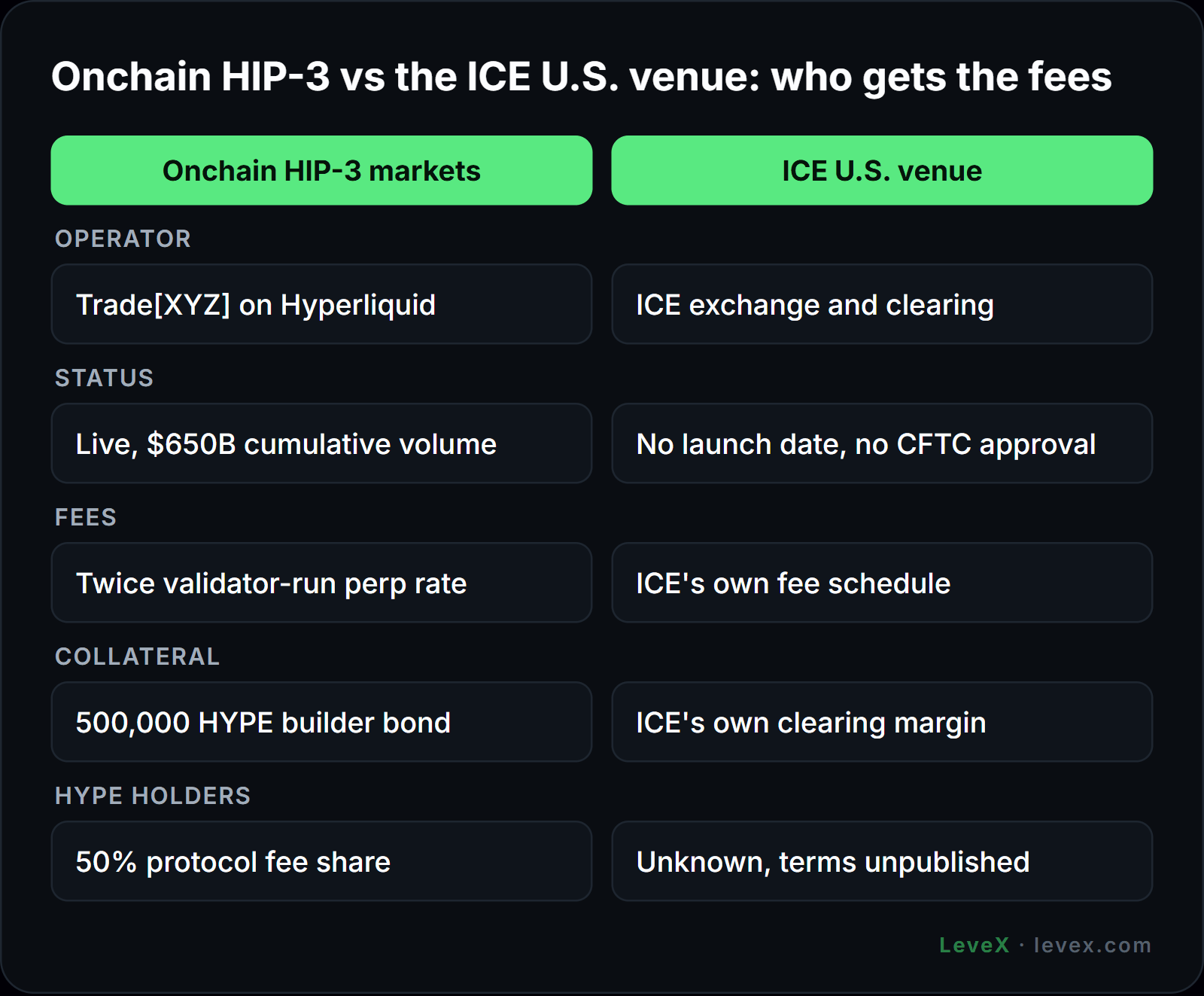
There is no launch date, no contract specification and no CFTC approval yet. ICE CEO Jeffrey Sprecher framed the venue as "additive to our futures markets," which is the polite way an exchange operator says it has watched $650 billion of volume happen somewhere else and would like a seat at the table. That $650 billion is trade[XYZ]'s own cumulative figure for its Hyperliquid markets in just over a year, per crypto.news, and Q2 2026 alone contributed $202 billion, with equity perps making up $58.9 billion of it.
That is the part worth sitting with. The most interesting crypto-native product of the past year, it turns out, was a way to trade Nvidia at 3 a.m. on a Sunday.
Where the Money Flows on HIP-3
Most coverage stopped at "HYPE up, Wall Street validates DeFi." The more useful question is how value moves through the stack, because the answer decides whether HYPE holders own a piece of this or are cheering from the sidelines.
Under HIP-3, as Nansen's explainer lays out, the economics on today's onchain markets run like this:
- The bond. A builder must stake 500,000 HYPE to deploy its own perp markets. At current prices that is around $45 million of HYPE locked per deployer.
- The fees. HIP-3 markets charge twice the fee rate of Hyperliquid's validator-run perps, and the deployer keeps 50% of the fees its markets generate.
- The protocol's half. The other half flows to the protocol side, where Hyperliquid's revenue has historically funded open-market HYPE buybacks.
So on the existing onchain markets, every dollar of trade[XYZ] volume pays the token directly through the protocol's fee share and indirectly through the stake. The ICE venue is a different animal. A U.S. exchange and clearing house regulated by the CFTC, with KYC at the broker level, has its own fee schedule, its own clearing margin and its own revenue line in ICE's quarterly report. Whether trades on it settle against HyperCore and pay the 50% protocol share, or merely run on Hyperliquid's matching technology under a separate licence, is the single most important detail for HYPE, and it is the detail nobody has published.
| Who | What they hold | How they get paid |
|---|---|---|
| ICE | Equity stake in trade[XYZ], venue operator | Exchange and clearing fees, equity upside |
| Trade[XYZ] | Builder role, 500,000 HYPE bond on existing markets | 50% of fees on its HIP-3 markets |
| HYPE holders | The token | Protocol fee share, only if the U.S. flow touches it |
The deal proved that Wall Street will pay for the builder layer, and the token layer is still waiting on the fine print.
The LeveX Take
The market priced this as a HYPE story, and the structure says it is a trade[XYZ] story with a HYPE option attached. That option is worth something, and the 15% move may well be a fair price for it, because the existing onchain markets keep running unchanged and keep paying the protocol regardless of what happens in Washington. Reading it as a forecast of U.S. volume flowing to holders is a stretch, since the contract terms that would decide that are still unwritten. Traders who buy HYPE expecting ICE's distribution to show up in buybacks are betting on a clause, and the safer assumption until the terms surface is that regulated retail volume gets monetized by the regulated parties first.
The bigger signal is what ICE chose to build. A 24/7 perpetual on stocks, indices and commodities is the product ICE expects American retail to want, and it is a product that already exists outside the U.S. LeveX added stock and commodity perpetuals in May, 22 instruments covering names like NVDA, TSLA and SPY plus commodities, trading around the clock with up to 25x leverage on stocks. When the operator of the NYSE copies a format, the format has stopped being an experiment. For traders already using it, the practical consequence is that the weekend gap, the moment Monday's open reprices everything that happened since Friday, is about to become a much more crowded trade as U.S. retail arrives, and that tends to compress the edge that early weekend traders have enjoyed.
A Crypto Product With a Wall Street Wrapper
The cleanest way to read October 29 is as a licensing event. The best idea in Hyperliquid this cycle was letting outside builders list any market they could price, and the largest exchange group in the world just paid to put its own wrapper around that idea. Last time crypto saw a TradFi giant embrace a crypto-native format this warmly, it was spot Bitcoin ETFs, and the people who did best were the ones who asked early which entity collected the fees. Same question here, and the answer for now is "mostly the builder," which leaves HYPE holders waiting on the fine print. The earlier OTC unlock sale is a reminder that supply events still move this token as much as headlines do.
HYPE is available on LeveX spot and perpetual futures, and the Crypto in a Minute series explains perps, funding and builder markets in short reads.