
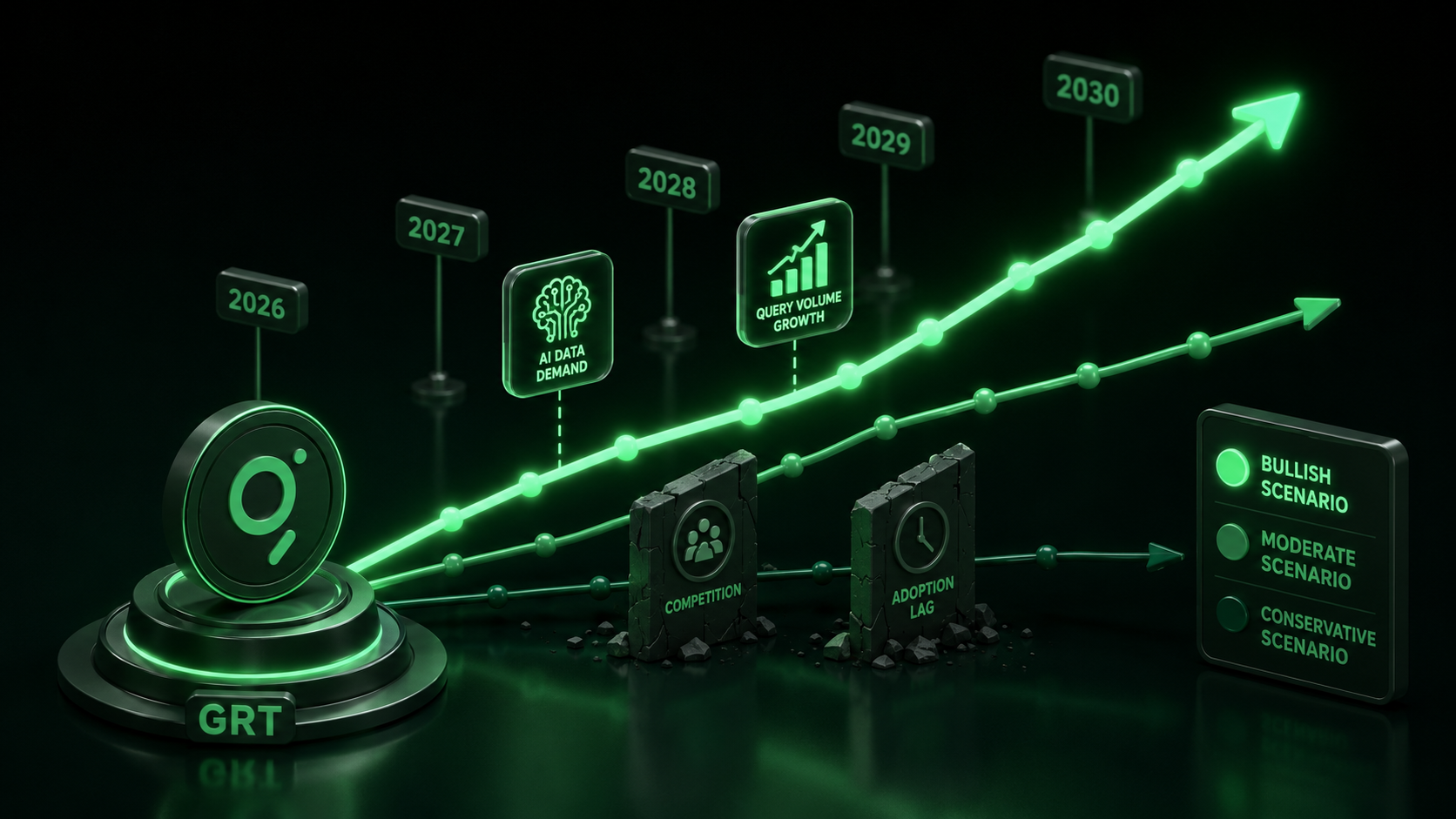
Most analyst forecasts for GRT in 2026 sit close to where the token already trades, near $0.018 to $0.02, with sharply divided views further out. Cautious models see the price drifting lower as token issuance outpaces demand, while more optimistic ones tie a recovery to The Graph's pivot into AI and institutional data services. As of July 2026, GRT sits near multi-year lows despite the network serving record query volume, and that gap between usage and valuation is the whole debate in one sentence.
Price predictions for a token like this are educated guesses, so treat every figure below as a scenario rather than a promise. No model can account for the next macro shock or the next protocol catalyst.
GRT Price Forecast at a Glance
The table below synthesizes the range of published outlooks, from the bearish end represented by forecasters like Changelly and CoinCodex to the more bullish community models that price in heavy AI-data adoption.
| Year | Cautious outlook | More optimistic outlook |
|---|---|---|
| 2026 | $0.015 – $0.020 | $0.04 – $0.06 |
| 2027 | $0.012 – $0.025 | $0.07 – $0.10 |
| 2028 | $0.015 – $0.030 | $0.10 – $0.16 |
| 2030 | $0.008 – $0.040 | $0.20 – $0.35 |
The spread is enormous, and that is the honest picture. Some models project GRT declining toward $0.006 by 2030 on continued inflation, while others see 15x or more if the network becomes the default data layer for AI agents. When forecasts disagree this much, the token's own fundamentals matter more than any single target.
Why GRT Trades Near Record Lows
GRT peaked near $2.88 in February 2021 and has lost more than 99% of that value since. The decline tracks two forces. The first is the broad reset in infrastructure-token valuations after the 2021 cycle, which hit tokens that traded on future promise rather than present cash flow. The second is specific to GRT: an inflationary supply that issues roughly 3% new tokens per year, creating steady sell pressure that demand has struggled to absorb.
What makes the chart puzzling is that the network is busier than ever. The Graph has served well over a trillion cumulative queries, and query fees on Arbitrum reached an all-time high of $8.11 million in August 2025, according to network data reported by Messari. Usage climbing while price falls tells you the market is weighing token economics more heavily than raw adoption numbers.
The Bull Case for GRT
The optimistic thesis rests on the 2026 roadmap. The Horizon upgrade, live since December 2025, turned The Graph into a full-stack data platform, and new services target demand that subgraphs alone never reached. Token API sells pre-indexed data across ten chains, Substreams streams real-time data to trading systems, and Amp courts regulated institutions with SQL access and compliance features.
The sharpest angle is AI. Through the x402 protocol, autonomous AI agents can query the network and pay per request, which turns machine demand into a direct source of query fees. If AI agents become heavy consumers of blockchain data, The Graph is positioned to meter that consumption in GRT. More query fees mean more tokens burned and more revenue for participants, the two levers that would pull the price off the floor.
The Bear Case and Key Risks
The cautious view is simpler. Three risks sit on GRT:
- Persistent inflation. The 3% annual issuance is a constant headwind. Unless query-fee burns and curation activity rise enough to offset it, circulating supply keeps growing and dilutes holders.
- Adoption that doesn't monetize. A trillion queries is impressive, but many are cheap or subsidized. The bull case needs paid, high-value demand, and the AI thesis is still early.
- Competition for data infrastructure. Other indexing and data-availability projects, along with in-house solutions at large protocols, all chip at the same market. Data infrastructure is a demanding business with thin margins.
A holder who ignores the supply mechanics is only reading half the ledger.
What Could Move the GRT Price
A few concrete catalysts are worth watching through 2026 and 2027. Query-fee growth is the cleanest signal, since rising fees show real demand and increase the burn. Institutional pickup of Amp or Substreams would validate the enterprise pivot. And measurable usage from AI agents via x402 would confirm the thesis that most excites bulls. On the downside, watch whether net supply keeps expanding, because sustained dilution caps any rally before it starts.
Frequently Asked Questions
Will GRT reach $1 again?
Returning to $1 would require roughly a 50x move from July 2026 levels and a market cap near $10 billion. No mainstream forecast projects that within the decade. It would take a dramatic surge in paid query demand plus a supply regime that stops diluting holders, a combination no current model treats as likely.
Is GRT a good investment in 2026?
GRT is a high-risk bet on The Graph becoming core data infrastructure for Web3 and AI. The network fundamentals are strong and the roadmap is ambitious, but the inflationary token and weak price action make it speculative. Anyone considering it should size the position for volatility and never rely on guaranteed returns.
What is the GRT price prediction for 2030?
Forecasts for 2030 range from around $0.006 in bearish models to $0.30 or higher in bullish ones. The wide gap reflects genuine uncertainty about whether The Graph's AI and institutional services convert into paid demand large enough to outrun token issuance.
How to Read GRT's Price Range
The useful takeaway is a framework built on one question. GRT's price hinges on whether paid query demand can grow faster than the 3% annual issuance dilutes supply. If it can, the optimistic scenarios become plausible. If no, the cautious forecasts near current levels or lower are the base case. Every catalyst on the roadmap ultimately routes back to that balance.
For traders, the low absolute price and high volatility cut both ways, offering large percentage moves alongside real downside. Treat any position as exposure to a specific thesis about data infrastructure, and manage risk accordingly.
Trade GRT on the spot market or take a leveraged view with GRT perpetual futures on LeveX. Explore the Crypto in a Minute series for more token analysis.