
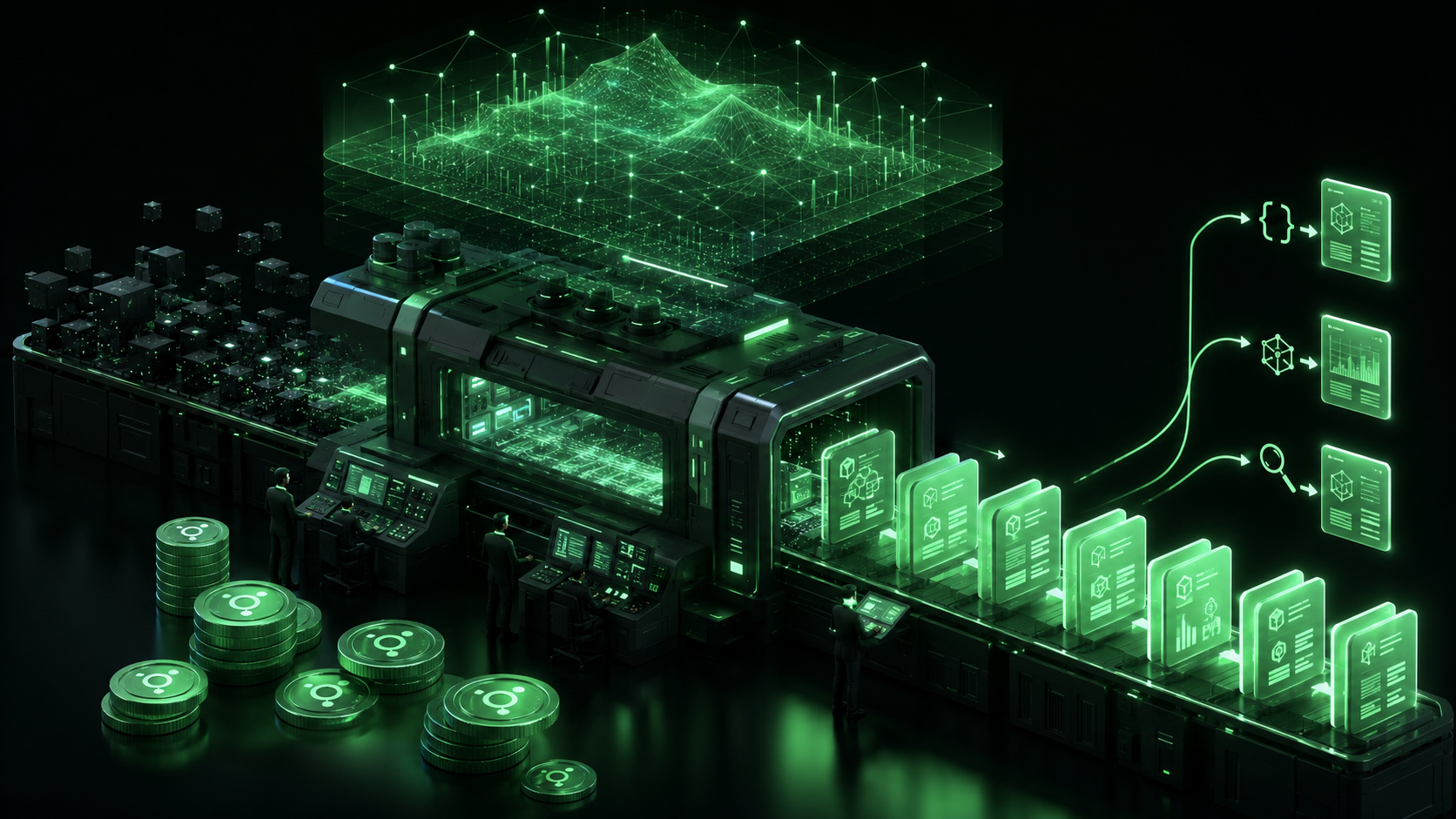
The Graph (GRT) is a decentralized protocol that indexes blockchain data and serves it to applications through open APIs called subgraphs. When a wallet shows your token balances or a DeFi dashboard plots historical prices, something has to read the raw chain, organize it, and answer queries in milliseconds. The Graph is the network that does that job across dozens of blockchains, and it has served well over a trillion queries in the process.
Blockchains are excellent at storing data and terrible at retrieving it. Reading a single balance from an Ethereum archive node is slow, and reconstructing anything richer, like "every trade a user made on Uniswap last month," means scanning millions of blocks. Before The Graph, teams either ran their own indexing servers or accepted that their apps could only ask the chain simple questions. The Graph turned that private, duplicated work into a shared public utility.
What The Graph Actually Does
The core unit is the subgraph, an open API that defines what on-chain data to collect and how to structure it. Developers write a subgraph manifest describing the smart contracts to watch, the events to record, and the shape of the resulting dataset. The network then indexes that data and makes it queryable through GraphQL, a query language that lets an app ask for exactly the fields it needs in one request.
Thousands of applications rely on this. A decentralized exchange like Uniswap uses subgraphs to power its analytics and trade history. Lending markets, NFT platforms, wallets, and governance dashboards do the same. The pattern repeats because building a reliable indexer in-house is expensive and fragile, while querying a subgraph is a single API call. That reusability is why people sometimes describe The Graph as the query layer for Web3.
The Four Roles That Keep the Network Running
The Graph coordinates work through four participant types, each with its own economic incentive. Understanding them is the fastest way to understand how GRT accrues value.
| Role | What they do | How they earn |
|---|---|---|
| Indexers | Run nodes that index subgraphs and serve queries; stake GRT as collateral | Query fees plus indexing rewards |
| Delegators | Delegate GRT to Indexers without running hardware | A share of the Indexer's rewards |
| Curators | Signal GRT on subgraphs they judge valuable | A cut of future query fees on that subgraph |
| Consumers | Applications and developers that pay to query data | They spend, funding the whole system |
Indexers are the backbone. They put GRT at stake, and that stake can be slashed if they serve inaccurate data, which keeps them honest. Delegators lower the barrier to participation by lending their tokens to Indexers and sharing in the yield, a design that lets ordinary holders support network security without operating servers. Curators act as a quality filter, using their own GRT to point Indexers toward subgraphs worth serving.
The GRT Token and How Supply Moves
GRT is the work token that secures the network and pays for its services. Every economic action, staking, delegating, curating, and querying, runs on it. As of July 2026, GRT trades near $0.018 with a market capitalization around $196 million, ranking roughly #158 by market cap on CoinGecko. That sits far below its February 2021 peak near $2.88, a gap that reflects how much crypto valuations detached from usage over the last cycle.
Supply is inflationary by design. The protocol issues roughly 3% new GRT per year as indexing rewards, which pays Indexers to keep data available even before query demand catches up. Several burn mechanisms push the other way: a 0.5% tax when Delegators delegate, a 1% tax when Curators signal on a subgraph, and 1% of all query fees, each burned permanently. Whether GRT is net inflationary in a given period depends on how much querying and curation activity offsets the fixed issuance. With circulating supply around 10.8 billion tokens and no fixed cap, that balance matters more to holders than any single price target.
From Hosted Service to a Fully Decentralized Network
The Graph launched in 2018, founded by Yaniv Tal, Brandon Ramirez, and Jannis Pohlmann, with its mainnet going live in December 2020 after a public token sale at $0.03 per GRT. For years it ran a free hosted service alongside the decentralized network, which made onboarding easy but kept a single company in the critical path.
That training-wheels era ended on June 12, 2024, when the hosted service was fully sunset and every query moved to the decentralized network. Around the same time the protocol scaled onto Arbitrum One, and since Q3 2024 all new subgraphs are created there, with indexing rewards distributed exclusively on the L2 for lower costs and faster settlement. The migration off the hosted service was the moment The Graph became what it always claimed to be: infrastructure owned by its participants rather than its founding company.
The New Era: Horizon and the AI Data Layer
The most consequential shift is happening now. In December 2025 the protocol shipped Horizon, a modular upgrade that turns The Graph from a single subgraph service into a full-stack data platform. The 2026 roadmap layers several services on top of it.
The lineup extends well past subgraphs. Token API offers pre-indexed token data across ten chains so wallets and explorers skip custom indexing entirely. Substreams delivers high-speed streaming already used by DeFi protocols on Base, BSC, and Solana. Tycho tracks live DEX liquidity for trading systems, and Amp targets institutions with an SQL-accessible blockchain database that includes audit trails and compliance features.
The AI angle is where the ambition shows. Through Subgraph MCP and related integrations, blockchain data becomes queryable in natural language inside tools like Claude, Cursor, and ChatGPT. The x402 protocol lets autonomous AI agents query the network and pay per request without a preset API key, positioning The Graph as a data backbone that machines can consume directly. According to Messari coverage, this pivot toward serving AI agents and institutions is the clearest thesis for why network demand could grow even while the token trades near multi-year lows.
Frequently Asked Questions
What is The Graph used for?
The Graph indexes data from blockchains and serves it to applications through queryable APIs called subgraphs. Wallets, DeFi dashboards, NFT marketplaces, and analytics platforms use it to fetch organized on-chain data quickly instead of building and maintaining their own indexing infrastructure.
Is GRT the same as The Graph?
GRT is the cryptocurrency that powers The Graph network. The Graph is the protocol itself. GRT is the token used to pay for queries, reward Indexers, and secure the network through staking, delegation, and curation.
How does The Graph make money?
Consumers pay query fees in GRT to read data from subgraphs. Those fees flow to Indexers who serve the data and to Curators who signaled the subgraph, with a portion burned. The protocol itself has no revenue in the corporate sense. Value circulates among network participants instead.
Does GRT have a maximum supply?
No. GRT has no fixed maximum supply. The protocol issues about 3% new tokens per year as indexing rewards, partly offset by burns from delegation taxes, curation taxes, and a share of query fees. Net supply change depends on network activity.
Why has the GRT price fallen so far from its high?
GRT peaked near $2.88 in early 2021 during a broad crypto bull market, then declined alongside most infrastructure tokens as speculative valuations reset. The divergence between strong network usage, over a trillion queries served, and a market cap near $196 million is a recurring theme in analyst coverage.
Why The Graph's Data Layer Matters
The Graph solved a problem every serious blockchain application eventually hits: chains are hard to read. By turning indexing into a shared, incentivized public network, it removed a costly bottleneck for developers and gave GRT holders a direct stake in that infrastructure. The open question is valuation, since a token trading near record lows while its network serves record query volume is either a warning sign or an opportunity, depending on your read of the 2026 roadmap.
For traders, that tension is the interesting part. The Horizon upgrade and the push toward AI agents and institutional data give The Graph a demand story that most infrastructure tokens lack, while the inflationary supply and weak price action demand a clear-eyed view of risk. Anyone taking a position should size it against both.
Trade GRT on the spot market or open a leveraged position with GRT perpetual futures on LeveX. For more token breakdowns, browse the Crypto in a Minute series.