
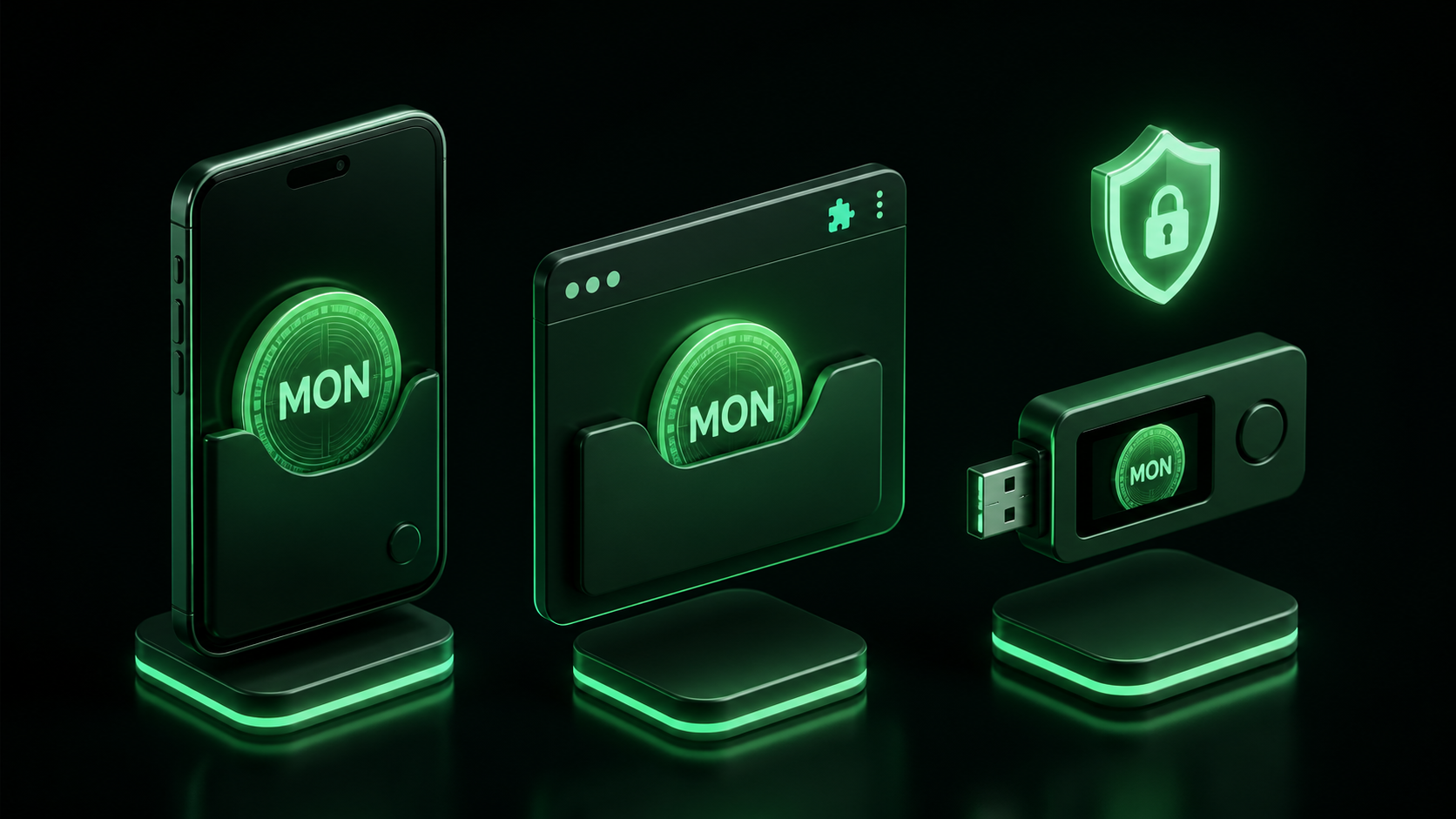
Any Ethereum-compatible wallet stores MON, because Monad uses standard EVM addresses, standard signatures, and a standard JSON-RPC interface. MetaMask, Phantom, and Rabby all handle it today, and Ledger and Trezor devices secure it through their existing Ethereum apps. The practical question is which one fits how you actually use MON, since a wallet optimized for daily DeFi activity is a poor fit for tokens you plan to hold through 2029.
Compatibility comes free. Everything else is a tradeoff between convenience and control.
Quick Comparison of Monad Wallets
| Wallet | Type | Best suited to | Hardware pairing |
|---|---|---|---|
| MetaMask | Extension and mobile | Broadest dApp coverage, default EVM experience | Ledger, Trezor |
| Phantom | Extension and mobile | Holders who also run Solana, Base, or Bitcoin assets | Ledger |
| Rabby | Extension and mobile | Active DeFi users who want pre-signature simulation | Ledger, Trezor |
| Ledger | Hardware device | Long-term MON holdings and large balances | Native |
| Trezor | Hardware device | Cold storage with open-source firmware | Native |
Because Monad's execution layer implements the EVM at the bytecode level, wallets need no Monad-specific code. Adding the network is a matter of entering the chain ID and RPC endpoint published in the Monad developer documentation, and many wallets now ship it preconfigured.
Software Wallets Worth Using
MetaMask
MetaMask remains the reference implementation for EVM chains, with the widest dApp support and the longest track record. It runs as a browser extension and on mobile with an in-app browser, and it pairs cleanly with hardware devices for anyone who wants keys off the machine. Its weakness is transaction legibility: approval prompts often show raw calldata rather than an intelligible summary of what you are signing.
Phantom
Phantom started on Solana and expanded across eight chains including Monad, Ethereum, Base, Polygon, Sui, and Bitcoin. For anyone holding assets across several ecosystems, running one wallet instead of four is a genuine reduction in operational risk, because every additional seed phrase is another thing to secure and another thing to lose. Its interface is the friendliest of the group, particularly on mobile.
Rabby
Rabby is built for people who transact frequently and want to know what a transaction will do before signing it. It simulates every transaction and shows the expected balance changes, flags risky approvals, and switches networks automatically based on the dApp you have open. That simulation layer is the single most useful safety feature available in a hot wallet, and it matters more on a fast-moving chain where new contracts appear weekly.
Cold Storage for Larger MON Balances
Hardware wallets keep private keys on a dedicated device that never exposes them to an internet-connected computer. Ledger and Trezor both support Monad through their Ethereum applications, and both pair with the software wallets above so you keep the familiar interface while the signing happens on the device.
The case for cold storage strengthens with holding period. MON's supply and unlock schedule runs through 2029, so anyone taking a genuine multi-year position is holding an asset far longer than the average lifespan of a browser extension's security assumptions. Tokens you do not intend to touch for two years have no business sitting behind a hot key.
Seed phrase handling is where most losses actually happen. Write it on paper or steel, store it somewhere physically secure, and never photograph it or type it into anything. LeveX's guide to cryptocurrency wallets and keys covers the fundamentals if any of this is unfamiliar.
Choosing Based on What You Do With MON
Delegation requires a self-custody wallet, since exchange-held balances cannot be delegated to a Monad validator. Anyone planning to stake MON for validator rewards needs a hot wallet to sign the delegation, and pairing that wallet with a hardware device gives you delegation access without leaving keys on a laptop.
Multichain holders have a different calculus. If your portfolio already spans several networks, Phantom's coverage removes friction that a single-chain setup creates. This matters most for people running positions across Monad and Solana, where a single interface handles both an EVM chain and an SVM one without switching applications.
Traders who move in and out of MON frequently face a different question again, which is whether self-custody is worth the operational overhead at all. Holding on an exchange means no seed phrase to lose and no gas to manage, at the cost of not controlling the keys. That is a reasonable trade for capital you intend to trade rather than hold, and a poor one for capital you intend to keep.
Monad Wallet Questions
Does MetaMask support Monad?
Yes. Monad is an EVM-compatible chain, so MetaMask stores, sends, and receives MON once the network is added by chain ID and RPC endpoint. Many wallets now include Monad in their default network list, removing the manual step entirely.
Can I store MON on a Ledger?
Yes. Ledger devices secure MON through the standard Ethereum application, because Monad uses the same address format and signature scheme as Ethereum. Pair the device with MetaMask, Phantom, or Rabby to interact with Monad applications while keys stay on the hardware.
Do I need a Monad-specific wallet?
No. Monad requires no specialized wallet software, and any EVM wallet that lets you add a custom network will work. Choose based on the features you care about, such as transaction simulation, multichain coverage, or hardware pairing, rather than looking for something branded for Monad.
Matching the Wallet to the Holding Period
Wallet selection for MON comes down to a single distinction: capital you are actively deploying versus capital you are parking. Active capital belongs in Rabby or MetaMask paired with a hardware device, close enough to reach and protected enough to survive a bad signature. Parked capital belongs on a hardware wallet with a seed phrase you have stored properly and tested once.
That distinction matters more than usual for a token with a multi-year supply schedule ahead of it. Anyone forming a view on MON's price outlook through the unlock period is implicitly committing to a holding period, and the custody setup should match that commitment rather than defaulting to whatever was convenient on day one.
Building the position comes first: MON trades on LeveX spot for withdrawal to any of the wallets above, and MON perpetuals cover directional exposure with no custody to manage. More asset guides are in Crypto in a Minute.