
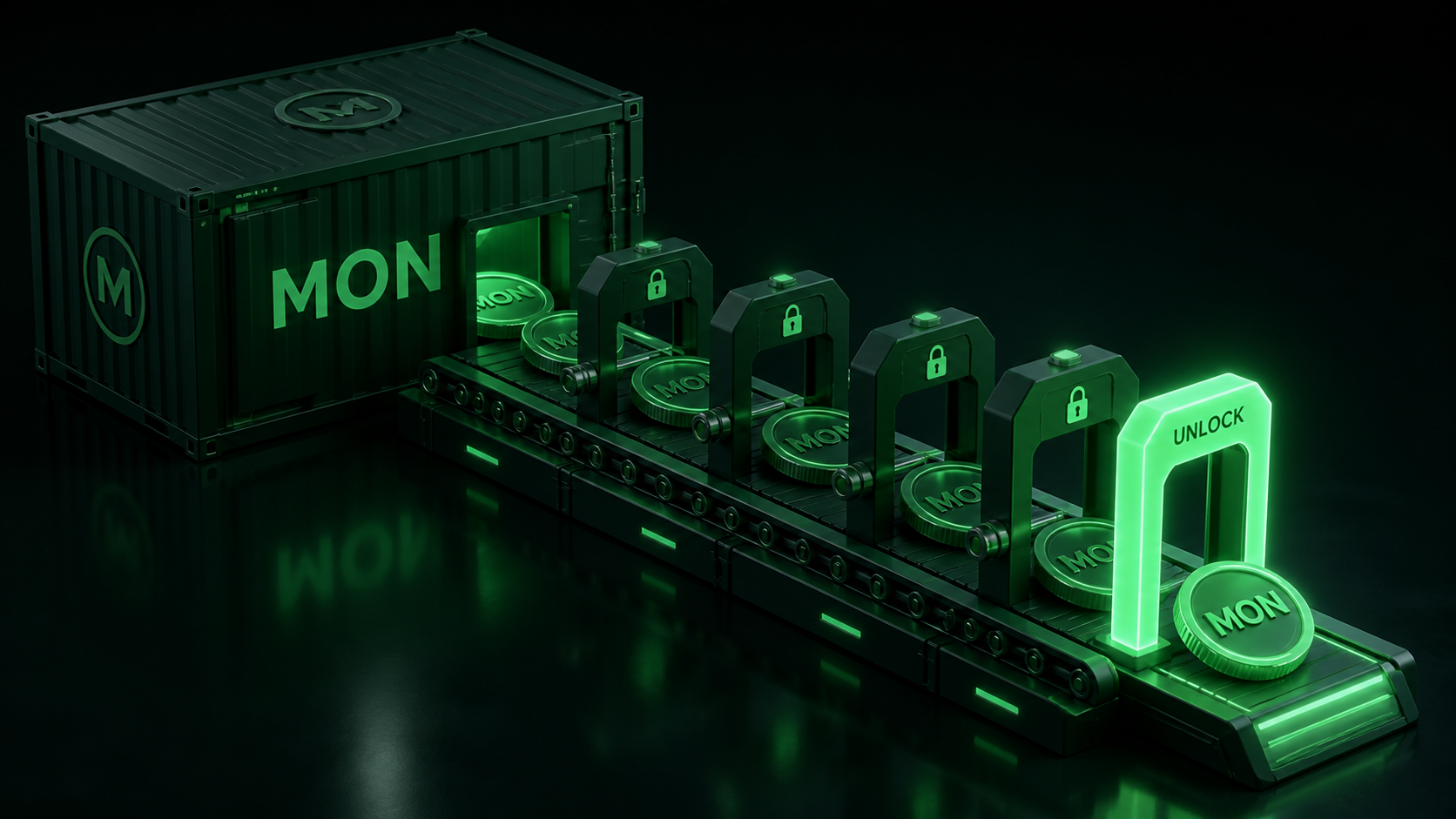
MON has a total supply of 100 billion tokens, of which roughly 11.83 billion circulated as of August 2026. The remaining 88% sits in allocations that vest through 2029, and the single most consequential date in Monad's token schedule is November 2026, when a one-year cliff releases the first tranche of nearly 47 billion tokens held by the team and early investors.
Supply mechanics rarely decide whether a network succeeds. They frequently decide what its token does while the network is proving itself.
The Cliff That Defines 2026
Every allocation outside the public sale, the airdrop, and the ecosystem fund was locked at mainnet on 24 November 2025, leaving 50.6% of supply locked on day one. Team tokens carry a full year of no movement followed by three years of vesting. Investor tokens follow a four-year schedule with a one-year cliff and equal monthly releases of 1/48 thereafter, terms disclosed in the Monad Foundation's tokenomics overview.
| Date | Event | Approximate size |
|---|---|---|
| 24 Nov 2025 | Mainnet, airdrop and public sale unlock | ~10.8B MON circulating |
| 24 Apr 2026 | Validator reward release | 170.2M MON (0.17% of supply) |
| Nov 2026 | Team and investor cliff expires, monthly vesting begins | ~47B MON enters schedule |
| 2027 to 2029 | Monthly vesting continues, quarterly step-ups | Remainder |
Run the arithmetic and the picture sharpens. If investor tokens release at 1/48 per month, that is roughly 410 million MON monthly. If the team's 26.9 billion vests evenly across its three-year window, add another 747 million. Combined, something in the region of 1.15 billion MON per month starts entering circulation from late 2026, worth about $35 million a month at August 2026 prices against a market capitalization near $355 million.
Not all of it reaches the market. Vested tokens held by long-term investors and working team members can sit idle indefinitely, and staking gives holders a reason to lock rather than sell. The supply schedule sets the ceiling on selling pressure rather than predicting it.
Supply Distribution and Vesting Terms
The initial 100 billion split six ways, weighted heavily toward growth spending.
| Allocation | Share | Tokens | Terms |
|---|---|---|---|
| Ecosystem development | 38.5% | 38.5B | Released against grants and incentive programs |
| Team and core contributors | 27.0% | 27.0B | One-year lock, then three-year vest |
| Investors | 19.7% | 19.7B | Four-year schedule, one-year cliff, 1/48 monthly |
| Public sale | 7.5% | 7.5B | Unlocked at mainnet, sold at $0.025 |
| Treasury | 4.0% | 4.0B | Foundation reserves and operations |
| Community airdrop | 3.3% | 3.3B | Claimed by ~230,000 wallets at launch |
The public sale detail is worth pausing on. Tokens went out at $0.025 to 85,820 participants, raising $269 million on top of roughly $225 million in earlier venture rounds from Paradigm, Electric Capital, and others. That sale price became a psychological line for the market, and MON spent stretches of 2026 trading beneath it, which is a fact worth knowing before reading any bullish price target.
Supply is also not fixed. Staking rewards mint approximately 2 billion MON annually, an inflation rate near 2% that pays validators and delegators out of new issuance rather than fees.
What Creates Demand for MON
Three sinks absorb MON, and they differ enormously in how much they can absorb.
Gas payments
Every transaction on Monad pays gas in MON. Throughput is the appeal of the chain, and Monad's parallel execution engine drives the cost per transaction toward negligible, so fee demand becomes meaningful only at transaction counts far above what the network currently processes. Cheap gas is a user acquisition feature that works against fee-driven token demand, and there is no way to have one without accepting the other.
Staking and delegation
Monad runs delegated proof of stake with no minimum delegation, paying roughly 13% annualized depending on total stake. This is the largest active sink, because it converts a holding decision into a yield decision and removes tokens from immediate circulation for as long as the delegator stays put.
Liquid staking collateral
aprMON from aPriori and gMON from Magma let stakers keep their MON productive inside DeFi while it earns validator rewards. That layer recycles staked MON into lending markets and DEX liquidity, which deepens demand without unlocking the underlying position.
Reading Monad's Fully Diluted Valuation
At $0.03 per token in August 2026, MON's market capitalization sat near $355 million while its fully diluted valuation implied roughly $3 billion. That ratio, around 8 to 1, is the number that appears in most bearish takes on the token.
The FDV framing deserves scrutiny in both directions. It overstates the problem by valuing tokens that will not exist for three years at today's price, which assumes a static market. It understates the problem by ignoring that a token which has already fallen from a $0.049 all-time high has demonstrated limited appetite for absorbing supply at higher prices.
The useful version of the question is narrower: does network activity between now and 2029 grow fast enough that staking yield, gas demand, and ecosystem incentives absorb the vesting schedule? Coverage of Monad's mainnet launch and token distribution laid out the starting conditions, and total value locked reaching roughly $408 million by May 2026 suggests real usage arrived. Whether it compounds at the rate the supply curve demands is the open item.
MON Tokenomics Questions
How many MON tokens are in circulation?
Roughly 11.83 billion MON circulated as of August 2026, about 11.8% of the 100 billion total supply. Circulating supply grows through scheduled vesting and through staking emissions of approximately 2 billion MON per year.
When do Monad team and investor tokens unlock?
The one-year cliff on both allocations expires in November 2026, one year after mainnet. Investor tokens then release at 1/48 monthly across four years, and team tokens vest over the three years following their initial lock, with the schedule running through 2029.
Does MON have a maximum supply?
MON has no hard cap. The initial supply was 100 billion, and staking rewards mint roughly 2 billion new MON each year to pay validators and delegators, producing about 2% annual inflation on top of the original allocation.
Supply Schedules Shape the Next Two Years
Monad's token design is conventional for a well-funded layer 1: a large ecosystem allocation to buy adoption, multi-year locks on insiders, a modest airdrop, and inflation-funded staking. Nothing in it is unusual, and that is partly the point, because the terms were disclosed clearly enough that nobody trading MON in 2027 can claim surprise.
What makes the next two years interesting is the collision between a fixed release schedule and a variable adoption curve. The unlock dates are known. The demand that has to meet them is not, and it depends on whether the applications running on Monad convert its throughput into activity people pay for.
If the setup interests you, MON trades on LeveX spot and the MON perpetual market allows positions in either direction around unlock events. More token breakdowns live in Crypto in a Minute.