
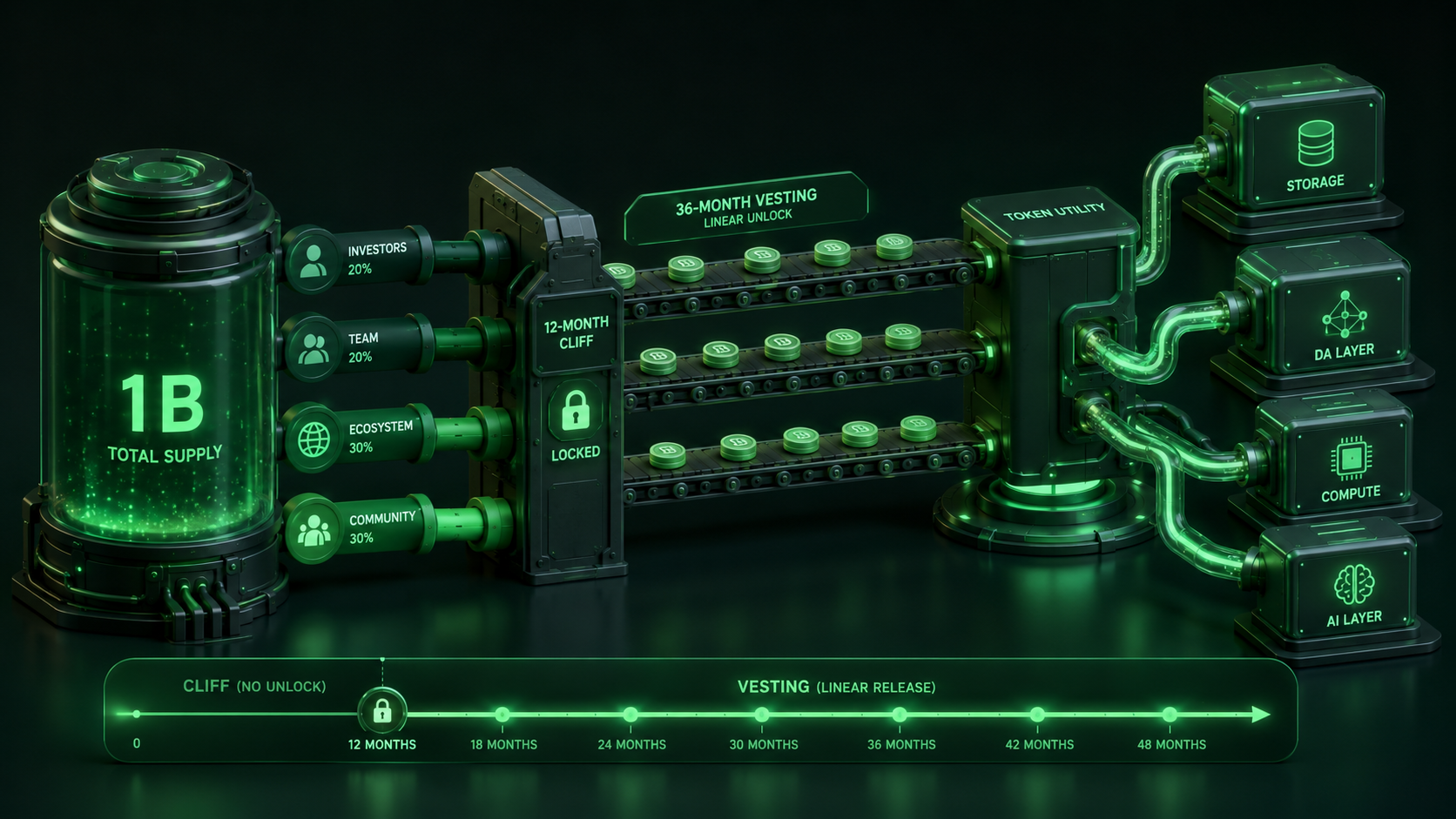
The 0G token carries a fixed supply of 1 billion units, with roughly a quarter currently circulating. The allocation mechanics, vesting cliffs, and reward emissions directly govern how supply enters the market over the next four years. Understanding these details matters because 0G's price action through 2028 will be shaped as much by unlock calendars as by ecosystem growth.
This article breaks down where the tokens sit, who controls them, and how the vesting schedule plays out in practice. The structure prioritizes community and ecosystem growth on paper, yet team and backer allocations still represent the largest single categorical claim on future circulating supply.
Total Supply and Allocation Breakdown
0G's hard cap is 1,000,000,000 tokens with no inflationary issuance planned beyond the defined schedule. The distribution leans heavily toward the community and ecosystem buckets, a pattern designed to reward long-term participants and fund ongoing development grants.
| Allocation Category | Percentage | Purpose |
|---|---|---|
| Community and Ecosystem | 41% | Grants, airdrops, liquidity programs, developer incentives |
| Team and Early Contributors | 25% | Founders, employees, advisors |
| Investors (Seed and Private) | 19% | Pre-seed ($35M round), private sale participants |
| AI Alignment Node Holders | 15% | Reserved for node operators supporting the network |
Exact sub-allocations vary slightly across public sources, but the aggregate picture is consistent: community and alignment node categories combined total 56% of supply, while insider allocations (team plus investors) represent the remaining 44%.
The 15% reserved for AI Alignment Nodes deserves specific attention. These tokens reward operators who run critical network infrastructure, including storage providers, compute providers, and DA samplers. This allocation is not a standard airdrop. It distributes tokens as compensation for actual network work, which shifts the economic dynamic from speculative holders to functional participants.
Vesting Schedule and Unlock Timeline
The allocation percentages only matter when paired with the unlock schedule. 0G's vesting design is conservative by industry standards, which helped the token launch without the cliff-edge dumping that has plagued other AI tokens. The insider vesting breakdown:
- Cliff period: 12 months from Token Generation Event (TGE). During this period, zero team and investor tokens unlock.
- Linear vesting: 36 months following the cliff. Team and investor tokens unlock on a rolling basis, typically daily or weekly.
- Community allocations: Released gradually through grant programs, liquidity mining, and ecosystem initiatives with no single large cliff.
Aristotle Mainnet launched in September 2025, which aligned roughly with TGE. The first major unlock event therefore falls in September 2026. From that point, approximately 1/36th of the combined team and investor allocation (44% of total supply) becomes sellable every month for three years. That works out to roughly 12.2 million tokens per month of insider supply, on top of any community allocations distributed in the same period.
Projecting through 2029, the circulating supply expands from ~252 million at present to potentially 800 million+ by the end of the vesting period. The 0G price outlook section covers how this unlock pressure interacts with demand scenarios, but the tokenomics takeaway is that demand must grow meaningfully just to keep price flat.
Token Utility Across the Stack
Supply and unlock mechanics tell only half the story. Demand is driven by what the token actually does on the network. 0G fills four distinct roles:
Gas and transaction fees. Every action on 0G Chain consumes 0G as gas. Smart contract deployment, transfers, and interactions with dApps all require the token. This is the most direct demand sink because it scales with network usage.
Staking for consensus. Validators stake 0G to participate in block production and earn rewards. Delegators can stake through validators without running infrastructure. Staked tokens are removed from circulating supply for the duration of the stake and associated unbonding period.
Storage, compute, and DA payments. Publishing data to 0G Storage, paying for GPU inference on the Compute Network, and posting blobs to 0G DA all settle in 0G. As these services scale, the payment flow creates structural buy pressure for operational token usage.
Governance. Token holders vote on protocol parameters, treasury allocations, and upgrade proposals. Governance weight is proportional to stake.
The diversified utility matters because single-purpose tokens often struggle when their one use case loses momentum. 0G's token captures value from consensus, three resource marketplaces, and governance simultaneously.
Emissions and Inflation Dynamics
Beyond the initial allocation, 0G has emission mechanics that distribute additional tokens to network participants over time. Staking rewards come from a combination of transaction fees and protocol emissions. Storage providers earn 0G for maintaining data availability. Compute providers earn 0G when their GPUs process inference or training jobs.
These emissions are not pure inflation in the Bitcoin sense. They function as a conversion mechanism: community and ecosystem tokens (pre-allocated in the supply schedule) are distributed to operators as compensation for work. The total supply cap of 1 billion is not exceeded. What changes is the identity of who holds circulating tokens, shifting from treasury and insider accounts toward operational participants.
For long-term holders, the key question is whether operational participants tend to hold their earned 0G or sell it for operating costs. Storage providers paying electricity bills in USD, for example, have a structural reason to convert 0G rewards to stablecoins. That dynamic creates persistent sell pressure that is separate from insider unlocks.
How 0G Tokenomics Compare to Peer AI Projects
The 0G allocation structure is broadly in line with other 2024-2025 AI infrastructure launches. The 12-month cliff and 36-month vesting are industry-standard terms. What distinguishes 0G is the explicit 15% carve-out for AI Alignment Nodes, which most peer projects bundle into generic community or ecosystem categories. This explicit earmarking gives operators a clearer expected reward pool to model their participation economics against.
The 1 billion supply cap sits in the middle of AI infrastructure peers. Render's tokenomics, for comparison, use a burn-and-mint equilibrium model with variable supply. 0G's fixed cap is simpler to model but places more weight on unlock timing because no burning mechanism offsets new supply entering the market.
Why 0G Tokenomics Shape Long-Term Value
The tokenomics of 0G reflect a deliberate choice: front-load community and operator incentives, accept significant insider allocation with a long vesting tail, and design multiple utility sinks so the token captures value from real network activity rather than pure speculation. This structure rewards patience from all participant categories and penalizes anyone expecting quick parabolic moves driven by scarcity alone.
The five-year window matters most because the full vesting schedule completes in late 2029. After that, 0G becomes a genuinely fixed-supply asset where price is driven by demand for network services rather than supply mechanics. Whether that post-vesting market is a vibrant agentic AI economy or a quieter infrastructure niche will determine the token's long-term trajectory.
Trade 0G on spot markets or explore 0G perpetual futures on LeveX. Browse Crypto in a Minute for more token guides and tokenomics breakdowns.