
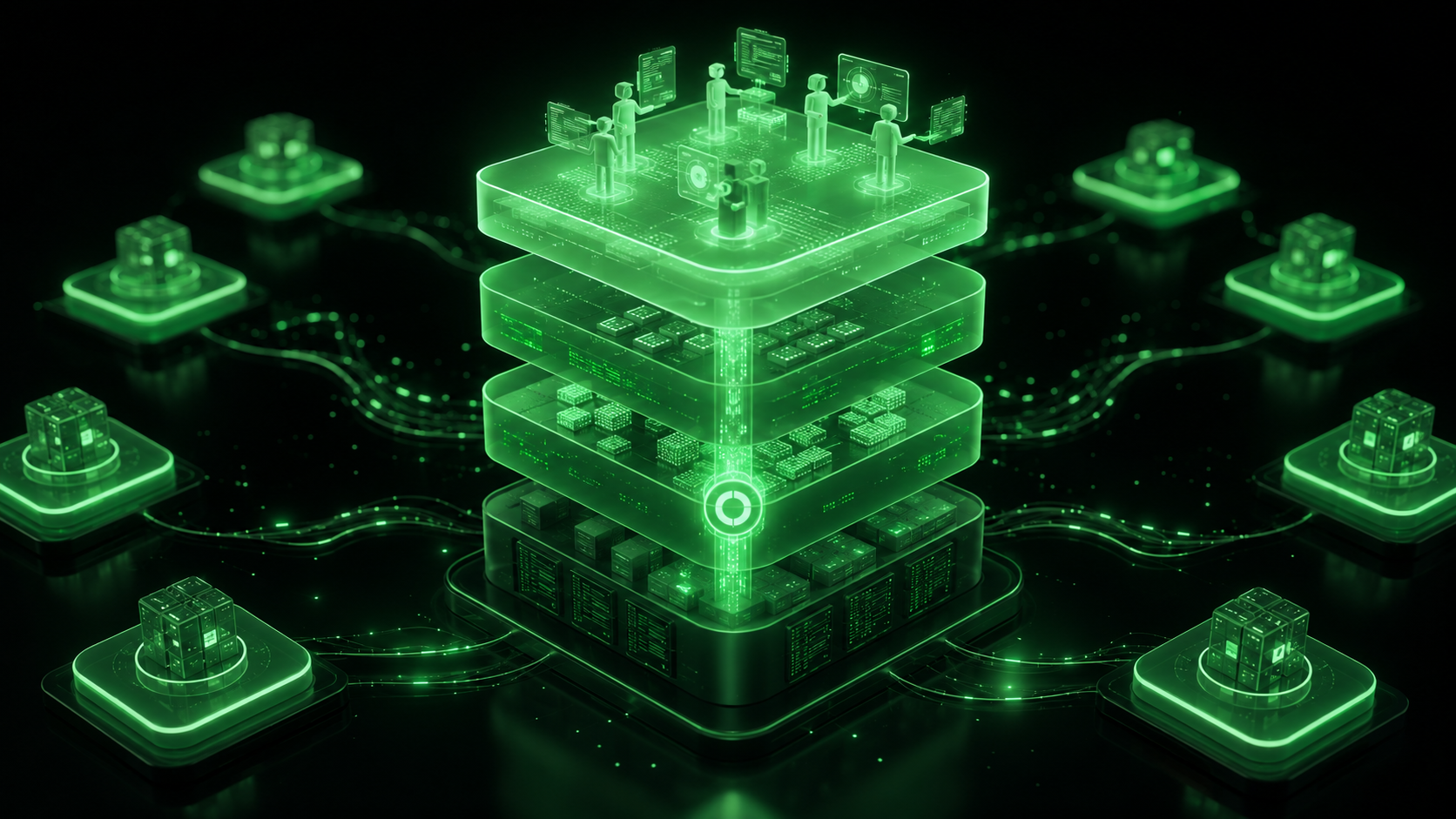
Zero Gravity launched 0G, an AI-native Layer 1 that bundles storage, compute, and data availability into a single modular stack built for onchain artificial intelligence. The Aristotle Mainnet went live in September 2025 with more than 100 ecosystem partners at day one, including Chainlink, Google Cloud, Alibaba Cloud, Ledger, Fireblocks, Coinbase Wallet, and MetaMask. Backed by $290 million across pre-seed and follow-on rounds, 0G positions itself as the infrastructure layer for what NVIDIA CEO Jensen Huang has described as a $1 trillion agentic AI opportunity.
The project's pitch is direct: AI should be verifiable, censorship-resistant, and owned by its users rather than a handful of centralized providers. 0G backs that pitch with measurable specs. Its data availability layer targets throughput 50,000 times faster and roughly 100 times cheaper than Ethereum's DA layer, and its storage network pushes up to 2 GB/s, enough to move AI model weights and training datasets without flinching.
What 0G Does Differently
Most Layer 1 blockchains were designed for financial transactions and retrofitted for other workloads. AI is different. Training runs chew through terabytes of data, inference requires verifiable compute, and autonomous agents need a settlement environment that can sign thousands of actions per second without stalling.
0G addresses these constraints with a four-part modular stack. The chain handles consensus and smart contract execution in an EVM-compatible environment, so developers can deploy with Solidity tooling they already know. The storage layer acts as a memory substrate for datasets, model weights, and application state, splitting responsibilities between a Log Layer for large unstructured blobs and a Key-Value Layer for millisecond lookups. The data availability layer uses sampling-based consensus to validate massive data streams. The compute network coordinates GPU providers into a decentralized marketplace for inference and fine-tuning jobs.
The result is an environment where an AI dApp can store its model, serve inferences, and settle agent actions on the same infrastructure, all cryptographically verifiable.
The Four Components of the Stack
| Component | Function | Key Specification |
|---|---|---|
| 0G Chain | EVM-compatible L1 for consensus and smart contracts | Shared security, AI-first execution environment |
| 0G Storage | Decentralized storage for models, datasets, application data | Up to 2 GB/s throughput, Log + KV layer design |
| 0G DA | Data availability with sampling-based consensus | 50,000x faster than Ethereum DA, infinitely scalable |
| 0G Compute | Decentralized GPU marketplace for AI inference | TEE-verified execution, sealed inference |
Each component can be used independently or combined. A rollup team might use only the DA layer for cheap data posting. An AI research group might use only the storage layer for dataset versioning. A full AI dApp might use all four, with tokens flowing between them as developers pay for storage, compute, and DA.
Sealed Inference and the Verification Problem
A recurring question in decentralized AI is how to prove that an inference actually ran correctly without trusting the operator. Running the same inference on every validator is prohibitively expensive for large models. 0G's answer is sealed inference using Trusted Execution Environments, a feature it calls zerogAuth.
When a user requests an inference, the compute provider runs the model inside a hardware enclave that cryptographically attests to the execution environment and the inputs. The response carries a signed proof that the correct model was run on the correct inputs and nothing was tampered with in between. In March 2026, 0G Labs published a technical framework extending this approach to decentralized AI training for models exceeding 100 billion parameters, combining TEEs with economic incentive alignment.
The practical implication: AI outputs can be audited, replayed, and disputed on-chain. For regulated industries and agent-to-agent economies, that audit trail matters more than most consumer use cases let on.
The 0G Token and What It Does
The 0G token secures the network and pays for its services. Validators stake 0G to participate in consensus. Storage nodes stake 0G to offer space. Compute providers are paid in 0G for inference and training jobs. Users pay for DA, storage, and compute services in 0G.
Supply is fixed at 1 billion tokens, with 56% allocated to community and ecosystem growth, 15% reserved for AI Alignment Node holders, and 44% split between team and early backers under a 12-month cliff followed by 36-month linear vesting. That vesting structure is both a stabilizer and a looming catalyst: it prevents immediate insider dumping but introduces a steady supply increase starting in late 2026 that the ecosystem will need to absorb through genuine usage. For a deeper breakdown of the allocation mechanics and the unlock schedule, see the full 0G tokenomics breakdown.
Ecosystem and Applications
The Aristotle Mainnet launched with an unusually dense partner set for a new chain. Infrastructure names like Chainlink provide oracles, Google Cloud and Alibaba Cloud operate nodes, and wallets like Ledger, Fireblocks, Coinbase Wallet, and MetaMask support 0G from day one. On the application side, builders are shipping AI agents, prediction markets, onchain recommendation engines, and consumer AI tools.
In April 2026, 0G Labs introduced 0G App, a natural-language development environment that lets non-developers build full AI applications through prompts, with decentralized compute, privacy-preserving TEE verification, and token deployment handled underneath. The move is a bet that the AI agent economy grows fastest when the cost of building an agent drops to near-zero.
How 0G Compares to Adjacent Infrastructure
0G occupies a lane that overlaps with multiple existing projects. Its data availability ambitions put it alongside Celestia and EigenDA. Its compute marketplace parallels Render Network and Akash. Its storage layer echoes Filecoin and Arweave. The differentiating claim is integration: those other projects are best-in-class at one thing, while 0G bundles all four functions under a single token and a unified developer experience. Whether that integration is a genuine advantage or a surface area problem is a question the market will answer over the next two years.
FAQ
What is 0G used for? 0G powers onchain AI applications: verifiable inference, decentralized model storage, training data markets, and agent coordination. Developers can build AI dApps that are cryptographically auditable and resistant to single-provider censorship.
Is 0G a Layer 1 or Layer 2? 0G Chain is a standalone EVM-compatible Layer 1. The storage, DA, and compute networks are modular services that integrate with 0G Chain and can also be consumed by external chains.
Who is behind 0G? 0G Labs raised $35 million in pre-seed in March 2024 and has since raised to $290 million total. Backers include Hack VC, Delphi Digital, OKX Ventures, Samsung Next, Bankless Ventures, and Animoca Brands.
How fast is 0G's data availability layer? The 0G DA layer demonstrated 50 Gbps throughput on the Galileo Testnet, which the team describes as roughly 50,000 times faster than Ethereum's native DA layer at significantly lower cost.
Can I run a node on 0G? Yes. 0G supports validator nodes, storage nodes, and compute providers. Each role has different hardware requirements and staking obligations, detailed in the 0G documentation.
Why 0G Sits at the Center of the AI Blockchain Debate
The bet underneath 0G is that AI becomes a public good only if the infrastructure beneath it is open, verifiable, and economically neutral. Centralized AI providers offer convenience but require trust in their training data, inference integrity, and access policies. 0G offers an alternative where every layer of the stack carries cryptographic proofs and open economic access.
Whether that vision materializes depends on adoption. The technical specs are competitive, the ecosystem is broad, and the funding runway is substantial. The open question is whether builders ship applications that meaningfully beat their centralized alternatives on user experience, not just ideological grounds. The next 18 months of usage data will settle it.
Trade 0G on spot markets or explore 0G perpetual futures on LeveX. Browse Crypto in a Minute for more token guides.